 HRTD Medical Institute


6-Month Best Homeopathy Course in Dhaka Details
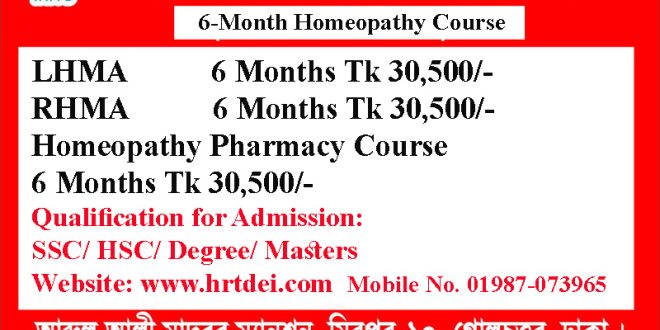
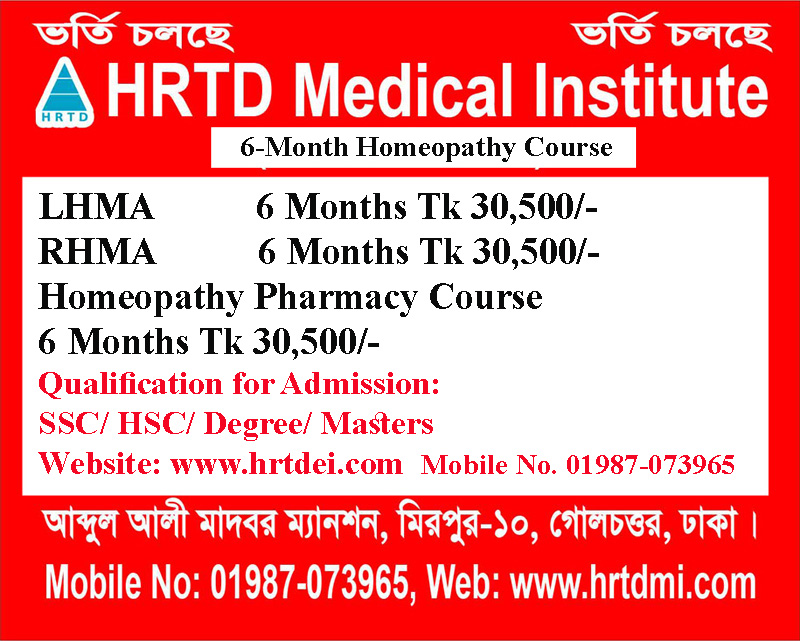
6 Month Homeopathy Course. Mobile No. 01969947171, 01987-073965, 01797-522136. LHMA 6 Months, RHMA 6 Months, and Homeopathy Pharmacy Course 6 Months. These Courses are only for those who are committed to providing their services in Remote and Rural Areas of Bangladesh.
6-Month Homeopathy Course Fee in Dhaka, Bangladesh
6 Month Homeopathy Course Fee. Mobile No. 01969947171, 01987-073965, 01797-522136. LHMA 6 Months Course Fee Tk 30500/-, RHMA 6 Months Course Fee Tk 30500/-, Homeopathy Pharmacy Course 6 Months Tk 30500/-.
Location of 6-Month Homeopathy Course in Dhaka, Bangladesh
Location of 6 Month Homeopathy Course. Mobile No. 01969947171, 01987-073965, 01797-522136. HRTD Medical Institute, Abdul Ali Madbor Mansion, Section-6, Block-Kha, Road-1, Plot-11, Mirpur-10 Roundabout, Metro Rail Piller No. 249. Dhaka-1216.
Qualification for 6-Month Homeopathy Course Admission
Qualification for admission in 6-Month Best Homeopathy Course. Mobile No. 01969947171, 01987-073965, 01797-522136. SSC/ HSC/Degree/ Masters. The age limit is 50 Years. But it is considerable for those who are highly educated or, experienced in the homeopathy business or study lover.
Admission Fee & Monthly Fee for Homeopathy 6-Month Course in Bangladesh
Admission Fee & Monthly Fee for Homeopathy 6-Month Course. Mobile No. 01969947171, 01987-073965, 01797-522136. Admission Fee Tk 10500/-, Monthly Fee Tk 3000/-, and Exam Fee Tk 2000/- for LHMA 6 Month Course, RHMA 6 Months Course, and Homeopathy Pharmacy 6 Months Course.
Subjects for 6-Month Homeopathy Courses in Dhaka, Bangladesh
Subjects for 6-Month Homeopathy Courses. Mobile No. 01969947171, 01987-073965, 01797-522136. Human Anatomy & Physiology, General Chemistry & Biochemistry, Homeopathic Remedies, Mataria Medica, Practice of Homeopathic Remedies, Schuslers Biochemic Remedies. Hematology & General Pathology. Total Exam Marks 500.
- Human Anatomy & Physiology.
- Homeopathic Remedies & Schussler’s Biochemic Remedies.
- Meteria Medica-1.
- First Aid & Homeopathic Practice of Medicine.
- Hematology & Pathology for Medical Practice.
- Chemistry
- Biochemistry.
Teachers For 6 Month Homeopathy Course in Dhaka
- Dr. Md. Sakulur Rahman, MBBS, CCD (BIRDEM), Course Director
- Dr. Ruhul Amin (BHMS)
- Dr. Sanjana Binte Ahmed, BDS, MPH, Assistant Course Director
- Dr. Tisha, MBBS, PGT Gyne, Assistant Course Director
- Dr. Suhana, MBBS, PGT Medicine
- Dr. Danial Hoque, MBBS, C-Card
- Dr. Tisha, MBBS
- Dr. Afrin Jahan, MBBS, PGT Medicine
- Dr. Ananna, MBBS
- Dr. Lamia Afroze, MBBS
- Dr. Amena Afroze Anu, MBBS, PGT Gyne, Assistant Course Director
- Dr. Farhana Antara, MBBS,
- Dr. Nazmun Nahar Juthi, BDS, PGT
- Dr. Farhana Sharna, MBBS
- Dr. Bushra, MBBS
- Dr. Turzo, MBBS
- Dr. Kamrunnahar Keya, BDS, PGT (Dhaka Dental College)
- Dr. Shamima, MBBS, PGT Gyne
- Dr. Alamin, MBBS
- Dr. Benzir Belal, MBBS
- Dr. Disha, MBBS
- Dr. Mahinul Islam, MBBS
- Dr. Tisha, MBBS, PGT Medicine
- Dr. Anika, MBBS, PGT
- Dr. Jannatul Ferdous, MBBS, PGT Gyne
- Dr. Jannatul Aman, MBBS, PGT
- Dr. Rayhan, BPT
- Dr. Abu Hurayra, BPT
- Dr. Sharmin Ankhi, MBBS, PGT Medicine
- Md. Monir Hossain, B Pharm, M Pharm
- Md. Monirul Islam, B Pharm, M Pharm
- Md. Feroj Ahmed, BSc Pathology, PDT Medicine
Human Anatomy & Physiology For Paramedical Course
Human Anatomy and Physiology include the integumentary, skeletal, muscular, nervous, and cardiovascular systems. Additionally, the digestive, respiratory, urinary, and reproductive systems are also crucial for a comprehensive understanding of the human body. Furthermore, understanding the basic principles of anatomy and physiology like homeostasis, cell function, and the levels of organization is essential.
Important Topics
1. Systems:
- Integumentary System: Skin, hair, and nails, their structure and functions.
- Skeletal System: Bones, joints, and their roles in support, movement, and protection.
- Muscular System: Muscles, their types, and how they facilitate movement.
- Nervous System: Brain, spinal cord, nerves, and their role in communication and control.
- Cardiovascular System: Heart, blood vessels, and blood, their roles in circulation and oxygen transport.
- Digestive System: Mouth, esophagus, stomach, intestines, and their role in breaking down food and absorbing nutrients.
- Respiratory System: Lungs, airways, and their role in gas exchange.
- Urinary System: Kidneys, bladder, and their role in filtering waste and maintaining fluid balance.
- Reproductive System: Male and female reproductive organs, their structure and function.
2. Basic Principles:
- Homeostasis: Maintaining a stable internal environment.
- Cellular Function: The basic unit of life and its functions.
- Levels of Organization: How the body is structured from cells to organ systems.
- Complementarity of Structure and Function: How the structure of a body part relates to its function.
- Metabolism and Energy: How the body transforms matter and energy.
3. Other Important Areas:
- Endocrine System: Hormones and their regulation of various bodily functions.
- Lymphatic System: Immune function and fluid balance.
- Sensory Systems: How we perceive the world around us.
- Development and Aging: How the body changes throughout life.
For specific topics within these systems, consider exploring:
- Muscle Contraction: Understanding how muscles contract at the cellular level (sliding filament theory).
- Cardiac Cycle: The sequence of events in a heartbeat.
- Nerve Impulses: How signals are transmitted through neurons.
- Hormone Regulation: How hormones are produced, transported, and regulated.
- Respiratory Physiology: Lung volumes, gas exchange, and breathing control.
- Kidney Function: Urine formation, filtration, and reabsorption.
- Reproductive Physiology: Spermatogenesis, ovulation, and hormonal cycles.
- Neurotransmitters: How they transmit signals across synapses.
- Joints: Types of joints and their movements.
Homeopathy Remedies For 6 Month Homeopathy Course in Dhaka
Based on homeopathic principles, various remedies are traditionally used for different conditions. It is important to note that homeopathy is an alternative and complementary medicine and is not a scientifically proven treatment for any medical condition. If you have a serious medical issue, you should consult a doctor or healthcare professional.
Here are some of the main topics and the homeopathic remedies associated with them:
Injuries and pain
- Arnica: This is a widely used homeopathic remedy for injuries, bruising, swelling, and shock. It is often recommended for recovery after surgery and for soreness associated with jet lag.
- Rhus Tox: Derived from poison ivy, this remedy is used for muscle sprains, strains, arthritis, backaches, and body aches that accompany the flu.
- Cantharis: A common ointment in homeopathy used to treat burns of any kind.
Digestive issues
- Nux Vomica: This is a key remedy for digestive complaints such as indigestion, nausea, bloating, and stomach discomfort, particularly after overeating or consuming rich food and alcohol. It is also used for hangovers.
- Arsenicum Album: This remedy is used to address various conditions and can help with digestive problems and liver support.
Cold and flu symptoms
- Aconite: This remedy is often used at the first sign of a cold or flu to stop its progression. It is used for acute conditions with sudden onset, such as a high fever or pain.
- Gelsemium: This is sometimes used for flu symptoms, including weakness, drowsiness, and fever.
Mental and emotional health
- Kali Phosphoricum: This is a mineral salt remedy used to support physical and mental strength, especially for those experiencing fatigue from chronic stress.
- Magnesia Phosphorica: Used for cramps and muscle spasms, this remedy is also associated with relieving fatigue, headaches, nerve pain, and insomnia.
- Phosphorus: Referenced for emotional balance and also used for anxiety and nervous system issues.
Other conditions
- Pulsatilla: While noted as having minimal nutritional benefits, this is a homeopathic remedy traditionally used for various ailments, including respiratory and menstrual issues.
- Bryonia: Dating back to ancient Greek and Roman times, this remedy is used for arthritis, rheumatism, chest problems, digestive issues, and breast inflammation during feeding.
Safety considerations
The U.S. Food and Drug Administration (FDA) and other health authorities have raised safety concerns regarding homeopathic treatments.
- Dilution and concentration: Homeopathic products are often labeled with a dilution factor, such as “30 CH,” indicating that the original substance has been diluted many times over. This can result in very little, if any, of the original material remaining in the final product.
- Lack of scientific evidence: There is no scientific evidence to support the effectiveness of homeopathy in preventing or treating any disease.
- Regulatory status: Homeopathic remedies have historically been allowed under certain regulations, but they do not undergo the same rigorous testing as conventional medicines to prove safety and effectiveness.
Schussler’s Biochemic Remedies 6 Month Homeopathy Course in Dhaka
Based on Dr. Wilhelm Heinrich Schüssler’s theory, the important topics for his biochemic remedies are the core principles of his system and the specific functions of the 12 tissue salts he identified.
Core concepts of Schüssler’s biochemic remedies
- Cellular theory of disease: Schüssler’s system is based on the idea that diseases are caused by a deficiency or imbalance of specific inorganic mineral salts in the body’s cells. Restoring this balance can cure the disease.
- The 12 tissue salts: Schüssler identified 12 essential mineral salts present in the body’s tissues. Each is responsible for maintaining the health of specific organs and functions.
- Minimal dosage: Like homeopathy, the remedies are administered in minute, or infinitesimal, doses. This process of dilution and trituration is believed to activate the healing properties of the mineral salts.
- Restoring cellular function: The remedies are intended to help the body’s cells absorb and utilize minerals more effectively, correcting biochemical imbalances and restoring the body’s innate healing ability.
The 12 biochemic tissue salts and their uses
Here are the 12 remedies, along with their primary functions and common applications:
- Calcarea fluorica (Calc fluor): Supports connective tissue, elasticity, and bones. Used for conditions like hemorrhoids, varicose veins, and cracked skin.
- Calcarea phosphorica (Calc phos): Promotes cell restoration and growth, bone formation, and digestion. It is often used for healing fractures and for issues related to slow cellular regeneration.
- Calcarea sulphurica (Calc sulph): Functions as a blood purifier and helps treat skin disorders, acne, and abscesses by promoting the expulsion of pus.
- Ferrum phosphoricum (Ferrum phos): Known as the “oxygen carrier,” it is used in the first stage of inflammation, fever, and pain. It can help reduce bleeding and accelerate healing.
- Kalium muriaticum (Kali mur): Aids in treating conditions with thick, white, or gray discharges. It is the remedy for mucous membranes and is used for infections, swelling, and catarrh.
- Kalium phosphoricum (Kali phos): A nerve tonic used for nervous conditions, stress, fatigue, anxiety, and irritability. It supports the health of nerve and brain cells.
- Kalium sulphuricum (Kali sulph): Helps with conditions involving yellow, slimy discharges. It is associated with the skin, mucous membranes, and metabolic processes, and can treat issues like psoriasis.
- Magnesia phosphorica (Mag phos): A primary remedy for spasms, cramps, and nerve pain. It is often used for tension headaches and conditions that are relieved by warmth and pressure.
- Natrum muriaticum (Nat mur): Regulates the distribution of bodily fluids and hydration. It is used for conditions related to fluid imbalance, such as edema, dryness, and colds with watery mucus.
- Natrum phosphoricum (Nat phos): Neutralizes excess acidity in the body and aids digestion. It is used for conditions like sour stomach, heartburn, and arthritis.
- Natrum sulphuricum (Nat sulph): Supports the liver, kidneys, and pancreas in cleansing the body. It can be used for liver issues and conditions worsened by damp weather.
- Silicea: A cleansing and strengthening remedy for connective tissue, skin, hair, and nails. It helps the body expel foreign objects and pus.
Applications and modern relevance
- General tonic: Combination preparations containing all 12 tissue salts can be taken as a general tonic to support overall health and address mineral deficiencies.
- Complementary approach: Biochemic remedies are often used as a complementary therapy alongside conventional medicine or other alternative practices like homeopathy.
- Personalized healthcare: The system is relevant to modern trends in personalized medicine, where specific mineral imbalances can be addressed with targeted remedies.
Materia Medica 6 Month Homeopathy Course in Dhaka
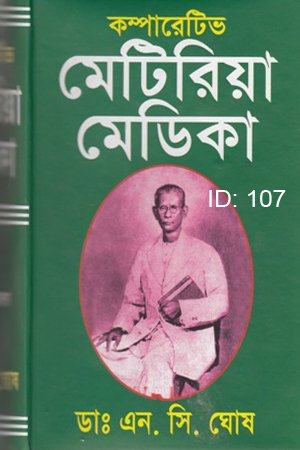
“Materia medica for very important topics” refers to the body of knowledge about the therapeutic properties and uses of medicinal substances, with a focus on key remedies, as documented in historical texts like the Dioscorides’ De Materia Medica and modern sources used in fields like homeopathy. To understand these important topics, it is crucial to learn the structure of various materia medica, as they serve as the foundation for prescribing information, and to use methods like case-based learning, visual aids, and mnemonics for deeper comprehension.
What Materia Medica covers
- Medicinal properties: A comprehensive record of the therapeutic indications and characteristics of substances used for healing.
- Historical significance: Ancient texts, like the one by Dioscorides, were fundamental sources of knowledge that influenced the development of pharmacology and botany.
- Modern applications: Today, materia medica continues to be a vital platform for different schools of medicine, such as homeopathy, forming the basis for its repertories and practice.
How to study Materia Medica for key topics
- Understand the structure: Learn the plan and construction of different materia medica texts, as they provide the foundation for their practical utility.
- Use case-based learning: Methods like case-based learning (CBL) and problem-based learning (PBL) are beneficial for understanding how remedies are applied in practice.
- Incorporate visual aids: Flashcards, charts, and even audio-visual methods can help visualize symptoms and modalities to improve retention.
- Employ memory aids: Create mnemonics or acronyms to help remember key symptoms and remedies.
- Practice repetition: Regularly revisiting the remedies is essential for better retention and mastery of the subject.
মেটেরিয়া মেডিকা (Materia Medica) হলো নিরাময়ের জন্য ব্যবহৃত বিভিন্ন ভেষজ ও অন্যান্য পদার্থের থেরাপিউটিক বা ঔষধি গুণাবলীর একটি সংকলন, যা মূলত হোমিওপ্যাথিক ওষুধ নির্বাচনের মূল ভিত্তি [৪]। এটি ওষুধের লক্ষণ, উৎস, এবং কার্যকারিতা সম্পর্কে বিস্তারিত তথ্য প্রদান করে Wikipedia, [২]। স্যামুয়েল হ্যানিম্যান ১৮১১ সালে প্রথম মেটেরিয়া মেডিকা পুরা প্রকাশ করেন, যা হোমিওপ্যাথিক চিকিৎসায় ব্যবহৃত প্রধান রেফারেন্স বই Homoeopathic Medicine Board Uttar Pradesh, [৫]।
মেটেরিয়া মেডিকা সম্পর্কে কিছু গুরুত্বপূর্ণ তথ্য নিচে দেওয়া হলো:
- হোমিওপ্যাথিক ভিত্তি: হোমিওপ্যাথিক ওষুধ নির্বাচনের জন্য প্রতিটি ওষুধের লক্ষণ, প্রকৃতি এবং রোগীর ওপর তাদের প্রভাব বিস্তারিতভাবে এই বইয়ে বর্ণনা করা থাকে [২]।
- প্রধান গ্রন্থসমূহ: স্যামুয়েল হ্যানিম্যানের «ম্যাটেরিয়া মেডিকা পুরা» (Materia Medica Pura) এবং জে.টি. কেন্টের «হোমিওপ্যাথিক মেটিরিয়া মেডিকার উপর বক্তৃতা» (Lectures on Homoeopathic Materia Medica) নতুন ও পুরাতন চিকিৎসকদের জন্য অত্যন্ত গুরুত্বপূর্ণ [৫]।
- বিষয়বস্তু: এতে ভেষজ, খনিজ, প্রাণীজ এবং অন্যান্য প্রাকৃতিক উৎস থেকে তৈরি ওষুধের বিবরণ, তাদের লক্ষণসমূহ এবং রোগ নিরাময়ের প্রক্রিয়া সম্পর্কে তথ্য থাকে [৩, ৪]।
- ব্যবহার: এটি চিকিৎসকদের সঠিক ওষুধ নির্বাচন করতে এবং ওষুধের লক্ষণগুলোর সাথে রোগীর লক্ষণগুলো মিলিয়ে (সিমিলিয়া সিমিলিবাস কিউরেন্টুর) চিকিৎসার পরিকল্পনা করতে সাহায্য করে [২]।
সংক্ষেপে, মেটেরিয়া মেডিকা হলো হোমিওপ্যাথিক চিকিৎসার একটি অপরিহার্য নির্দেশিকা, যা চিকিৎসকদের সঠিক ওষুধ নির্বাচনের জ্ঞান প্রদান করে।
Homeopathic Practice of Medicine 6 Month Homeopathy Course in Dhaka
When seeking to understand homeopathy, it’s important to be aware of the specific topics that define its practice and the context surrounding them
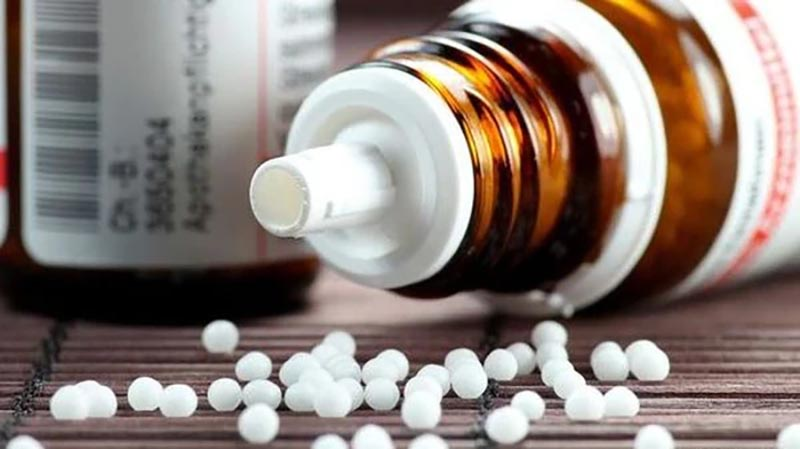
These include its fundamental principles, core texts, and the ongoing scientific and regulatory debate about its efficacy and safety.
Foundational principles
- Law of Similars (Similia Similibus Curenturcap S i m i l i a space cap S i m i l i b u s space cap C u r e n t u r𝑆𝑖𝑚𝑖𝑙𝑖𝑎 𝑆𝑖𝑚𝑖𝑙𝑖𝑏𝑢𝑠 𝐶𝑢𝑟𝑒𝑛𝑡𝑢𝑟): The central tenet of homeopathy, developed by Samuel Hahnemann in the late 1700s, posits that “like cures like”. This means a substance that causes symptoms in a healthy person can, in highly diluted form, treat similar symptoms in a sick person.
- Minimum Dose: Homeopathic remedies are prepared through a process of repeated dilution and vigorous shaking (succussion), known as potentization. The more diluted the substance, the more potent it is believed to be. Due to the high level of dilution, many remedies contain no measurable molecules of the original substance.
- Individualization: Homeopathy treats the whole person, not just the disease. A practitioner takes a detailed case history covering a patient’s physical, mental, and emotional state to select a single remedy that matches their unique symptom profile.
- Vital Force: An immaterial, “spirit-like” energy or life force is believed to animate the body and maintain health. Disease is viewed as a derangement of this vital force, and the highly diluted remedies are thought to stimulate and restore its balance.
- Miasms (Theory of Chronic Disease): Hahnemann theorized that chronic diseases stem from inherited or underlying causes called miasms, which he believed explained why illnesses could return even after homeopathic treatment.
Essential texts for practitioners
- The Organon of the Healing Art: Written by Hahnemann, this book lays out the complete system of homeopathic medicine and its philosophical principles.
- Materia Medica: This reference work is a collection of “drug pictures” developed from “provings,” or experiments where healthy individuals record all symptoms experienced after taking a substance.
- Repertory: As an index to the Materia Medica, the repertory is used to quickly find remedies associated with specific symptoms. The Kent Repertory is one of the most widely used.
Scientific and regulatory context
- Lack of Evidence for Efficacy: Numerous national and international health bodies, including the Australian National Health and Medical Research Council and the UK’s National Health Service, have concluded that there is no reliable evidence that homeopathy is effective for any health condition. Studies of homeopathic remedies have found them to perform no better than placebos.
- Safety Concerns: While the high dilution of most remedies makes them generally safe, serious risks exist when homeopathy is used as a replacement for proven medical treatments, especially for serious conditions. Relying solely on homeopathy can lead to delayed or missed diagnoses, potentially worsening conditions.
- Varying Regulation: Regulatory standards for homeopathic products differ significantly across countries. In the U.S., the FDA does not regulate homeopathic remedies for safety and effectiveness in the same way as conventional drugs. In other countries, such as Bangladesh, there may be specific government ordinances to regulate practitioners.
- Scientific and Ethical Debates: The core principles of homeopathy contradict fundamental concepts of physics and chemistry. The debate continues, with critics labeling the practice as pseudoscience and fraud, while proponents and some patients continue to report positive outcomes.
Areas of practice and application
Despite scientific and regulatory concerns, homeopathy is used for a variety of conditions, often alongside conventional medicine.
- Acute Conditions: Homeopathy is sometimes used to self-manage mild conditions like colds, flu, allergies, and digestive issues.
- Chronic Conditions: Some people seek homeopathic treatment for long-term illnesses such as arthritis, asthma, chronic fatigue syndrome, and mental health issues like anxiety.
- Lifestyle and Wellness: Practitioners may recommend homeopathic remedies to support general wellness, manage stress, or improve sleep quality.
Disclaimer: It is important to note that homeopathy lacks robust, reproducible scientific evidence of its effectiveness beyond the placebo effect. Before starting any new treatment, especially for a serious medical condition, you should consult with a qualified healthcare professional. Do not delay or stop any conventional medical treatment in favor of homeopathy.
First Aid for 6 Month Homeopathy Course in Dhaka
First Aid is an important subject for Medical courses including Diplomas in Medicine & Surgery course. RMP Courses, LMAF Courses, Paramedical Courses, DMA Courses, DMS Courses, Nursing Courses, Dental Courses, Pathology Courses, Physiotherapy Courses, Caregiver courses etc. Here we discuss shock, Classification Shock, causes of Shock, Stages of Shock, Clinicle Features of Shock, Hypovolemic Shock, Cardiogenic Shock, Neurogenic Shock, Traumatic Shock, Burn Shock, Electric Shock, Psychogenic Shock, Anaphylactic Shock, First Aid of Shock, First Aid of cut, First Aid of Snake Bite, First Aid of Accidental Injury etc.
Hematology For 6 Month Homeopathy Course in Dhaka
Hematology is the branch of medicine focused on blood and blood-forming organs, encompassing the study of blood and its components, as well as blood-related diseases. Key topics include the anatomy of blood (red and white blood cells, platelets, plasma), hemoglobinopathies, hematologic malignancies (like leukemia and lymphoma), anemia, and coagulopathy. It also involves understanding the functions of bone marrow, spleen, and lymph nodes, as well as the processes of hemostasis and thrombosis.
Here’s a more detailed breakdown:
1. Blood and its Components:
Bone Marrow: The site of blood cell production.
Red Blood Cells (Erythrocytes): Carry oxygen from the lungs to the body’s tissues.
White Blood Cells (Leukocytes): Part of the immune system, fighting infection.
Platelets: Involved in blood clotting.
Plasma: The liquid component of blood, containing proteins, electrolytes, and other substances.
Hemoglobin: The protein in red blood cells that carries oxygen.
2. Blood Disorders:
- Anemia: A condition characterized by a deficiency in red blood cells or hemoglobin.
- Hemoglobinopathies: Abnormalities in the structure or production of hemoglobin, such as sickle cell disease.
- Hematologic Malignancies: Cancers of the blood and bone marrow, including leukemia and lymphoma.
- Coagulopathy: Disorders affecting blood clotting, such as hemophilia.
- Thrombocytopenia: Low platelet count, leading to bleeding problems.
- Disorders of Iron Metabolism: Conditions related to iron deficiency or excess.
3. Other Important Areas:
- Hemostasis and Thrombosis: The processes of blood clotting and the formation of blood clots, respectively.
- Transfusion Medicine: The study and practice of blood transfusions.
- Hematologic Oncology: The branch that deals with blood cancers, often in collaboration with oncologists.
- Hematopathology: The study of blood and bone marrow diseases, often performed by hematopathologists.
- Stem Cell Transplantation: A treatment for some hematologic diseases, involving the transplantation of healthy stem cells.
Pathology for Medical Practice For 6 Month Homeopathy Course in Dhaka
Pathology, in the context of medical practice, primarily focuses on understanding the causes, mechanisms, and effects of diseases, with a strong emphasis on the structural and functional changes within the body. It involves studying disease at various levels, including molecular, cellular, tissue, and organ levels. The main topics in pathology for medical practice can be broadly categorized into General Pathology, Anatomical Pathology, and Clinical Pathology.
General Pathology: This area covers fundamental concepts about disease, including:
- Etiology: The cause of disease.
- Pathogenesis: The mechanisms of disease development.
- Morphologic Changes: Structural alterations in cells and tissues.
- Clinical Manifestations: The functional consequences of these changes
Anatomical Pathology: This branch focuses on the gross and microscopic examination of tissues and organs, often involving:
- Surgical Pathology: Examination of tissues removed during surgery.
- Cytopathology: Examination of individual cells.
- Autopsy Pathology: Examination of the body after death.
- Forensic Pathology: Investigation of death for legal purposes.
Clinical Pathology: This area involves the analysis of body fluids (like blood and urine) and the application of laboratory techniques to diagnose and monitor diseases. It includes:
- Clinical Chemistry: Analysis of chemical components in body fluids.
- Hematology: Study of blood and blood-forming tissues.
- Microbiology: Identification and characterization of microorganisms.
- Immunology: Study of the immune system and its role in disease.
- Molecular Pathology: Focuses on genetic testing and biomarkers.
Other important topics within pathology include:
- Inflammation and Tissue Repair: Understanding the body’s response to injury.
- Infectious Diseases: Studying diseases caused by pathogens.
- Neoplasia (Cancer): Understanding the development, characteristics, and treatment of tumors.
- Genetic Diseases: Studying diseases caused by inherited or acquired genetic mutations.
- Environmental and Occupational Diseases: Studying diseases related to environmental or workplace exposures.
- Nutritional Disorders: Studying diseases related to nutritional deficiencies or excesses.
- Age-Related Diseases: Studying diseases that are more common in older individuals.
Chemistry Subject for 6 Month Homeopathy Course in Dhaka
Chemistry revolves around five main branches—Organic, Inorganic, Physical, Analytical, and Biochemistry—covering the study of matter, energy, and their interactions. Core topics essential for understanding the subject include atomic structure, the periodic table, chemical bonding, thermodynamics, chemical kinetics, equilibrium, acids and bases, and stoichiometry.
Here are the key areas and main topics in chemistry:
- Physical Chemistry (Energy & Dynamics): Focuses on thermodynamics, kinetics, electrochemistry, and atomic structure.
- Organic Chemistry (Carbon Compounds): Covers hydrocarbons, functional groups, reaction mechanisms, and polymers.
- Inorganic Chemistry (Elements & Compounds): Deals with the periodic table, bonding, s, p, d, and f block elements, and coordination compounds.
- Analytical Chemistry (Techniques): Involves methods to measure and identify substances, such as titration, spectroscopy, and chromatography.
- Biochemistry (Life Processes): Studies chemical processes in living organisms, including proteins, carbohydrates, and DNA.
- Fundamental Principles: Key concepts include stoichiometry (quantitative calculations), redox reactions, gases, solutions, and states of matter.
These foundational topics span across high school and undergraduate studies.
হোমিওপ্যাথি ওষুধ মানুষের জীবনে অত্যন্ত গুরুত্বপূর্ণ কারণ এটি রোগের মূল কারণ নির্মূলে কাজ করে এবং পার্শ্বপ্রতিক্রিয়াহীনভাবে শরীরকে সুস্থ করে তোলে [১, ৪]। জার্মান চিকিৎসক স্যামুয়েল হ্যানিম্যান ১৮০৫ সালে এই চিকিৎসা প্রবর্তন করেন, যা স্নায়ুর মাধ্যমে কাজ করে এবং দীর্ঘস্থায়ী ও জটিল রোগের চিকিৎসায় বিশেষ কার্যকর [১, ৩]।
হোমিওপ্যাথির গুরুত্বের মূল কারণসমূহ:
- রোগের মূল উৎপাটন: শুধুমাত্র লক্ষণের চিকিৎসা না করে, এটি শরীরের রোগ প্রতিরোধ ক্ষমতা বৃদ্ধির মাধ্যমে রোগের উৎস বা মূল কারণ নির্মূল করে [১, ৪]।
- পার্শ্বপ্রতিক্রিয়াহীন ও নিরাপদ: সাধারণত প্রাকৃতিক উপাদান থেকে তৈরি এবং সূক্ষ্ম মাত্রায় ব্যবহৃত হওয়ায় এই ওষুধের কোনো ক্ষতিকর পার্শ্বপ্রতিক্রিয়া নেই [২, ৪]।
- সার্বিক চিকিৎসা (Holistic Approach): এটি মানুষের শারীরিক লক্ষণের পাশাপাশি মানসিক ও আবেগীয় দিক বিবেচনা করে চিকিৎসা করে [১, ৪]।
- দীর্ঘস্থায়ী রোগের সমাধান: অ্যালোপ্যাথিক চিকিৎসার পাশাপাশি দীর্ঘস্থায়ী, জটিল এবং এলার্জিজনিত রোগে এটি খুবই কার্যকর [১, ২]।
- সহজ প্রয়োগ: ওষুধগুলো সাধারণত মিষ্টি স্বাদের হওয়ায় শিশু থেকে বৃদ্ধ সবার জন্য সেবন করা সুবিধাজনক [১]।
হোমিওপ্যাথি (Homeopathy) মানুষের জীবনে একটি নিরাপদ, সাশ্রয়ী এবং কার্যকর চিকিৎসা পদ্ধতি হিসেবে স্বীকৃত [১, ৪]।
হোমিওপ্যাথি ঔষধ কিভাবে কাজ করে
হোমিওপ্যাথি ঔষধ “লাইক কিউরস লাইক” (Like Cures Like) বা সমতত্ত্বে কাজ করে, যার অর্থ যা রোগের লক্ষণ সৃষ্টি করে, তা-ই সেই রোগ নিরাময় করে [৪, ৮]। এটি শরীরের নিজস্ব নিরাময় ক্ষমতাকে (Self-healing capacity) উদ্দীপিত করে [৩]। এছাড়া, রোগীকে সামগ্রিকভাবে বিবেচনা করে এবং ঔষধ অত্যন্ত পাতলা ও ঝাঁকিয়ে (Potentization) প্রস্তুত করা হয় বলে বিশ্বাস করা হয় যে, এর কোনো পার্শ্বপ্রতিক্রিয়া নেই [৬, ৯]।
হোমিওপ্যাথি ঔষধের কার্যপদ্ধতি:
- সমতত্ত্ব নীতি: ডা. স্যামুয়েল হ্যানিম্যান প্রতিষ্ঠিত এই চিকিৎসায়, যে বস্তু সুস্থ দেহে যে লক্ষণ তৈরি করে, তা রোগাক্রান্ত ব্যক্তির সদৃশ লক্ষণ নিরাময় করতে ব্যবহার করা হয় [২, ৪]।
- শক্তি বৃদ্ধি বা পোটেনটাইজেশন: ঔষধের মূল উপাদানকে জল বা অ্যালকোহলের সাথে বারবার পাতলা করা হয় এবং ঝাঁকানো হয় (Succussion) [৪]। বিশ্বাস করা হয়, এই প্রক্রিয়ায় ঔষধের উপাদানের কার্যকারিতা বৃদ্ধি পায়, এমনকি মূল উপাদানের কোনো অণু না থাকলেও [৬, ৮]।
- স্নায়ুর মাধ্যমে কার্যকারিতা: উইকিপিডিয়া মতে, হোমিওপ্যাথিক ঔষধ স্নায়ুর মাধ্যমে কাজ করে। ঔষধের প্রভাব ঠিক রাখতে এটি পানিসহ সেবন করা ভালো [১]।
- ব্যক্তিগত চিকিৎসা: রোগীর শারীরিক, মানসিক এবং আবেগগত লক্ষণগুলো বিবেচনা করে ঔষধ নির্বাচন করা হয় [৩]।
- সংশয়: আধুনিক চিকিৎসা বিজ্ঞানে অনেক ক্ষেত্রে প্রমাণিত হয়েছে যে, হোমিওপ্যাথিক ঔষধের কার্যকারিতা প্লেসিবো (Placebo) বা মনস্তাত্ত্বিক প্রভাবের চেয়ে বেশি নয় [৬, ৭]।
হোমিওপ্যাথি ঔষধের কোনো পার্শ্বপ্রতিক্রিয়া নেই, তাই এটি অন্যান্য চিকিৎসার সাথেও ব্যবহার করা যেতে পারে, তবে তা ডাক্তারের পরামর্শ অনুযায়ী হওয়া উচিত [৯]।
অপারেশন ছাড়া চিকিৎসা ! কেন হোমিওপ্যাথিতে ভরসা ৪০ শতাংশ মানুষের ?
কম খরচ, পার্শ্বপ্রতিক্রিয়াহীনতা, এবং দীর্ঘস্থায়ী (chronic) রোগের ক্ষেত্রে কার্যকর নিরাময়ের ধারণার কারণে বাংলাদেশে প্রায় ৪০ শতাংশ মানুষ হোমিওপ্যাথির ওপর আস্থা রাখেন। অপারেশন ছাড়াই জটিল রোগ নিরাময়, সহজলভ্য ওষুধ, এবং রোগীকে সামগ্রিকভাবে চিকিৎসার (holistic approach) মানসিকতার কারণে এই চিকিৎসা পদ্ধতিটি জনপ্রিয় [৪, ৭, ১২]।
কেন হোমিওপ্যাথি জনপ্রিয় (মূল কারণসমূহ):
- কম খরচ: অ্যালোপ্যাথির তুলনায় চিকিৎসাবাবদ খরচ অনেক কম হওয়ায় সাধারণ মানুষের কাছে এটি সাশ্রয়ী [৪]।
- সহজলভ্য: ঔষধগুলো সহজে পাওয়া যায় এবং পার্শ্বপ্রতিক্রিয়া নেই বললেই চলে, যা রোগীকে আশ্বস্ত করে [৪, ৭]।
- সফল নিরাময় (কথিত): অনেক ক্ষেত্রেই দীর্ঘমেয়াদী বা জটিল রোগ—যেমন কিডনি পাথর, চর্মরোগ, বা বাতব্যথা—অপারেশন ছাড়াই দূর করার অভিজ্ঞতায় মানুষ এই চিকিৎসায় ভরসা পায় [৫]।
- মানসিক স্বস্তি: রোগ নিরাময়ের পাশাপাশি রোগী বা তার আত্মীয়দের মনে একটি বিশ্বাস তৈরি হয় যে, এটি শরীরের কোনো ক্ষতি করবে না [৭]।
যদিও আধুনিক চিকিৎসা বিজ্ঞান হোমিওপ্যাথিক ওষুধের কার্যকারিতা সম্পর্কে যথেষ্ট প্রমাণের অভাব দাবি করে, তবুও সাধারণ মানুষের মধ্যে এর জনপ্রিয়তার হার বেশি
হোমিওপ্যাথি ওষুধ মানুজের জিবনে কেন গুরুতপুরন ভুমিকা পালন করে ?
হোমিওপ্যাথি ওষুধ মানুষের জীবনে অত্যন্ত গুরুত্বপূর্ণ কারণ এটি রোগের মূল কারণ নির্মূলে কাজ করে এবং পার্শ্বপ্রতিক্রিয়াহীনভাবে শরীরকে সুস্থ করে তোলে [১, ৪]। জার্মান চিকিৎসক স্যামুয়েল হ্যানিম্যান ১৮০৫ সালে এই চিকিৎসা প্রবর্তন করেন, যা স্নায়ুর মাধ্যমে কাজ করে এবং দীর্ঘস্থায়ী ও জটিল রোগের চিকিৎসায় বিশেষ কার্যকর [১, ৩]।
হোমিওপ্যাথির গুরুত্বের মূল কারণসমূহ:
- রোগের মূল উৎপাটন: শুধুমাত্র লক্ষণের চিকিৎসা না করে, এটি শরীরের রোগ প্রতিরোধ ক্ষমতা বৃদ্ধির মাধ্যমে রোগের উৎস বা মূল কারণ নির্মূল করে [১, ৪]।
- পার্শ্বপ্রতিক্রিয়াহীন ও নিরাপদ: সাধারণত প্রাকৃতিক উপাদান থেকে তৈরি এবং সূক্ষ্ম মাত্রায় ব্যবহৃত হওয়ায় এই ওষুধের কোনো ক্ষতিকর পার্শ্বপ্রতিক্রিয়া নেই [২, ৪]।
- সার্বিক চিকিৎসা (Holistic Approach): এটি মানুষের শারীরিক লক্ষণের পাশাপাশি মানসিক ও আবেগীয় দিক বিবেচনা করে চিকিৎসা করে [১, ৪]।
- দীর্ঘস্থায়ী রোগের সমাধান: অ্যালোপ্যাথিক চিকিৎসার পাশাপাশি দীর্ঘস্থায়ী, জটিল এবং এলার্জিজনিত রোগে এটি খুবই কার্যকর [১, ২]।
- সহজ প্রয়োগ: ওষুধগুলো সাধারণত মিষ্টি স্বাদের হওয়ায় শিশু থেকে বৃদ্ধ সবার জন্য সেবন করা সুবিধাজনক [১]।
হোমিওপ্যাথি (Homeopathy) মানুষের জীবনে একটি নিরাপদ, সাশ্রয়ী এবং কার্যকর চিকিৎসা পদ্ধতি হিসেবে স্বীকৃত [১, ৪]।