 HRTD Medical Institute

Diploma in Dental ( DID-4 Years): Mobile No. 01797522136,
Diploma in Dental/Dental Diploma 4 Years: Mobile No. 01987-073965, 01797-522136. A diploma in Dental is a long diploma in Dental Education & Training. This long diploma in the dental course contains 30 subjects in 8 semesters. 1st semester contains 5 subjects which are Human Anatomy & Physiology, Chemistry & Pharmacology, First Aid & Treatment, Hematology & Pathology, and Study of OTC Drugs. The 2nd Semester contains 5 Subjects which are Anatomy of the Head and Neck, Neuro Anatomy & Physiology, Dental Anatomy & Physiology, Dental Pathology & Dental Caries, and Conservative Dentistry & Dental Surgery.
Subjects of 3rd and 4th semesters:
Diploma in Dental 3rd Semester contains 4 subjects which are Orthopedic Anatomy & Physiology, Cardiovascular Anatomy & Physiology, Microbiology & Antimicrobial Drugs, and Dental Sterilization. The 4th semester contains 4 subjects and the subjects are Dental Anatomy & Physiology-2, Dental Pharmacology, Conservative Dentistry and Dental Surgery-2, and Clinical Practice in Dental Surgery-1.
Subjects of 5th, 6th, 7th and 8th semesters:
The 5th semester contains 3 subjects which are Oral Pathology and Oral Surgery, Dental Prosthesis, and Periodontology. The 6th semester contains 3 subjects and three subjects Dental Anesthesiology, Conservative Dentistry and Dental Surgery-3, and Medical Diagnosis. The 7th semester contains 3 subjects which are Orthodontics, Dental Filling Materials, and the Study of Oral X-Ray Films. The 8th semester contains 3 subjects which are Hypertension and Dental Surgery, Diabetes & Dental Surgery and Clinical Practice in Dental Surgery-2.
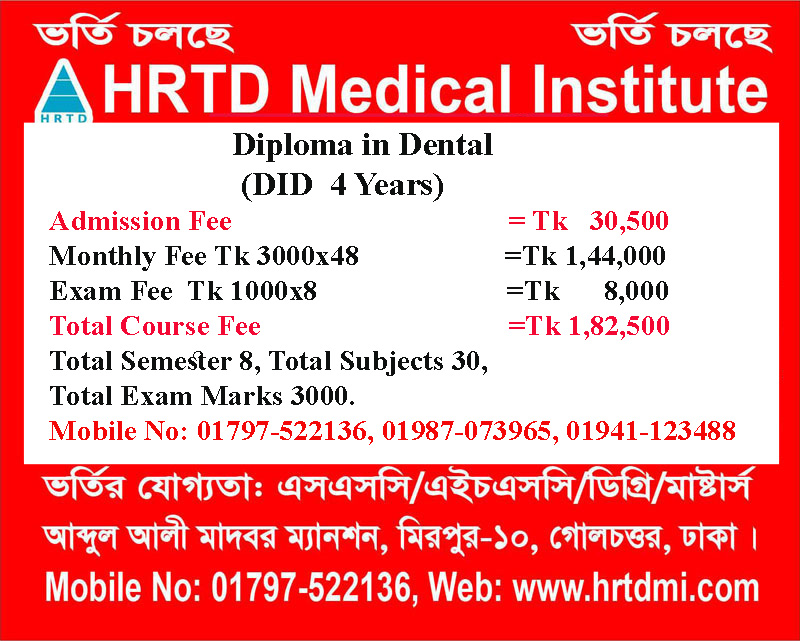
The total Course Fee for 4 Year Dental Diploma Course is Tk 198,500
The total Course Fee for 4 Year Dental Diploma Course is Tk 198,500 including the Admission fee of Tk 30,500, Monthly fee of Tk 3000×48=Tk 144,000, and Exam fee of Tk 3000×8=Tk 8000.
Location of Diploma in Dental
Location: HRTD Medical Institute, Abdul Ali Madbor Mansion, Section-6, Block-Kha, Road-1, Plot-11, Metro Rail Piller No. 249, Mirpur-10 Golchattar, Dhaka-1216.
Teachers for Diploma in Dental Course 4 Years
Dr. Sanjana Bite Ahmed, BDS, MPH
Dr. Sakulur Rahman, MBBS, CCD (BIRDEM)
Dr. Nurunnahar Keya, BDS,
Dr. Suhana, MBBS, PGT
Dr. Layla, MBBS, PGT
Dr. Lamia, MBBS
Dr. Disha, MBBS, FCPS (FP)
Dr. Afrin, MBBS, PGT
Dr. Tisha, MBBS, PGT
Dr. Nazmun Nahar Juthi, BDS, PGT
Dr. Kamrunnahar Keya, BDS, PGT
Dr. Danial Haque, MBBS, CCD
Dr. Turzo, MBBS, FCPS (FP)
Dr. Benzir, MBBS, FCPS (FP)
Dr. Trisha, MBBS, PGT
Dr. Farhana, MBBS, PGT
Dr. Jannatul Aman, MBBS, PGT
Dr. Mahinul Islam, MBBS
Dr. Amena Afroze Anu, MBBS, PGT
Job Opportunities After Completed Diploma in Dental
Jobs are available in Bangladesh and many other countries as dental assistants, dental technicians, or dental technologists. Each and every busy dental surgeon needs at least 2 to 3 dental technicians for the proper surgical treatment in his/her chamber or dental clinic.
Our Others Course:
Pharmacy Course, Dental Course, Nursing Course, Pathology Course, Homeopathy Course, Veterinary Course, Village Doctor Course, PDT( Post Diploma Training) Course, PPT, LMAF Training Course, LMAFP Course, Poultry Course, DMA ( Diploma Medical Assistant), Diploma in Medicine and Surgery (DMDS).
Dental Chamber Starting & Establishment
After completing the Diploma in Dental Course you can start a dental chamber in any location in Bangladesh. You need to obtain The Registration and The License from the Respective Authority of the Government of the People’s Republic of Bangladesh. We only help our students obtain registration and licenses for the Starting & Establishment of Dental Chamber.
ডেন্টাল কোর্সে ডিপ্লোমা শেষ করার পর আপনি বাংলাদেশের যেকোনো স্থানে ডেন্টাল চেম্বার শুরু করতে পারেন। আপনাকে গণপ্রজাতন্ত্রী বাংলাদেশ সরকারের সংশ্লিষ্ট কর্তৃপক্ষের কাছ থেকে নিবন্ধন এবং লাইসেন্স পেতে হবে। আমরা শুধুমাত্র আমাদের ছাত্রদের ডেন্টাল চেম্বারের শুরু ও প্রতিষ্ঠার জন্য নিবন্ধন এবং লাইসেন্স পেতে সাহায্য করি।
What works you can do after completing the Diploma in Dental 4 Years Course
After completing Diploma in Dental 4 Years Course you will be able to do the following dental surgical works. Scaling, Filling, Whitening, Root canal treatment, Polishing, Breeze, deposit filling, Dental Extraction, Dental Setting, Dental Binding, and Treatment of Zigzak teeth.
What is Dental Scaling?
Dental scaling is dental cleaning by a caller dental machine. This is routinely performed to help patients with gum disease and excessive plaque buildup. While a standard cleaning will address the surface of the tooth, scaling goes much deeper. If your dentist suggests dental scaling and root planing for your teeth, you should do this otherwise your teeth may be damaged day after day.
ডেন্টাল স্কেলিং কী?
ডেন্টাল স্কেলিং হল একটি কলার ডেন্টাল মেশিন দ্বারা দাঁত পরিষ্কার করা। মাড়ির রোগ এবং অতিরিক্ত প্লাক জমা রোগীদের সাহায্য করার জন্য এটি নিয়মিতভাবে করা হয়। যদিও একটি স্ট্যান্ডার্ড পরিষ্কার দাঁতের পৃষ্ঠকে মোকাবেলা করবে, স্কেলিং আরও গভীরে যায়। যদি আপনার দাঁতের ডাক্তার আপনার দাঁতের জন্য ডেন্টাল স্কেলিং এবং রুট প্ল্যানিংয়ের পরামর্শ দেন, তাহলে আপনার এটি করা উচিত অন্যথায় আপনার দাঁত দিনের পর দিন ক্ষতিগ্রস্ত হতে পারে।
What is Dental Filling?
A dental filling is the fill-up of a small dental hole or cavity. To repair a cavity, a dentist removes the decayed tooth tissue and then fills the space with a filling material. The filling materials are of various types. Some are long-lasting and some are shot-lasting.
ডেন্টাল ফিলিং কী?
ডেন্টাল ফিলিং হল দাঁতের একটি ছোট গর্ত বা গর্ত পূরণ করা। গর্ত মেরামত করার জন্য, একজন দন্তচিকিৎসক ক্ষয়প্রাপ্ত দাঁতের টিস্যু অপসারণ করেন এবং তারপর একটি ফিলিং উপাদান দিয়ে স্থানটি পূরণ করেন। ফিলিং উপকরণ বিভিন্ন ধরণের হয়। কিছু দীর্ঘস্থায়ী এবং কিছু শট-লাস্টিং।
Causes of dental filling
When decay-causing bacteria come into contact with sugars and starches from foods and drinks, they form an acid. This acid can attack the tooth’s surface (enamel), causing it to lose minerals.
When a tooth is repeatedly exposed to acid, such as when you frequently consume food or drink high in sugar and starches, the enamel continues to lose minerals. A white spot may appear where minerals have been lost. This is a sign of early decay.
Tooth decay can be stopped or reversed at this point. Enamel can repair itself by using minerals from saliva and fluoride from toothpaste or through the application of fluoride by a dentist or dental hygienist. If more minerals are lost than can be restored, the enamel weakens and eventually breaks down, forming a cavity.
More severe decay can cause a large hole or even destruction of the entire tooth. If tooth decay is not treated, it can cause pain, infection, and even tooth loss. So dental filling treatment is very essential for a cavity patient.
দাঁত ভরাটের কারণ
যখন ক্ষয়কারী ব্যাকটেরিয়া খাবার এবং পানীয় থেকে পাওয়া চিনি এবং স্টার্চের সংস্পর্শে আসে, তখন তারা একটি অ্যাসিড তৈরি করে। এই অ্যাসিড দাঁতের পৃষ্ঠ (এনামেল) আক্রমণ করতে পারে, যার ফলে এটি খনিজ পদার্থ হারাতে পারে।
যখন দাঁত বারবার অ্যাসিডের সংস্পর্শে আসে, যেমন যখন আপনি ঘন ঘন চিনি এবং স্টার্চযুক্ত খাবার বা পানীয় গ্রহণ করেন, তখন এনামেল খনিজ পদার্থ হারাতে থাকে। খনিজ পদার্থ হারিয়ে যাওয়ার জায়গায় একটি সাদা দাগ দেখা দিতে পারে। এটি প্রাথমিক ক্ষয়ের লক্ষণ।
এই সময়ে দাঁত ক্ষয় বন্ধ করা যেতে পারে বা বিপরীত করা যেতে পারে। লালা থেকে খনিজ পদার্থ এবং টুথপেস্ট থেকে ফ্লোরাইড ব্যবহার করে অথবা দাঁতের ডাক্তার বা ডেন্টাল হাইজিনিস্ট দ্বারা ফ্লোরাইড প্রয়োগের মাধ্যমে এনামেল নিজেকে মেরামত করতে পারে। যদি পুনরুদ্ধার করা সম্ভবের চেয়ে বেশি খনিজ পদার্থ নষ্ট হয়ে যায়, তাহলে এনামেল দুর্বল হয়ে যায় এবং অবশেষে ভেঙে যায়, যার ফলে একটি গর্ত তৈরি হয়।
আরও তীব্র ক্ষয় একটি বড় গর্ত বা এমনকি পুরো দাঁত ধ্বংস করতে পারে। যদি দাঁত ক্ষয়ের চিকিৎসা না করা হয়, তাহলে এটি ব্যথা, সংক্রমণ এবং এমনকি দাঁতের ক্ষতির কারণ হতে পারে। তাই ক্যাভিটি রোগীর জন্য ডেন্টাল ফিলিং চিকিৎসা অত্যন্ত প্রয়োজনীয়।
Total Subjects for Diploma in Dental 4 Years
1st Year Subjects for Diploma in Dental 4 Years
- Human Anatomy & Physiology,
- Chemistry & Pharmacology,
- First Aid & Treatment,
- Hematology & Pathology,
- Study of OTC Drugs,
- Anatomy of the Head and Neck,
- Neuro Anatomy & Physiology,
- Dental Anatomy & Physiology,
- Dental Pathology & Dental Caries,
- Conservative Dentistry & Dental Surgery.
2nd Year Subjects for Diploma in Dental 4 Years
- Orthopedic Anatomy & Physiology,
- Cardiovascular Anatomy & Physiology,
- Microbiology & Antimicrobial Drugs,
- Dental Sterilization,
- Dental Anatomy & Physiology-2,
- Dental Pharmacology,
- Conservative Dentistry and Dental Surgery-2,
- Clinical Practice in Dental Surgery-1.
3rd Years Subjects for Diploma in Dental 4 Years
- Oral Pathology and Oral Surgery,
- Dental Prosthesis,
- Periodontology.
- Dental Anesthesiology,
- Conservative Dentistry and Dental Surgery-3,
- Medical Diagnosis.
4th Year Subjects for Diploma in Dental 4 Years
- Study of Orthodontics
- Dental Filling Materials
- Study of Oral X-Ray Films
- Hypertension and Dental Surgery
- Diabetes and Dental Surgery
- Clinical Practice in Dental Surgery-2
What are the 5 dental problems?
Dentistry is one of the oldest fields of medicine, and it is vitally important to our overall health and well-being. That said, it is also one of the most commonly neglected aspects of health care, with many people failing to receive regular dental checkups and cleanings.
Unfortunately, this opens the door to a wide range of dental problems, all of which can have serious consequences if left untreated. Here are five of the most common dental problems:
1. Tooth Decay: Tooth decay is one of the most common dental problems and is caused by a buildup of plaque and bacteria on the teeth. Over time, this buildup can lead to cavities and tooth decay, which can cause serious pain and discomfort.
১. দাঁত ক্ষয়: দাঁতের ক্ষয় হল সবচেয়ে সাধারণ দাঁতের সমস্যাগুলির মধ্যে একটি এবং এটি দাঁতে প্লাক এবং ব্যাকটেরিয়া জমা হওয়ার কারণে হয়। সময়ের সাথে সাথে, এই জমা হওয়ার ফলে গর্ত এবং দাঁতের ক্ষয় হতে পারে, যা গুরুতর ব্যথা এবং অস্বস্তির কারণ হতে পারে।
2. Gum Disease: Gum disease is caused by bacteria and plaque that accumulates at the gum line. If left untreated, it can lead to gum recession, tooth loss, and even bone loss.
২. মাড়ির রোগ: মাড়ির রোগ ব্যাকটেরিয়া এবং প্লাকের কারণে হয় যা মাড়ির রেখায় জমা হয়। যদি চিকিৎসা না করা হয়, তাহলে মাড়ির পতন, দাঁতের ক্ষয়, এমনকি হাড়ের ক্ষয়ও হতে পারে।
3. Tooth Sensitivity: Tooth sensitivity is caused by a thinning of the enamel, which is the outer layer of the tooth. This can lead to pain when consuming hot or cold foods and drinks.
৩. দাঁতের সংবেদনশীলতা: দাঁতের বাইরের স্তর, এনামেল পাতলা হয়ে যাওয়ার কারণে দাঁতের সংবেদনশীলতা দেখা দেয়। গরম বা ঠান্ডা খাবার এবং পানীয় গ্রহণ করলে ব্যথা হতে পারে।
4. Tooth Abrasion: Tooth abrasion is caused by improper brushing techniques and can lead to the erosion of the enamel. Over time, this can cause the teeth to become more sensitive and can even lead to tooth loss.
৪. দাঁত ঘর্ষণ: দাঁত ঘর্ষণ ভুল ব্রাশ করার কৌশলের কারণে হয় এবং এর ফলে এনামেল ক্ষয় হতে পারে। সময়ের সাথে সাথে, এর ফলে দাঁত আরও সংবেদনশীল হয়ে উঠতে পারে এবং এমনকি দাঁতের ক্ষতিও হতে পারে।
These five dental problems are just some of the many that can occur if proper oral hygiene is not maintained. Regular visits to the dentist for checkups and cleanings can help to prevent and address these issues and is essential for maintaining a healthy smile.
৫. ম্যালোক্লুশন: ম্যালোক্লুশন হল দাঁতের ভুল সারিবদ্ধতা, হয় জেনেটিক্স বা অন্যান্য কারণে। এর ফলে কথা বলতে এবং খেতে অসুবিধা হতে পারে, পাশাপাশি দাঁতের ক্ষয় এবং মাড়ির রোগের ঝুঁকিও বেড়ে যেতে পারে।
৫. ম্যালোক্লুশন: ম্যালোক্লুশন হল দাঁতের ভুল সারিবদ্ধতা, হয় জেনেটিক্স বা অন্যান্য কারণে। এর ফলে কথা বলতে এবং খেতে অসুবিধা হতে পারে, পাশাপাশি দাঁতের ক্ষয় এবং মাড়ির রোগের ঝুঁকিও বেড়ে যেতে পারে।
এই পাঁচটি দাঁতের সমস্যা হল সঠিক মৌখিক স্বাস্থ্যবিধি বজায় না রাখলে যে অনেক সমস্যা দেখা দিতে পারে তার মধ্যে কয়েকটি। নিয়মিত চেকআপ এবং পরিষ্কারের জন্য দন্তচিকিৎসকের কাছে যাওয়া এই সমস্যাগুলি প্রতিরোধ এবং সমাধানে সাহায্য করতে পারে এবং একটি সুস্থ হাসি বজায় রাখার জন্য এটি অপরিহার্য।
Human Anatomy and Physiology for Diploma in Dental Course
The study of the Body Structure and its functions is Anatomy and Physiology. Here we discuss the systems of the Human Body and its Organs, Tissues, and Cells. The systems of the Human Body are the Digestive System, Respiratory System, Cardiovascular System, Skeletal System, Muscular System, Nervous System, Endocrine System, Immune System, Lymphatic System, Integumentary System, and Urinary System.
Pharmacology-1 for Diploma in Dental 4 Years
The study of Drugs and Medicine is called Pharmacology. Here we discuss group-wise drugs and their medicines in Pharmacology-1. Common Groups of Drugs are Pain Killer Drugs, Anti Ulcer Drugs, Anti Vomiting Drugs, Laxative Drugs, Motility Drugs, Antimotility Drugs, Bronchodilator Drugs, Antibiotic Drugs, Anti Fungal Drugs, Anti Protozoal Drugs, Anti Viral Drugs, Anthelmintic Drugs, Anti Hypertensive Drugs, Beta Blocker Drugs, Calcium Channel Blocker Drugs, ACE Inhibitor Drugs, Hemostatic Drugs, Analgesic Drugs, Antipyretic Drugs, Anti Thrombotic Drugs, etc.
First Aid for Diploma in Dental 4 Years Course
First Aid is an important subject for Medical Courses including Diploma in Dental, Diploma in Medicine& Surgery Course, RMP Courses, LMAF Courses, Paramedical Courses, DMA Courses, DMS Courses, Nursing Courses, Dental Courses, Pathology Courses, Physiotherapy Courses, Caregiver Courses, etc. Here we discuss Shock, Classification Shock, Causes of Shock, Stages of Shock, Clinical Features of Shock, Hypovolemic Shock, Cardiogenic Shock, Neurogenic Shock, Traumatic Shock, Burn Shock, Electric Shock, Psychogenic Shock, Anaphylactic Shock, First Aid of Shock, First Aid of Cut, First of Snake Bite, First Aid of Accidental Injury, etc.
Study of OTC Drugs for Diploma in Dental 4 Years Course
OTC Drugs are important for Diploma in Dental Course, Diploma Dental Assistant Course, all Medical Assistant Courses, Diploma Medical Courses, LMAF Courses, and RMP Courses. It is also important for the Diploma in Medicine & Diploma in Surgery Course. These OTC Drugs can be sold or purchased without any prescription from Registered MBBS Doctors. These Drugs are Emergency and Safe for the patients. The study of OTC Drugs improves the quality of practice. Some OTC Drugs are Albendazole, Ascorbic Acid, Calcium, Multivitamins, Vitamin B Complex, Omeprazole, Oral Rehydration Salt, Salbutamol, etc.
Hematology and Pathology for Diploma in Dental 4 Years Course
The study of Blood and Blood Disease is called Hematology and the Study of Pathos and Process of Disease Creation and Diagnosis is called Pathology. In Hematology and Pathology, we discuss blood cells, their structure and functions, Blood Diseases, Common Pathos and their pathogenesis, Atrophy, Hypertrophy, Metaplasia, Gangrene, Pathological Tests like TC, DC, ESR, Hemoglobin Percentage, etc.
Microbiology and Antimicrobial Drugs for Diploma in Dental
The Study of Microorganisms is called Microbiology. The Drugs that are used for the treatment of Infectious Diseases are Antimicrobial Drugs. Microorganisms are Bacteria, Protozoa, Fungus, and Virus. Antimicrobial Drugs are Antibiotic Drugs ( Antibacterial Drugs), Anti Protozoal Drugs, Anti Fungal Drugs, and Anti Viral Drugs. Antibacterial Drugs are Azithromycin, Erythromycin, Clarithromycin, Cefaclor, Cefixime, Cefuroxime, Ceftriaxone, Ciprofloxacin, Moxifloxacin, Doxicicline, Gentamycin, Neomycin, Flucloxacillin, Amoxicillin, Clindamycin, etc. Antiprotozoal Drugs are Metronidazole, Secnidazole, Tinidazole, Ornidazole, Nitazoxanide, etc. Antifungal Drugs are Fluconazole, Ketoconazole, Itraconazole, Econazole, Miconazole, Terbinafine, etc.
Cardiovascular Anatomy & Physiology for Diploma in Dental
Cardiovascular Anatomy is a branch of Anatomy, and Cardiovascular Physiology is a branch of Physiology. These two subjects are related to cardiology. Cardiovascular Anatomy and Physiology are being studied in a single subject for Diploma Medical Courses, Paramedical Courses, and All Short Medical Courses.
We discuss here the Anatomy of the Heart, Cardiac Chambers, Cardiac Valves, Cardiac Wall, Cardiac Septum, Right Heart, Left Heat, Function of Right Heat, Functions of Left Heart, Aorta, Venecava, Artery, Vein, Capillary, Pulmonary Blood Circulation, Cerebral Blood Circulation, Renal Blood Circulation, Hepatic Blood Circulation, Portal Vein and Portal Circulation, Heart Beat, Pulse, Pulse Rate, Tachycardia, Bradycardia, Blood Pressure, Normal Blood Pressure, Hypertension, Hypotension, Stroke Volume, Cardiac Output, Heart Failure, etc. This Subject is the most essential for the Diploma in Medicine and Diploma in Surgery Course.
Practice of Medicine for Diploma in Dental
The study of Disease and Treatment is called the Practice of Medicine. This subject is important for Diploma in Dental, Dental Practitioners, Diploma Medical Practitioner, Diploma Medical Assistant, and Rural Medical Practitioner. This subject discusses some common diseases. The discussion points for the Practice of Medicine are the Definition of Disease, Causes of Disease, Clinical Features of Disease ( Symptoms and Signs), Investigation of Disease, Treatment of Disease, Complication of Disease, and Advice for the Patients.
Dental Anatomy for Diploma in Dental 4 Years
Dental Anatomy is an important subject for the Diploma in Dental 4 Years Course. Dental Anatomy describes the structure of every tooth and its parts. Dental parts are Enamel, Dentin, Dental Neck, Pulp Cavity or Pulp Chamber, Dental Pulp, Dental Root, Cementum etc. After studying Dental Anatomy we can understand clearly the structure of the above dental parts.
Dental Anatomy is the branch of anatomy that focuses on the structure and development of the teeth, as well as their relationship to the surrounding tissues and the mouth as a whole. It is a fundamental subject in dentistry and dental technology, as it helps professionals understand how teeth function, how to diagnose dental conditions, and how to design restorations like dentures, crowns, and bridges.
ডেন্টাল অ্যানাটমি হল অ্যানাটমির একটি শাখা যা দাঁতের গঠন এবং বিকাশের উপর দৃষ্টি নিবদ্ধ করে, সেইসাথে পার্শ্ববর্তী টিস্যু এবং সামগ্রিকভাবে মুখের সাথে তাদের সম্পর্কের উপর দৃষ্টি নিবদ্ধ করে। এটি দন্তচিকিৎসা এবং দন্ত প্রযুক্তিতে একটি মৌলিক বিষয়, কারণ এটি পেশাদারদের দাঁত কীভাবে কাজ করে, কীভাবে দাঁতের অবস্থা নির্ণয় করতে হয় এবং ডেনচার, ক্রাউন এবং ব্রিজের মতো পুনরুদ্ধার কীভাবে ডিজাইন করতে হয় তা বুঝতে সাহায্য করে
There are four main types of human teeth, and each type has a specific shape and function:
1. Incisors
Number: 8 (4 in upper jaw, 4 in lower jaw)
Location: Front of the mouth
Function: Cutting and slicing food
Shape: Sharp, thin edges
2. Canines
Number: 4 (2 in upper jaw, 2 in lower jaw)
Location: Beside the incisors
Function: Tearing and holding food
Shape: Pointed and sharp
3. Premolars
Number: 8 (4 in upper jaw, 4 in lower jaw)
Location: Between canines and molars
Function: Crushing and grinding food
Shape: Flat surface with ridges
4. Molars
Number: 12 (including 4 third molars or wisdom teeth)
Location: At the back of the mouth
Function: Grinding and chewing food
Shape: Broad, flat surface
দন্তের ৪টি প্রধান প্রকারভেদ (Types of Teeth in Bangla):
| দন্তের ধরন | সংখ্যা | অবস্থান | কাজ | আকৃতি |
|---|---|---|---|---|
| Incisors (ইনসাইজার) | ৮টি | সামনের দিকে (সামনে ৪টা, নিচে ৪টা) | কাটা ও ছেঁড়া (Cutting) | পাতলা ও ধারালো প্রান্ত |
| Canines (কেনাইন) | ৪টি | ইনসাইজারের পাশে | ছেঁড়া ও ধরা (Tearing) | একদম ধারালো ও ঠোকরানো আকৃতি |
| Premolars (প্রীমোলার) | ৮টি | কেনাইনের পাশে | চূর্ণ ও দলা পাকানো (Crushing & Grinding) | চ্যাপ্টা, ২টি খাঁজ থাকে |
| Molars (মোলার) | ১২টি | একদম পেছনে | পেষা ও চিবানো (Chewing) | বড়, চওড়া এবং অনেক খাঁজবিশিষ্ট |
Dental Physiology for Diploma in Dental Course 4 Years
Dental Physiology is an important subject for the Diploma in Dental 4 Years Course. Dental Physiology describes the functions of every tooth and its parts. After studying Dental Physiology we can understand clearly the functions of Enamel, Dentin, Dental Pulp, Dental Root, Pulp Chamber, Cementum, etc.
Dental Physiology is the study of how the teeth and oral structures function in the human body. It focuses on the biological and functional roles of teeth, supporting tissues, and how they interact with the entire oral system during actions like chewing, speaking, and swallowing.
ডেন্টাল ফিজিওলজি হলো মানবদেহে দাঁত এবং মুখের গঠন কীভাবে কাজ করে তার অধ্যয়ন। এটি দাঁতের জৈবিক এবং কার্যকরী ভূমিকা, সহায়ক টিস্যু এবং চিবানো, কথা বলা এবং গিলে ফেলার মতো ক্রিয়াগুলির সময় তারা কীভাবে সমগ্র মৌখিক সিস্টেমের সাথে যোগাযোগ করে তার উপর আলোকপাত করে।/
Dental Physiology হলো দাঁত, মুখগহ্বর, লালাগ্রন্থি, চোয়াল, ও মুখের নানা টিস্যুর স্বাভাবিক কাজ (function) ও জৈব প্রক্রিয়া (biological process) নিয়ে অধ্যয়ন।
দাঁতের ফিজিওলজি (Tooth Physiology)
(A) Enamel এর ফিজিওলজি
- শরীরের সবচেয়ে শক্ত টিস্যু
- 96% mineral (hydroxyapatite)
- এর কাজ:
- দাঁতকে চিবানোর শক্তি সহ্য করা
- Caries থেকে সুরক্ষা
- নিজে regenerate করতে পারে না
(B) Dentin এর ফিজিওলজি
- Enamel এর নিচে
- 70% mineral
- জীবন্ত টিস্যু (odontoblast cell থাকে)
- Sensitivity সৃষ্টি করে (tubules এর মাধ্যমে)
(C) Pulp এর ফিজিওলজি
- Soft tissue, ভিতরে nerve & blood vessels
- কাজ:
- Sensation (pain)
- Nutrition supply
- Dentin তৈরি করতে সাহায্য
(D) Cementum এর ফিজিওলজি
- দাঁতের রুট ঢেকে রাখে
- Periodontal ligament (PDL) এর সাথে বন্ধন করে
- কাজ:
- দাঁতকে socket এ স্থির রাখা
Periodontium এর ফিজিওলজি
Periodontium = Gingiva + PDL + Cementum + Alveolar bone
Gingiva (মাড়ি)
- দাঁতকে microbial infection থেকে রক্ষা করে
- Barrier হিসেবে কাজ করে
Periodontal Ligament (PDL)
- Shock absorber
- Chewing pressure কমায়
- Root কে socket এ ধরে রাখে
Alveolar Bone
- দাঁতের socket
- দাঁতকে স্থির রাখে
- Function অনুযায়ী remodel হয়
৩. Saliva ও Salivary Gland এর ফিজিওলজি
Saliva এর উপাদান
- 99% পানি
- Electrolytes (Na, K, Ca, Cl)
- Enzyme (amylase, lipase)
- Mucin, antibodies (IgA)
Saliva এর কাজ
- খাবার ভিজিয়ে নরম করা
- Digestion শুরু (amylase → starch breakdown)
- pH balance বজায় রাখা
- দাঁতকে caries থেকে রক্ষা
- Oral lubrication
- Taste sensation এ সাহায্য
৪. Mastication (চিবানো) এর ফিজিওলজি
- Masseter, temporalis, medial & lateral pterygoid যোগে
- Food গ্রাইন্ড করে ছোট particle করে
- প্রথম digestion শুরু হয় মুখে
৫. Deglutition (গিলা) এর ফিজিওলজি
৩টি ফেজ:
- Oral phase — voluntary
- Pharyngeal phase — involuntary
- Esophageal phase — involuntary
৬. Taste Physiology
Taste buds → papillae এ থাকে
- Sweet: tip
- Sour: side
- Bitter: back
- Salty: front-side
- Umami: all over tongue
৭. Oral Mucosa এর ফিজিওলজি
- Protection (mechanical, chemical, microbial)
- Sensation
- Secretion
- Thermoregulation
৮. TMJ Physiology (Temporomandibular Joint)
- Synovial joint
- কাজ:
- Opening
- Closing
- Protrusion
- Retrusion
- Lateral movement
Chawing এ smooth movement নিশ্চিত করে।
Dental Head and Neck Anatomy for Diploma In Dental/4Years Dental Diploma
Dental Head & Neck Anatomy is the study of the bones, muscles, blood vessels, nerves, glands, and other structures of the head and neck that are essential for dental functions. This knowledge is crucial for dentists, dental surgeons, and dental technologists to perform safe and effective treatments.
ডেন্টাল হেড অ্যান্ড নেক অ্যানাটমি হল মাথা ও ঘাড়ের হাড়, পেশী, রক্তনালী, স্নায়ু, গ্রন্থি এবং অন্যান্য কাঠামোর অধ্যয়ন যা দাঁতের কার্যকারিতার জন্য অপরিহার্য। নিরাপদ এবং কার্যকর চিকিৎসা সম্পাদনের জন্য দন্ত চিকিৎসক, ডেন্টাল সার্জন এবং ডেন্টাল টেকনোলজিস্টদের জন্য এই জ্ঞান অত্যন্ত গুরুত্বপূর্ণ।
Maxilla (Upper Jaw Bone)
Maxilla হলো মুখের উপরের দিকের প্রধান হাড় যা দাঁতের উপরের সারিকে ধারণ করে এবং মুখের অনেক গুরুত্বপূর্ণ কাঠামোর সাথে সম্পর্কিত। এটি মুখ, নাক এবং চোখের গঠনে গুরুত্বপূর্ণ ভূমিকা পালন করে।
স্থান (Location):
- মুখের উপরের অংশে, নাকের দুই পাশে অবস্থিত
- উপরের দাঁত (upper teeth) এই হাড়ে স্থাপন থাকে
- এটি ডান ও বাম দুইটি ভাগে বিভক্ত যা মাঝখানে জোড়া লেগে থাকে
Mandible (ম্যান্ডিবল) – নিচের চোয়ালের হাড়
Mandible হলো মানুষের মুখমণ্ডলের সবচেয়ে বড় ও শক্তিশালী হাড়, যা নিচের চোয়াল গঠন করে এবং নিচের দাঁত বহন করে। এটি একমাত্র মুখের হাড় যা চলমান এবং চোয়ালের ওঠানামা বা চিবানোর জন্য অত্যন্ত গুরুত্বপূর্ণ।
asal Bone (নাসাল হাড়) – নাকের হাড়
Nasal bone হলো দুইটি ছোট ও পাতলা হাড় যা একসাথে মানুষের নাকের ব্রিজ (bridge of the nose) গঠন করে। এই হাড় দুটি মুখমণ্ডলের সামনের দিকে, নাকের উপরের অংশে অবস্থিত।
Frontal Bone (ফ্রন্টাল হাড়) – কপালের হাড়
Frontal bone হলো মানুষের কপালের সামনে অবস্থিত একটি বড় এবং একক হাড়। এটি মাথার সামনের অংশ (forehead), চোখের খোপ (eye sockets) এর ওপরের অংশ এবং নাকের উপরের দিক গঠন করে। এটি মাথার খুলি বা cranial vault-এর একটি গুরুত্বপূর্ণ অংশ।
অবস্থান (Location):
- মাথার সামনের অংশে
- কপাল, চোখের ওপরের অংশ এবং কিছু অংশে নাকের গঠন তৈরি করে
Temporal Bone (টেম্পোরাল হাড়) – কানের পাশে অবস্থিত মাথার হাড়
Temporal bone হলো মানুষের মাথার দুই পাশে (কানের চারপাশে) অবস্থিত একটি জোড়া হাড়। এটি মস্তিষ্কের নিচের পাশে, কানের কাঠামো, এবং চোয়ালের সন্ধি (TMJ) গঠনে গুরুত্বপূর্ণ ভূমিকা পালন করে।
অবস্থান (Location):
- মাথার দুই পাশে, কানের চারপাশে
- Parietal bone এবং Occipital bone এর সাথে সংযুক্ত
Dental Filling (দাঁতের ফিলিং) – দাঁতের ক্ষতিগ্রস্ত অংশ পূরণ করার প্রক্রিয়া
Dental filling হলো একটি ডেন্টাল চিকিৎসা পদ্ধতি, যার মাধ্যমে দাঁতের ক্ষতিগ্রস্ত বা ক্ষয়প্রাপ্ত অংশে বিশেষ ধরণের পদার্থ ব্যবহার করে সেই ফাঁকা জায়গা পূরণ করা হয়। এটি দাঁতের সংরক্ষণে এবং ব্যথা প্রতিরোধে সাহায্য করে।
ফিলিং এর ধরণ (Types of Dental Fillings):
| ফিলিং | বৈশিষ্ট্য | সুবিধা | অসুবিধা |
|---|---|---|---|
| Amalgam (সিলভার) | ধাতব মিশ্রণ | টেকসই, সস্তা | রঙ গাঢ়, দৃশ্যমান |
| Composite Resin | দাঁতের রঙের মিশ্রণ | দৃষ্টিনন্দন, রঙ মেলে | সময়সাপেক্ষ, টেকসই কম |
| Glass Ionomer (GIC) | Fluoride release করে | শিশুদের জন্য ভালো | টেকসই কম |
| Gold Filling | বিশুদ্ধ সোনার তৈরি | খুব টেকসই | খুব ব্যয়বহুল |
| Ceramic / Porcelain | দাঁতের রঙে মেলে | টেকসই ও দৃষ্টিনন্দন | ব্যয় বেশি |
ফিলিং-এর পর কীভাবে যত্ন নেবেন:
- ফিলিং-এর পর প্রথম ১-২ ঘন্টা কিছু চিবাবেন না
- গরম-ঠান্ডা খাবারে সংবেদনশীলতা থাকলে ডাক্তারকে জানাবেন
- দাঁত নিয়মিত ব্রাশ ও ফ্লস করুন
- ৬ মাস পরপর ডেন্টাল চেকআপ করুন
Dental Microbiology for Diploma in Dental 4 Years
Dental Microbiology is the subject that describe the pathogenic microorganisms that create dental infections. Pathogenic Microorganisms are bacteria, Virus, Fungus, and Protozoa. Common Dental Infectious Diseases are being studied in Dental Microbiology.
Dental Microbiology is the subjects that describe the pathogenic microorganisms that create dental infections. Pathogenic Microorganisms are bacteria, Virus, Fungus, and Protozoa.
Dental Microbiology (ডেন্টাল মাইক্রোবায়োলজি) হল এক শাখা মাইক্রোবায়োলজি যা মুখগহ্বরের জীবাণু (oral microorganisms) ও তাদের দাঁত ও মাড়িতে (teeth and gums) কীভাবে প্রভাব ফেলে—তা নিয়ে আলোচনা করে।
উপকারিতা:
- ক্ষতিকর জীবাণুকে প্রতিরোধ করে।
- খাবার হজমে সাহায্য করে।
- ইমিউন সিস্টেমকে সক্রিয় রাখে।
Dental Microbiology এর প্রধান বিষয়সমূহ:
Dental Plaque (ডেন্টাল প্লাক):
- এটি একটি bacterial biofilm যা দাঁতের উপরে তৈরি হয়।
- প্লাক যদি না সরানো হয়, তাহলে তা দাঁতের ক্ষয় (caries) ও মাড়ির রোগ (gingivitis) তৈরি করতে পারে।
- তৈরি হয় ২৪–৪৮ ঘণ্টার মধ্যে।
Dental Caries (দাঁতের ক্ষয়):
- দাঁতের সবচেয়ে সাধারণ সংক্রমণ।
- কারণ:
- Streptococcus mutans
- Lactobacillus acidophilus
- এই জীবাণু চিনি ভেঙে acid তৈরি করে, যা enamel কে ক্ষয় করে।
Periodontal Disease (মাড়ির রোগ):
- Gingivitis → Periodontitis
- প্রধান জীবাণু:
- Porphyromonas gingivalis
- Prevotella intermedia
- Actinobacillus actinomycetemcomitans
- এই রোগে মাড়ির ফুলে যাওয়া, রক্ত পড়া, দাঁতের গোড়া নড়ে যাওয়া দেখা যায়।
Oral Candidiasis (মুখে ফাঙ্গাল সংক্রমণ):
- Candida albicans নামক ছত্রাক দ্বারা হয়।
- সাধারণত রোগ প্রতিরোধ ক্ষমতা কমে গেলে হয়।
- লক্ষণ:
- মুখে সাদা দাগ
- জ্বালাপোড়া
- খাবার খেতে কষ্ট
Oral Viral Infections:
- Herpes Simplex Virus (HSV-1): ঠোঁটের ফোস্কা।
- Human Papillomavirus (HPV): মুখে ছোট ছোট দানা।
- Cytomegalovirus, EBV: রোগ প্রতিরোধ ক্ষমতা কমে গেলে সক্রিয় হয়।
Cross Infection Control in Dentistry:
- জীবাণু ছড়ানো রোধে কিছু নিয়ম মানতে হয়:
- Autoclave ও Sterilization
- Hand hygiene
- Mask, gloves, PPE ব্যবহার
- Instruments Disinfection
Dental Microbiology এর গুরুত্ব:
- দাঁতের সংক্রমণ বুঝতে ও প্রতিরোধ করতে সাহায্য করে
- দন্ত চিকিৎসা নিরাপদ করতে জ্ঞান দেয়
- Antibiotic ও antiseptic ব্যবহারের জ্ঞান দেয়
- Oral cancer বা systemic infection এর ঝুঁকি কমাতে সাহায্য করে
Dental Surgery for Diploma in Dental 4 Years Course
Dental Surgery is a very vital subject for the Diploma in Dental 4 Years Course. Some common Dental Surgeries are Scaling, Polishing, Whitening, Filling, Root Canal Treatment, Fixed Denture, etc. Every Surgical Procedure should be known by the students of the Diploma in Dental 4 Years Course.
ডেন্টাল সার্জারি হলো দাঁতের ও মুখগহ্বরের বিভিন্ন রোগ বা সমস্যা সারানোর জন্য অস্ত্রোপচারের একটি শাখা। এটি দাঁত, মাড়ি, চোয়াল এবং মুখের অন্যান্য অংশে অপারেশন বা সার্জিক্যাল পদ্ধতি প্রয়োগ করে চিকিৎসা করে।
ডেন্টাল সার্জারির আগে ও পরে করণীয়:
সার্জারির আগে:
- পর্যাপ্ত খাবার খাওয়া
- প্রেসক্রিপশন অনুযায়ী ওষুধ খাওয়া
- ধূমপান পরিহার করা
সার্জারির পরে:
- বরফ সেঁক ব্যবহার করা (ব্যথা ও ফোলা কমাতে)
- নরম খাবার খাওয়া
- পরিষ্কার-পরিচ্ছন্নতা বজায় রাখা
- ডাক্তার যা বলবেন তা মেনে চলা
ডেন্টাল সার্জারি কেন প্রয়োজন?
- দাঁতের সংক্রমণ
- দাঁত ভাঙা বা ক্ষতিগ্রস্ত হওয়া
- দাঁতের ব্যথা
- চোয়ালের গঠনগত ত্রুটি
- মুখ ও দাঁতের সৌন্দর্য রক্ষা
Preservative Dentistry for Diploma in Dental
Preservative Dentistry is a subject that describes the technique for survival of the teeth. This subject is described broadly in this Dental Diploma Course of 4 Years so that the theeth of patient can be survived.
Definition (সংজ্ঞা)
Preservative Dentistry হলো ডেন্টিস্ট্রির সেই শাখা যেখানে দাঁতকে যতটা সম্ভব সংরক্ষণ করে রাখা হয়—অর্থাৎ দাঁতের ক্ষয়, ভাঙা, সংক্রমণ ইত্যাদি সমস্যাকে প্রাথমিকভাবে চিকিৎসা করে দাঁত তুলে ফেলার আগে দাঁতকে বাঁচিয়ে রাখা।
Explanation (ব্যাখ্যা)
Preservative Dentistry মূলত দাঁতের প্রাকৃতিক গঠন (enamel, dentin, pulp) যতটুকু সম্ভব অক্ষত রেখে চিকিৎসা করে। এর উদ্দেশ্য হলো দাঁতকে নষ্ট হওয়া বা তোলার প্রয়োজন থেকে রক্ষা করা।
এটি সাধারণত নিচের কাজগুলো নিয়ে গঠিত—
1️⃣ Early Diagnosis
দাঁতের ক্ষয়, ফাটল, মাড়ির সমস্যা ইত্যাদি প্রথমে শনাক্ত করা।
2️⃣ Dental Caries Management
- ছোট ক্ষয় হলে fluoride therapy
- মাঝারি ক্ষয় হলে filling
- গভীর ক্ষয় হলে RCT
3️⃣ Restoration (পুনর্গঠন)
দাঁতের হারানো অংশকে পুনরায় তৈরি করা—
- Amalgam filling
- Composite filling
- GIC
- Crown
4️⃣ Management of Pulp Diseases
- Reversible pulpitis → Medication
- Irreversible pulpitis → RCT
- Periapical infection → drainage বা RCT
5️⃣ Protection of Tooth Structure
- Sealant
- Fluoride varnish
- Desensitizing agents
- Splinting (loose tooth stability)
6️⃣ Tooth Wear Management
- Attrition
- Abrasion
- Erosion
এই ক্ষয় কমানোর জন্য: filling, crown, bonding।
Preservative Dentistry-এর মূল লক্ষ্য
✔ দাঁতকে যতদিন সম্ভব জীবিত ও কার্যকর রাখা
✔ ন্যূনতম দাঁত কাটাকুটি (minimal invasive dentistry)
✔ রোগ প্রতিরোধ → সমস্যা হওয়ার আগেই নিয়ন্ত্রণ
✔ Aesthetic ও function বজায় রাখা
✔ Patient-এর discomfort কমানো
Dental Pathology for Diploma in Dental 4 Years
Dental Pathology is an essential subject for dental students. Dental Pathology describes the process of formation of abnormal teeth. Pathology is related to pathogens. Pathogens are the substances that create disease.
Dental Pathology হলো দাঁত, মাড়ি, মুখগহ্বর ও সংলগ্ন টিস্যুগুলোর রোগ, তার কারণ (etiology), বিকাশ (pathogenesis) এবং পরিবর্তন (morphological change) নিয়ে অধ্যয়ন।
১. Dental Caries (দাঁতের ক্ষয়)
কারণ (Etiology)
- Bacteria (Streptococcus mutans)
- খাদ্যে চিনি
- কম saliva
- Improper brushing
প্রক্রিয়া (Pathogenesis)
- Bacteria → sugar ferment → acid
- Acid → enamel ডিমিনারেলাইজ করে
- Dentin এ ছড়িয়ে sensitivity/pain
- Pulp পর্যন্ত পৌঁছালে severe pain
ধরন
- Enamel caries
- Dentin caries
- Root caries
- Recurrent caries
২. Pulpal Pathology (Pulp diseases)
(A) Pulpitis
- Reversible pulpitis: ঠান্ডা/মিষ্টি সংস্পর্শে ব্যথা, পরে কমে
- Irreversible pulpitis: তীব্র ব্যথা, রাতে বেশি, টানা ব্যথা
(B) Pulp Necrosis
- Pulp পুরো মারা যায়
- ব্যথা নাও থাকতে পারে
- দাঁত গাঢ় রং ধারণ করে
৩. Periapical Pathology
Pulp ক্ষতিগ্রস্ত হলে মূলের (root tip) চারপাশে রোগ হয়।
সাধারণ রোগসমূহ
- Periapical abscess: পুঁজ জমা
- Periapical granuloma: chronic inflammation
- Radicular cyst: দাঁতের root থেকে cyst তৈরি
৪. Periodontal Pathology (মাড়ি ও PDL রোগ)
(A) Gingivitis
- মাড়ির লালভাব
- রক্তপাত
- ব্যথা নেই সাধারণত
(B) Periodontitis
- Bone loss
- Pocket তৈরি
- Mobility
- দাঁত নড়ে যায়
৫. Oral Mucosal Lesions
Ulcer (ঘা)
- Recurrent aphthous ulcer
- Traumatic ulcer
- Viral ulcer (HSV)
White Lesions
- Leukoplakia
- Candidiasis
- Frictional keratosis
Red Lesions
- Erythroplakia (precancerous)
- Atrophic glossitis
৬. Developmental Disorders of Teeth
- Hypodontia: দাঁতের সংখ্যা কম
- Hyperdontia: বাড়তি দাঁত
- Amelogenesis imperfecta: enamel defect
- Dentinogenesis imperfecta: dentin defect
- Fusion/Gemination
- Dilaceration
৭. Oral Cancer (মুখগহ্বরের ক্যান্সার)
Risk factor
- Tobacco
- Betel nut
- Alcohol
- Chronic irritation
সাধারণ স্থান
- Tongue lateral border
- Floor of mouth
লক্ষণ
- না শুকানো ঘা
- সাদা/লাল দাগ
- গিলতে কষ্ট
৮. Salivary Gland Pathology
- Mumps (viral infection)
- Sialolithiasis (stone)
- Mucocele/Ranula
- Sjogren syndrome – dry mouth
৯. Cysts of Oral Cavity
- Radicular cyst
- Dentigerous cyst
- Odontogenic keratocyst (OKC)
- Eruption cyst
১০. Tumors of Oral Cavity
Benign
- Fibroma
- Papilloma
- Hemangioma
Malignant
- Squamous cell carcinoma (সবচেয়ে সাধারণ)
- Mucoepidermoid carcinoma (salivary gland)
Neuro Anatomy & Physiology For Diploma in Dental
Neuroanatomy is the study of the structure and organization of the nervous system, including the brain, spinal cord, and peripheral nerves.
নিউরোঅ্যানাটমি হলো স্নায়ুতন্ত্রের গঠন, বিন্যাস ও বিভিন্ন অংশের (যেমন—মস্তিষ্ক, মেরুদণ্ড, ক্রেনিয়াল নার্ভ, পেরিফেরাল নার্ভ) কাঠামোগত অধ্যয়ন।
Nervous system দুই ভাগে ভাগ:
A. Central Nervous System (CNS)
- Brain (মস্তিষ্ক)
- Spinal Cord (মেরুদণ্ড)
B. Peripheral Nervous System (PNS)
- Cranial Nerves (১২ জোড়া)
- Spinal Nerves
Dentistry-তে সবচেয়ে গুরুত্বপূর্ণ: Cranial Nerves
Brain-এর প্রধান অংশ
1. Cerebrum (বড় মস্তিষ্ক)
- চিন্তা, স্মৃতি, মুভমেন্ট নিয়ন্ত্রণ করে।
2. Cerebellum
- Balance ও coordination।
3. Brainstem
- Midbrain
- Pons
- Medulla
Dental importance: PONS = Trigeminal nerve (CN V) origin
Cranial Nerves – Dental এর জন্য সবচেয়ে Important
CN V – Trigeminal Nerve
Face, teeth, gums, oral mucosa এর sensation দেয়
Chewing muscle (mastication muscle) control করে
ট্রাইজেমিনাল নার্ভের ৩টি শাখা:
- Ophthalmic (V1) – চোখের উপরের অংশ
- Maxillary (V2) – Upper jaw (maxilla) এর অনুভূতি
- Upper teeth
- Maxillary sinus
- Upper lip
- Mandibular (V3) – Lower jaw (mandible) এর অনুভূতি ও chewing movement
- Lower teeth
- Tongue anterior 2/3 sensation
- Mastication muscles (masseter, temporalis, pterygoids)
Cranial Nerves কী?
Cranial nerves হলো ১২ জোড়া স্নায়ু, যেগুলো brain থেকে সরাসরি বের হয় এবং
head, face, oral cavity, teeth, tongue, salivary gland, eyes, nose, neck–এর কাজ নিয়ন্ত্রণ করে।
এদেরকে “brain-এর special nerves” বলা যায়।
Number of Cranial Nerves
মোট ১২ জোড়া cranial nerve আছে:
I → XII পর্যন্ত নাম্বার দেওয়া থাকে।
নীচে প্রতিটি cranial nerve-এর নাম + কাজ (Bangla-friendly short notes):
I. Olfactory Nerve
- কাজ → Smell (ঘ্রাণ)
II. Optic Nerve
- কাজ → Vision (দৃষ্টি/দেখা)
III. Oculomotor Nerve
- চোখের নড়াচড়া
- চোখের pupil ছোট করা
IV. Trochlear Nerve
- চোখের নির্দিষ্ট muscle (superior oblique) কে চালায়
V. Trigeminal Nerve → MOST IMPORTANT for Dentistry
Face, teeth, gums, oral cavity এর sensation দেয়
এছাড়াও chewing muscle (mastication muscle) চালায়
শাখা:
- V1 → Ophthalmic
- V2 → Maxillary (upper teeth sensation)
- V3 → Mandibular (lower teeth sensation + chewing muscles)
VI. Abducens Nerve
- চোখের lateral movement (side দিকে)
VII. Facial Nerve
- Facial expression (হাসা, রাগ করা)
- Taste (tongue anterior 2/3)
- Salivary gland (submandibular, sublingual)
VIII. Vestibulocochlear Nerve
- Hearing (শোনা)
- Balance (ভারসাম্য)
IX. Glossopharyngeal Nerve
- Taste (posterior 1/3 tongue)
- Parotid gland secretion
- Gag reflex
X. Vagus Nerve
- Heart, lungs, digestive organs নিয়ন্ত্রণ
- Speech ও swallowing-এ ভূমিকা
XI. Accessory Nerve
- Neck muscle (sternocleidomastoid, trapezius) চালায়
XII. Hypoglossal Nerve
- Tongue movement (জিভ নড়াচড়া)
Cranial Nerves Chart
| No. | Name | Type | Main Function (Bangla) |
|---|---|---|---|
| I | Olfactory | Sensory | Smell (ঘ্রাণ) |
| II | Optic | Sensory | Vision (দেখা) |
| III | Oculomotor | Motor | চোখের নড়াচড়া, pupil control |
| IV | Trochlear | Motor | চোখের superior oblique muscle চালায় |
| V | Trigeminal | Both | Face sensation, teeth sensation, chewing muscles |
| VI | Abducens | Motor | চোখকে side-এ নড়ায় |
| VII | Facial | Both | Facial expression, taste (front 2/3 tongue), saliva |
| VIII | Vestibulocochlear | Sensory | Hearing & balance |
| IX | Glossopharyngeal | Both | Taste (back 1/3), gag reflex, parotid gland |
| X | Vagus | Both | Speech, swallowing, heart & digestive control |
| XI | Accessory | Motor | Neck muscles (SCM, trapezius) |
| XII | Hypoglossal | Motor | Tongue movement |
Extra Dental-Focused Short Chart
| Nerve | Dental Importance |
|---|---|
| V (Trigeminal) | Upper & lower teeth sensation, local anesthesia |
| VII (Facial) | Saliva, taste, facial movement |
| IX (Glossopharyngeal) | Gag reflex, posterior tongue sensation |
| XII (Hypoglossal) | Tongue movement, speech |
Trigeminal Nerve For Diploma in Dental
The Trigeminal nerve (Cranial Nerve V) is the largest cranial nerve that provides sensation to the face, oral cavity, teeth, and anterior scalp, and controls the muscles of mastication.
ট্রাইজেমিনাল নার্ভ (Cranial Nerve V) হলো সবচেয়ে বড় ক্রেনিয়াল নার্ভ, যা মুখ, দাঁত, জিহ্বা, ঠোঁট এবং সামনের ত্বকের সংবেদন দেয় এবং চিবানোর মাংসপেশি নিয়ন্ত্রণ করে।
Type (ধরন):
Origin (উৎপত্তি):
- Sensory root: Trigeminal ganglion থেকে আসে
- Motor root: Pons থেকে আসে (brainstem-এর অংশ)
Functions (কার্য):
A. Sensory Function
| Structure | Nerve Branch | Dental/Clinical Importance |
|---|---|---|
| Upper teeth, upper gums | Maxillary (V2) | Upper toothache, dental anesthesia |
| Lower teeth, lower gums | Mandibular (V3) | Lower toothache, IAN block |
| Face, forehead, eye | Ophthalmic (V1) | Facial sensation, eye reflexes |
| Tongue (anterior 2/3) | Mandibular (V3 – Lingual nerve) | Tongue sensation, taste (with VII) |
| Oral mucosa | V2, V3 | Oral pain perception |
B. Motor Function
- Muscles of mastication (চিবানোর মাংসপেশি)
- Masseter
- Temporalis
- Medial pterygoid
- Lateral pterygoid
- Other small muscles: Tensor veli palatini, Tensor tympani
Dental Relevance:
- Chewing movement
- Bite force
- Jaw control during procedures
Branches of Trigeminal Nerve (V1, V2, V3)
| Branch | Name | Type | Area/Function | Dental Importance |
|---|---|---|---|---|
| V1 | Ophthalmic | Sensory | Forehead, eye, upper eyelid, nose bridge | Rarely dental, mostly face sensation |
| V2 | Maxillary | Sensory | Upper jaw, upper teeth, upper gums, maxillary sinus, upper lip | LA blocks, upper tooth procedures |
| V3 | Mandibular | Both | Lower jaw, lower teeth, lower gums, anterior tongue (sensation), mastication muscles | LA blocks, lower teeth procedures, mastication control |
Dental Local Anesthesia (LA) Related Nerves
- Inferior Alveolar Nerve (V3) → Lower teeth, mandibular block
- Mental Nerve (V3) → Lower anterior teeth & lip
- Lingual Nerve (V3) → Tongue anterior 2/3, floor of mouth
- Infraorbital Nerve (V2) → Upper teeth, upper lip, cheek
- Posterior Superior Alveolar Nerve (V2) → Upper molars
Clinical Relevance (Dental Focus)
- Toothache & pulpitis diagnosis
- Gum disease & oral pain pathways
- Nerve blocks for painless dental procedures
- Trigeminal neuralgia (severe facial pain)
- Surgical procedures: Tooth extraction, root canal, implants
Mnemonic for Trigeminal Nerve
“Three Big Branches Take Care of Face, Teeth & Chewing”
- V1 → Ophthalmic → Face
- V2 → Maxillary → Upper teeth
- V3 → Mandibular → Lower teeth + Chewing muscles
Quick Dental Chart – Trigeminal Nerve
| Branch | Teeth | Gum | Tongue | Muscles | LA Block |
|---|---|---|---|---|---|
| V1 (Ophthalmic) | None | None | None | None | None |
| V2 (Maxillary) | Upper teeth | Upper gums | None | None | Infraorbital, PSA |
| V3 (Mandibular) | Lower teeth | Lower gums | Anterior 2/3 | Mastication | IAN, Mental, Lingual |
Clinical Practice in Dental Surgery for Diploma in Dental
Clinical practice in dentistry হলো রোগীর মুখগহ্বর, দাঁত, মাড়ি ও মুখের টিস্যুর পরীক্ষা, রোগ নির্ণয় (diagnosis), চিকিৎসা প্রদান (treatment) এবং ওরাল হেলথ রক্ষা করার জন্য ডেন্টিস্টের হাতে–কলমে (practical) কাজ করার প্রক্রিয়া।
Clinical Practice in Dentistry–এ কী থাকে?
- Patient history নেওয়া
- Oral examination করা
- Diagnosis করা
- Treatment plan তৈরি
- Scaling, filling, extraction, RCT ইত্যাদি করা
- Infection control ও sterilization
- Patient education & follow-up
Patient History নেওয়া (Detailed Dental History Taking)
Patient history হলো রোগীর কাছ থেকে তথ্য সংগ্রহ করে রোগের কারণ, অবস্থান, প্রকৃতি ও সম্ভাব্য চিকিৎসা নির্ধারণ করার প্রথম ধাপ।
এটি সাধারণত ৭টি ভাগে নেওয়া হয়:
Personal Information (ব্যক্তিগত তথ্য)
- রোগীর নাম
- বয়স
- লিঙ্গ
- ঠিকানা
- ফোন নম্বর
- পেশা
- মার্শাল স্ট্যাটাস
কেন জরুরি: রোগী সনাক্তকরণ, follow-up এবং রোগের ঝুঁকি নির্ণয়ে সাহায্য করে।
. Chief Complaint (CC) — প্রধান সমস্যা
রোগী কী সমস্যা নিয়ে এসেছে?
- উদাহরণ: “দাঁতে ব্যথা”, “ফোলা”, “মাড়ি থেকে রক্ত পড়ছে”, “দাঁত ভেঙে গেছে”
নিয়ম:
✔ রোগীর নিজের ভাষায় লিখতে হবে
✔ সংক্ষিপ্ত এবং স্পষ্ট
✔ একাধিক complaint থাকলে ক্রমানুসারে লিখতে হবে
৩. History of Present Illness (HPI) — বর্তমান সমস্যার বিবরণ
প্রধান সমস্যাটি কিভাবে শুরু হলো, কবে থেকে, কতটা তীব্র—এসব বিস্তারিত।
এখানে যা জানতে হয়:
- Onset (কবে শুরু)
- Duration (কতদিন ধরে)
- Nature (ব্যথা কেমন? – dull, sharp, throbbing)
- Frequency (বারবার হয় কি না)
- Aggravating factor (কী করলে ব্যথা বাড়ে — ঠান্ডা/গরম/মিষ্টি?)
- Relieving factor (কী করলে কমে — ব্যথার ট্যাবলেট?)
- Previous treatment (আগে কোনো চিকিৎসা করেছেন?)
৪. Medical History (মেডিক্যাল ইতিহাস)
দাঁতের চিকিৎসা অনেক সময় শরীরের অন্যান্য রোগ বা ওষুধের সঙ্গে সম্পর্কিত।
জানতে হবে:
- Diabetes
- High blood pressure
- Asthma
- Heart disease
- Thyroid problem
- Kidney disease
- Bleeding disorder
- Allergy (drug allergy & food allergy)
- চলমান ওষুধ (medicine list)
- Hospital admission / Surgery history
কেন গুরুত্বপূর্ণ:
- Extraction বা surgery এর সময় ঝুঁকি নির্ণয়
- Local anesthesia সম্পর্কিত সতর্কতা
- Delayed healing বা infection control পরিকল্পনা
৫. Dental History (ডেন্টাল ইতিহাস)
রোগীর আগের ডেন্টাল অভিজ্ঞতা জানতে হবে:
প্রশ্ন:
- আগে কি দাঁতের চিকিৎসা নিয়েছেন? (ফিলিং, স্কেলিং, এক্সট্র্যাকশন, RCT)
- পূর্বে similar pain ছিল কি?
- ব্রাশ করার রুটিন কেমন?
- রেগুলার ডেন্টাল চেক-আপ করেন কি না
- মাউথওয়াশ ব্যবহার?
- দাঁত ভাঙ্গা বা ট্রমা history?
- Night grinding/Clenching?
৬. Family History (পারিবারিক ইতিহাস)
- পরিবারে কারও diabetes, hypertension, heart disease, bleeding disorder আছে?
- Genetic tooth disorder (AI/DI) কোনো সদস্যের আছে?
৭. Social History (সামাজিক অভ্যাস)
যে অভ্যাসগুলো দাঁতের ক্ষতি করে:
- Smoking
- Tobacco chewing
- Betel nut
- Alcohol
- High sugar diet
- Oral hygiene habits
- Stress level
কেন গুরুত্বপূর্ণ:
Caries, periodontitis, oral cancer-এর ঝুঁকি মূল্যায়নে সাহায্য করে।
৮. General Examination (GE)
(History নেওয়ার শেষে ক্ষুদ্র পর্যবেক্ষণ)
- Patient appearance
- Face symmetry
- Swelling / redness
- Temperature
- Pulse
- BP
৯. Locally Focused Questions (Problem-related প্রশ্ন)
উদাহরণ:
If tooth pain →
- Pain type?
- Hot/Cold sensitivity?
- Chewing pain?
If swelling →
- কবে শুরু?
- নরম/কঠিন?
- Pus discharge?
If gum bleeding →
- ব্রাশ করার সময় রক্ত পড়ে কি?
- Bad breath আছে?
Dental Anesthesiology for Diploma in Dental
Dental Anesthesiology হলো দন্ত চিকিৎসায় ব্যথা নিয়ন্ত্রণ (pain control), সংবেদনহীনতা সৃষ্টি (anesthesia), উদ্বেগ কমানো (anxiolysis), এবং রোগীকে নিরাপদভাবে চিকিৎসা প্রদান করার জন্য বিভিন্ন anesthetic drug, technique এবং pain-management procedure ব্যবহার করার বিজ্ঞান ও চর্চা।
Dental Anesthesiology–এ যা অন্তর্ভুক্ত থাকে:
- Local anesthesia (infiltration, nerve block)
- General anesthesia (GA)
- Conscious sedation (nitrous oxide, oral sedation)
- Pain pathway understanding
- Pharmacology of anesthetic drugs
- Medical emergency management
Local Anesthesia (LA) — বিস্তারিত
Local anesthesia হলো এমন একটি পদ্ধতি যেখানে দাঁত বা মুখের নির্দিষ্ট অংশকে সাময়িকভাবে অসাড় (numb) করে ব্যথাহীন চিকিৎসা করা হয়।
ব্যবহৃত ওষুধ → Lidocaine, Articaine, Mepivacaine ইত্যাদি
ধরন — দুইটি প্রধান পদ্ধতি
- Infiltration anesthesia
- Nerve block anesthesia
1. Infiltration Anesthesia (Infiltration Technique)
এটি ছোট এলাকায় সংবেদনহীনতা তৈরি করে।
সাধারণত Maxilla (upper jaw) এ বেশি কার্যকর কারণ হাড় পাতলা।
Infiltration এর কাজের ধরন
ওষুধ দাঁতের কাছের soft tissue এ ইনজেক্ট করা হয় →
ওষুধ → হাড়ের মাধ্যমে → nerve ending কে ব্লক করে → ব্যথা অনুভব অস্থায়ীভাবে বন্ধ হয়।
কোথায় দেওয়া হয়? (Injection Sites)
- Buccal infiltration → দাঁতের উপরের/বাইরের দিকে
- Palatal infiltration → মাড়ির তালু দিকে
- Interdental papilla infiltration
Step-by-step Procedure
- Patient positioning
- Area dry করে topical anesthetic লাগানো (gel form)
- Needle bevel up
- Mucobuccal fold এ needle insert
- 0.5–1 ml LA ধীরে ইনজেক্ট
- 2–3 মিনিট অপেক্ষা
Indications (কখন ব্যবহার করা হয়)
- Maxillary teeth
- Small cavities
- Extraction of anterior & premolar
- Scaling, polishing
- Soft tissue procedures
Advantages
- সহজ
- দ্রুত কাজ করে
- কম ওষুধ লাগে
Nerve Block Anesthesia (Nerve Block Technique)
এতে নির্দিষ্ট nerve trunk ব্লক করা হয়, ফলে বড় এলাকা সংবেদনহীন হয়।
বিশেষ করে Lower jaw (mandible) এ সবচেয়ে বেশি ব্যবহৃত।
সাধারণ ডেন্টাল Nerve Blocks
🔹 Inferior Alveolar Nerve Block (IANB)
→ Lower teeth-এর সবচেয়ে গুরুত্বপূর্ণ ব্লক
Numb করে:
- Lower teeth of that side
- Lower lip
- Chin skin
- Buccal mucosa (partial)
🔹 Long Buccal Nerve Block
→ Lower molar এর buccal gingiva numb
🔹 Mental Nerve Block
→ Lower lip & chin এলাকায় অনুভূতি ব্লক
🔹 Incisive Nerve Block
→ Lower anterior & premolar numb
🔹 Posterior Superior Alveolar (PSA) Block
→ Upper molars numb
🔹 Infraorbital Nerve Block
→ Upper anterior teeth + lower eyelid area numb
Inferior Alveolar Nerve Block — বিস্তারিত
(সবচেয়ে বেশি পরীক্ষায় আসে / সবচেয়ে বেশি ব্যবহার হয়)
✔️ Steps (Clinical Technique)
- Patient mouth wide open
- Thumb দিয়ে coronoid notch শনাক্ত
- Needle entry → pterygomandibular raphe এর lateral side
- Syringe barrel → contralateral premolar direction
- Needle depth 20–25 mm
- Aspiration test
- 1.5–2 ml LA ধীরে ইনজেক্ট
- Effect আসে 3–5 মিনিটে
✔️ Areas Numbed
- Lower teeth (same side)
- Body of mandible
- Lower lip
- Buccal gingiva (anterior area)
✔️ Advantages
- বড় এলাকায় anesthesia
- Mandibular molar extraction সহজ
✔️ Disadvantages
- Technique sensitive
- Failure rate comparatively high
Complications of Local Anesthesia
- Pain during injection
- Needle break
- Hematoma
- Trismus
- Facial nerve paralysis (temporary)
- Allergic reaction
- Tachycardia (if epinephrine enters vessel)
Contraindications
- Allergy to anesthetic drug
- Severe infection at injection site
- Bleeding disorder



3 comments
Pingback: Diploma in Medicine & Diploma in Surgery 4 years Course
Pingback: Pharmacy Technician Courses. 3-Months, 6-Months, 1-Year.....
Pingback: Best Diploma in Medicine and Diploma in Surgery (DMDS) Course - MATCDHAKA - Medical Assistant Training Centre in Dhaka