 HRTD Medical Institute

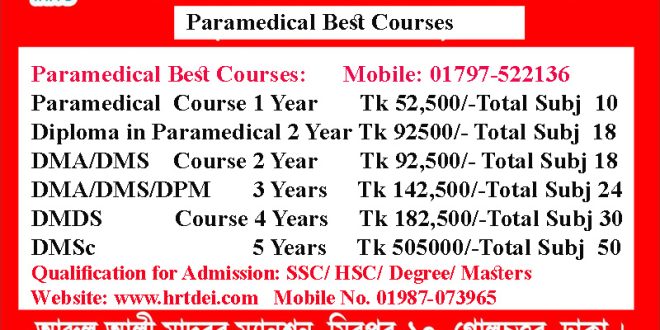
Paramedical Course 1 Year Details
Paramedical Course 1 Years : Mobile Number. 01987073965. 01941123488, 01797522136. A Paramedical course of 1 Year 1 duration is a Short Type of Paramedical Course in Bangladesh This Course contains 10 subject in 2 semesters. The 1st Semester contains 5 subject and 2nd semester contains 5 subjects.
Location of Paramedical Course 1 Year Training Center in Dhaka, Bangladesh
Location of Paramedical course 1 Year Training center. Mobile Number. 01987073965. 01941123488, 01797522136. HRTD Medical Institute , Abdul Ali Madbor Mention, Section-6, Block-Kha, Road-1, Plot-11, Mirpur-10 (Gol-Chattar) Metro Rail Piller NO-249, Dhaka-1216.

Course Fee for Paramedical Course 1Year in Dhaka, Bangladesh
Course Fee for Paramedical Course 1 Year. Mobile Number. 01987073965. 01941123488, 01797522136. Paramedical Course Fee for 1 Year TK 52,500/- Including Admission Fee, Monthly Fee & Exam Fee.
Paramedical Course 1 Year Admission Eligibility in Dhaka, Bangladesh
Paramedical Course 1 Year Admission Eligibility. Mobile Number. 01987073965. 01941123488, 01797522136. SSC or Equivalent/HSC/ Degree/ Masters from any Background (Science/ Arts/ Commerce/ Technical).
Some Subject for Paramedical Course 1 Year In Dhaka, Bangladesh
Paramedical Course 1 Year subjects. Mobile No. 01987073965, 01797522136.
- Human Anatomy & Physiology-1
- Pharmacology-1
- Study of OTC Drugs
- First Aid-1 & 2
- Practice of Medicine
- Hematology
- Pathology for Medical Practice
- Surgery-1
- Cardiovascular Anatomy
- Antimicrobial drugs
- Medical Diagnosis-1 & 2
- Chemistry
- Medical Biochemistry
- Orthopedic Anatomy
Teachers For Paramedical Course 1 Year
- Dr. Md. Sakulur Rahman, MBBS, CCD (BIRDEM), Course Director
- Dr. Sanjana Binte Ahmed, BDS, MPH, Assistant Course Director
- Dr. Tisha, MBBS, PGT Gyne, Assistant Course Director
- Dr. Suhana, MBBS, PGT Medicine
- Dr. Danial Hoque, MBBS, C-Card
- Dr. Tisha, MBBS
- Dr. Afrin Jahan, MBBS, PGT Medicine
- Dr. Ananna, MBBS
- Dr. Lamia Afroze, MBBS
- Dr. Amena Afroze Anu, MBBS, PGT Gyne, Assistant Course Director
- Dr. Farhana Antara, MBBS,
- Dr. Nazmun Nahar Juthi, BDS, PGT
- Dr. Farhana Sharna, MBBS
- Dr. Bushra, MBBS
- Dr. Turzo, MBBS
- Dr. Kamrunnahar Keya, BDS, PGT (Dhaka Dental College)
- Dr. Shamima, MBBS, PGT Gyne
- Dr. Alamin, MBBS
- Dr. Benzir Belal, MBBS
- Dr. Disha, MBBS
- Dr. Mahinul Islam, MBBS
- Dr. Tisha, MBBS, PGT Medicine
- Dr. Anika, MBBS, PGT
- Dr. Jannatul Ferdous, MBBS, PGT Gyne
- Dr. Jannatul Aman, MBBS, PGT
- Dr. Rayhan, BPT
- Dr. Abu Hurayra, BPT
- Dr. Sharmin Ankhi, MBBS, PGT Medicine
- Md. Monir Hossain, B Pharm, M Pharm
- Md. Monirul Islam, B Pharm, M Pharm
- Md. Feroj Ahmed, BSc Pathology, PDT Medicine
Human Anatomy & Physiology For Paramedical Course 1 Year
The Study of the body Structure and its function is Anatomy & Physiology. Here we discuss the systems of the human body and its organ, Tissues, and cells. The systems of the human body are the digestive system, Respiratory system, Cardiovascular system, Skeletal system, Muscular system, nervous system, Endocrine system, Immune System, Integumentary System and Urinary System.
Human Anatomy and Physiology is the study of the body’s structures (anatomy) and their functions (physiology). Anatomy focuses on the physical arrangement of cells, tissues, organs, and systems, while physiology explains how these structures work together to maintain life processes like movement, metabolism, and reproduction. The two are intertwined, as a structure’s form determines its function, and understanding one requires understanding the other.
Anatomy
- Definition:The scientific study of the body’s structures and their physical arrangement.
- Levels of Study:Can be studied at different levels, including:
- Gross Anatomy: The study of structures visible without a microscope, such as organs and organ systems.
- Microscopic Anatomy (Histology): The study of tissues and cells using a microscope.
- Methods of Study:Historically involved dissection, but now also uses advanced imaging techniques like MRI and CT scans to visualize structures in living people.
Physiology
- Definition: The study of how the body’s structures function to sustain life.
- Key Concepts:
- Complementarity of Structure and Function: The shape and form of a body structure are directly related to what it can do.
- Homeostasis: The body’s ability to maintain a stable internal environment, which is essential for survival.
- Examples: Studying how the heart regulates blood flow or how muscles contract and bring bones together.
Major Body Systems
Understanding human anatomy and physiology involves studying the body’s major systems, including:
Musculoskeletal System, Circulatory System, Nervous System, Digestive System, Respiratory System, Integumentary System, Endocrine System, Lymphatic System, Urinary System, and Reproductive System.
Why It’s Important
- Health Professions:It is a fundamental science for careers in medicine and other health fields.
- Personal Health:Knowledge of the human body helps in making informed health decisions and understanding medical information.
Pharmacology-1 for Paramedical Course 1 Year
The study of drugs and Medicine is called Pharmacology. Here we discuss group-wise drugs and their medicines in Pharmacology-1. Common Group of Drugs are pain killer drugs, Anti ulcer Drugs, Anti Vomiting Drugs, Laxative Drugs, Motility Drugs, Antimotility Drugs, Bronchodilator Drugs, Antibiotic Drugs. Anti Fungal Drugs, Anti Protozoal Drugs, Anti Viral Drugs, Anthelmintic Drugs, Anti Hypertensive Drugs, Beta Blocker Drugs, Calcium Channel Blocker Drugs, Antipyretic Drugs, Anti Thrombotic Drugs etc.
First Aid for Paramedical Course 1 Year
First Aid is an important subject for Medical courses including Diplomas in Medicine & Surgery course. RMP Courses, LMAF Courses, Paramedical Courses, DMA Courses, DMS Courses, Nursing Courses, Dental Courses, Pathology Courses, Physiotherapy Courses, Caregiver courses etc. Here we discuss shock, Classification Shock, causes of Shock, Stages of Shock, Clinicle Features of Shock, Hypovolemic Shock, Cardiogenic Shock, Neurogenic Shock, Traumatic Shock, Burn Shock, Electric Shock, Psychogenic Shock, Anaphylactic Shock, First Aid of Shock, First Aid of cut, First Aid of Snake Bite, First Aid of Accidental Injury etc.
Study of OTC Drugs for Paramedical Course 1 Year
OTC Drugs are important for all Medical Assistant Courses, Diploma Medical Courses, LMAF Courses and RMP Courses. It is also important for the Diploma in Medicine & Diploma in Surgery Course. These OTC Drugs can be sold purchases without any prescription From Registered MBBS Doctors. These Drugs are Emergency and safe for the patients. The Study of OTC Drugs improves the quality of practice. Some OTC Drugs are Albendazole, Ascorbic Acid, Calcium, Multivitamins, Vitamin B Complex, Omeprazole, Oral Rehydration Salt, Salbutamol etc.
Practice of Medicine For Paramedical Course 1 Year
Paramedical Course 1 Year for Important topics in the practice of medicine include fundamental sciences like anatomy, physiology, and pathology; core clinical subjects such as internal medicine, surgery, and pediatrics; and practical applications like pharmacology, diagnostic procedures, and patient management. Additionally, crucial areas include public health (sanitation, vaccination), family medicine (addressing a wide range of patient needs), and increasingly, community medicine (epidemiology, health indicators), and interdisciplinary fields like addiction medicine, forensic medicine, and genomic medicine.
Foundational and core topics
- Basic Sciences: Anatomy, physiology, pathology, microbiology
- Clinical Specialties: Internal medicine, surgery, pediatrics, and others that focus on specific body systems
- Pharmacology: Understanding drug mechanisms, uses, and adverse effects
Practical and applied topics
- Diagnostics and treatment: Medical imaging, diagnostic procedures, and treatment modalities
- Patient management: Skills for managing patient care and encounter
- Pain management: Includes both pharmacological and non-pharmacological treatments
Public and community health
- Public Health: Sanitation, vaccination, and lifestyle factors
- Community Medicine: Epidemiology, health indicators, levels of prevention, and the natural history of disease
Specialized and interdisciplinary fields
- Family Medicine: Provides a wide range of services for all ages and genders
- Addiction Medicine: Addresses the physical, psychological, and social aspects of substance misuse
- Forensic Medicine: Deals with medical questions in a legal context
- Genomic Medicine: Uses an individual’s genomic information to guide healthcare decisions
- Disaster Medicine: Deals with emergency preparedness and disaster management
Pathology For Paramedical course 1 Year
Important topics in pathology include General Pathology (cell injury, inflammation, neoplasia) and Systemic Pathology, which covers diseases of specific organ systems like the Cardiovascular, Respiratory, Renal, and Gastrointestinal systems. Other key areas are Hematology, Immunopathology, and Genetics.
General pathology
- Cell Injury and Adaptation: Reversible and irreversible cell injury, mechanisms like free radical injury, and adaptations such as atrophy, hypertrophy, and hyperplasia.
- Inflammation: Acute and chronic inflammation, the mediators involved, and processes like wound healing.
- Hemodynamic Disorders: Edema, hyperemia, thrombosis, embolism, infarction, and shock.
- Neoplasia: Classification of tumors, carcinogenesis, diagnosis, and tumor markers.
- Genetic Disorders: Mendelian and chromosomal disorders, diagnosis, and their role in disease.
Systemic pathology
- Cardiovascular System: Ischemic heart disease, hypertension, and vasculitis.
- Respiratory System: Lung diseases, including cancers and cystic lesions.
- Gastrointestinal System: Pathology of the esophagus, liver, biliary system, and pancreas.
- Renal and Urinary System: Glomerular and tubular diseases, and renal tumors.
- Endocrine System: Pathology of the thyroid, adrenal, and other endocrine glands.
- Central Nervous System: Infections and tumors of the brain.
Other key areas
- Hematology: Disorders of blood cells like anemias, leukemias, and lymphomas, as well as coagulation disorders and bleeding diseases.
- Immunopathology: Hypersensitivity reactions, autoimmune diseases, immunodeficiency disorders, and transplant immunology.
- Infectious Disease: Common pathogens and their mechanisms of disease, with a focus on bacterial, viral, and fungal infections.
- Histopathology and Clinical Pathology: The study of tissues and the interpretation of clinical laboratory results.
Hematology For Paramedical Course 1 Year
Important hematology topics include anemias, bleeding and clotting disorders (like hemophilia), malignancies (leukemia, lymphoma, myeloma), blood transfusions, and bone marrow and stem cell transplantation. Other key subjects are blood composition, plasma proteins, and the basics of hematopoiesis and hemostasis.
Blood cell and hemoglobin disorders
- Anemia (types: iron-deficiency, megaloblastic, aplastic, hemolytic)
- Sickle cell disease
- Thalassemia
- Glucose-6-phosphate dehydrogenase deficiency (G6PD)
- Polycythemia vera
Bleeding and clotting disorders
- Hemophilia (A and B)
- Von Willebrand’s disease
- Idiopathic thrombocytopenic purpura (ITP)
- Thrombotic thrombocytopenic purpura (TTP) and Hemolytic Uremic Syndrome (HUS)
- Disseminated Intravascular Coagulation (DIC)
Blood cancers and malignancies
- Leukemia (acute and chronic, myelogenous and lymphocytic)
- Lymphoma
- Multiple myeloma
- Myelodysplastic syndromes (MDS)
Transfusion and transplantation
- Blood transfusion medicine and reactions
- Bone marrow transplantation
- Stem cell transplantation
Foundational and other topics
- Blood composition, including plasma proteins
- Erythropoiesis and blood cell formation
- Hemostasis and coagulation
- Red blood cell indices and labs
- Complete blood count (CBC) and peripheral blood smear analysis
- Bone marrow aspiration and biopsy
Cardiovascular Anatomy For Paramedical Course 1 Year
The main topics of the practice of medicine include foundational sciences, patient care, and specific medical fields. Foundational topics cover the molecular and cellular basis of medicine, the structure and function of the human body, and how diseases develop. Patient care includes diagnosis, treatment, patient safety, ethical considerations, and communication skills. Specific medical fields span areas like internal medicine, surgery, pediatrics, psychiatry, and preventive medicine.
Foundational topics
- Molecular and cellular basis: Building blocks of cells, genetics, gene expression, population genetics, and drug-receptor interactions.
- Structure and function of the body: Cell and tissue types, histology, embryology, and the anatomy of body systems.
- Mechanisms of disease: Pathogenesis of infectious diseases, inflammation, immunity, and common disease themes like cancer and atherosclerosis.
- Pharmacology: How drugs work, pharmacokinetics, pharmacodynamics, and drug-drug interactions.
Patient care and practice management
- Diagnosis and testing: Interpreting diagnostic tests, evidence-based medicine, and clinical problem-solving.
- Treatment: Applying treatment strategies, pain management, and understanding adverse drug events.
- Patient safety: Improving quality, preventing errors, and risk management.
- Ethics and professionalism: Medical ethics, legal issues, and maintaining a professional attitude.
- Communication and empathy: Establishing rapport with patients, communication skills, and showing empathy.
- Health promotion and prevention: Preventive health care, immunization, and health diversity.
Specific medical fields
- Internal Medicine: Focuses on adult diseases, covering a wide range of conditions like cardiovascular disease, respiratory illness, and geriatrics.
- Surgery: Involves operative techniques for treating injuries and diseases.
- Pediatrics: The health and well-being of children.
- Psychiatry: Diagnosis and treatment of mental disorders.
- Preventive Medicine: Measures taken to prevent disease, rather than just treat it.
- Sports Medicine: Prevention and treatment of injuries related to physical activity.
Antimicrobial Drugs For Paramedical Course 1 Year
The most important topics regarding antimicrobial drugs for study and professional practice involve their mechanisms, appropriate use, and the global challenge of resistance.
Core Concepts and Mechanisms
- Selective Toxicity: The fundamental principle that an antimicrobial drug must harm the microbe without significantly harming the host (human, animal, or plant).
- Mechanisms of Action: Understanding how different drug classes work at the cellular level is crucial. Key mechanisms include:
- Inhibition of cell wall synthesis: (e.g., Penicillins, cephalosporins, vancomycin)
- Inhibition of protein synthesis: (e.g., Aminoglycosides, tetracyclines, macrolides)
- Inhibition of nucleic acid (DNA/RNA) synthesis: (e.g., Fluoroquinolones, rifampin)
- Disruption of cell membranes: (e.g., Antifungals, polymyxins)
- Inhibition of metabolic pathways: (e.g., Sulfonamides, trimethoprim)
- Bacteriostatic vs. Bactericidal: Knowing whether a drug inhibits growth (bacteriostatic) or actively kills the microorganism (bactericidal) is important for treating different types of infections and patients (e.g., immunocompromised individuals often require bactericidal drugs).
- Spectrum of Activity: Understanding the range of pathogens a drug is effective against (broad-spectrum vs. narrow-spectrum) and the implications of using each (e.g., broad-spectrum use can disrupt the normal microbiome and lead to superinfections like C. difficile).
Clinical Application
- Rational Drug Selection: Choosing the correct drug involves considering the type of organism, the site of infection (e.g., ability to cross the blood-brain barrier), pharmacokinetics (absorption, distribution, elimination), potential toxicity, and cost.
- Culture and Sensitivity Testing: The importance of obtaining samples (blood, urine, etc.) for lab tests before administering antibiotics to identify the specific pathogen and its vulnerabilities.
- Empiric Therapy: The use of broad-spectrum antibiotics to begin treatment for serious, suspected infections before laboratory results are available, followed by tailoring therapy to a more specific, narrow-spectrum agent once the organism is identified.
- Side Effects and Adverse Effects: Recognizing common side effects (e.g., GI upset) and serious adverse reactions (e.g., allergic reactions, organ toxicities, superinfections).
- Drug Interactions: Awareness of how antimicrobials can interact with other drugs (e.g., penicillins and potassium-sparing diuretics, antacids and antibiotics).
Global Health Concern: Antimicrobial Resistance (AMR)
- Mechanisms of Resistance: The ways microbes develop resistance, including altering the drug target, inactivating the drug with enzymes, decreasing drug entry, or using efflux pumps to remove the drug.
- Drivers of AMR: The major role of the misuse and overuse of antimicrobials in humans, animals, and agriculture in accelerating the development of resistance.
- Antimicrobial Stewardship: Programs and practices that promote the judicious and appropriate use of antimicrobials to preserve their effectiveness and slow the emergence of resistance.
- Prevention Strategies: The critical importance of patient education on completing the full course of prescribed antibiotics, proper hygiene, and the need for new drug development.
Orthopedic Anatomy For Paramedical Course 1 Year
Important topics in orthopedic anatomy include the skeletal system (bones, joints, and their articulations), muscles, tendons, ligaments, and nerves. Understanding these structures, their interactions, and common injuries like fractures, dislocations, and soft tissue damage is crucial. Key areas include the upper limb (shoulder, elbow, wrist, hand), lower limb (hip, knee, ankle, foot), and spine.
Key Areas and Specific Topics:
- Skeletal System:
- Bones: Types of bones (long, short, flat, irregular), bone structure (compact and spongy), bone formation (endochondral and intramembranous ossification), and common fractures.
- Joints: Types of joints (fibrous, cartilaginous, synovial), examples of each (e.g., shoulder, hip, knee, elbow, ankle, wrist).
- Spine: Vertebral column structure (vertebrae, intervertebral discs, facet joints), spinal curves, and common spinal conditions.
- Musculoskeletal System:
- Muscles: Muscle origins, insertions, actions, and innervation, particularly focusing on muscles of the limbs and back.
- Tendons and Ligaments: Their roles in joint stability and common injuries (e.g., tendonitis, ligament sprains).
- Nerves: Major nerves in the limbs (e.g., radial, ulnar, median, sciatic, femoral), nerve injuries (e.g., carpal tunnel syndrome, sciatic nerve compression), and their impact on movement and sensation.
- Specific Anatomical Regions:
- Upper Limb: Shoulder joint (rotator cuff, glenohumeral joint), elbow joint, wrist and hand (carpal bones, metacarpals, phalanges, common injuries), and nerve pathways.
- Lower Limb: Hip joint, knee joint (menisci, ligaments), ankle and foot (tarsals, metatarsals, phalanges, arches), and nerve pathways.
- Spine: Cervical, thoracic, and lumbar vertebrae, spinal cord and nerve roots, and common spinal conditions like herniated discs, spinal stenosis, and scoliosis.
- Orthopedic Conditions:
- Fractures: Types of fractures, fracture healing, and complications.
- Dislocations: Types of dislocations and joint instability.
- Soft Tissue Injuries: Sprains, strains, tendonitis, and bursitis.
- Arthritis: Osteoarthritis and rheumatoid arthritis.
- Tumors: Bone tumors (e.g., osteosarcoma, chondrosarcoma) and soft tissue tumors.
Medical Biochemistry For Paramedical Course 1 Year
Important topics in Medical Biochemistry include metabolism (carbohydrates, lipids, amino acids, and nucleotides), enzymes, molecular biology (DNA, RNA, gene expression), and the role of vitamins and minerals. Other key areas are bioenergetics, protein structure and function, cell biology, and clinical biochemistry (including liver and kidney function tests).
Here’s a more detailed breakdown:
1. Metabolism:
- Carbohydrate Metabolism:This includes glycolysis, gluconeogenesis, the citric acid cycle, glycogen metabolism, and the pentose phosphate pathway.
- Lipid Metabolism:This covers fatty acid synthesis and breakdown (beta-oxidation), cholesterol metabolism, and the structure and function of lipoproteins.
- Amino Acid Metabolism:This includes amino acid synthesis and degradation, the urea cycle, and the metabolism of specific amino acids like tyrosine and phenylalanine.
- Nucleotide Metabolism:This involves the synthesis and breakdown of purines and pyrimidines.
2. Enzymes:
- Enzyme kinetics (Michaelis-Menten equation, Lineweaver-Burk plot).
- Enzyme regulation (allosteric regulation, covalent modification).
- Examples of enzymes in metabolic pathways.
3. Molecular Biology:
DNA structure and replication, RNA structure and transcription, Protein synthesis (translation), and Gene regulation and the Lac operon.
4. Vitamins and Minerals:
- Water-soluble and fat-soluble vitamins.
- Essential minerals and their roles in the body.
5. Other Important Areas:
- Bioenergetics: The study of energy flow in living organisms.
- Protein Structure and Function: This includes protein folding, domains, and the relationship between structure and function.
- Cell Biology: This includes cell structure, organelles, and membrane transport.
- Clinical Biochemistry: This covers topics like liver and kidney function tests, acid-base balance, and tumor markers.
- Free Radicals and Antioxidants: Oxidative stress and its role in disease.
- Inborn Errors of Metabolism: Lysosomal storage diseases and other metabolic disorders.
6. Specific Topics:
- Glycogen storage diseases.
- Hemoglobin structure and function.
- Hormone action and second messengers.
- Markers enzymes and their significance.
- Clinical disorders related to metabolism (e.g., diabetes).
Medical Biochemistry Of Paramedical Course 1 year
Important topics in medical biochemistry include metabolism, especially carbohydrate (like glycolysis and the citric acid cycle) and lipid metabolism (like fatty acid oxidation and cholesterol synthesis). Other key areas are enzymology, molecular biology (including DNA replication, transcription, and genetic code), and clinical biochemistry, which covers how biochemical principles relate to diseases like diabetes and how tests like liver or kidney function tests are used.
Metabolism
- Carbohydrate Metabolism:
- Glycolysis, gluconeogenesis, and the citric acid cycle
- Glycogen metabolism and its disorders (like Glycogen Storage Diseases)
- Pentose phosphate pathway
- Lipid Metabolism:
- Fatty acid oxidation and ketogenesis
- Cholesterol metabolism
- Lipoproteins and related disorders
- Amino Acid and Protein Metabolism:
- Amino acid classification and metabolism
- The urea cycle
- Protein structure and function
- Protein targeting
Molecular Biology and Genetics
- DNA and RNA:
- DNA replication and repair
- Transcription and post-transcriptional modification
- The genetic code
- Types of RNA
- Regulation:
- Gene regulation and operons (e.g., Lac operon)
- Biotechnology:
- Recombinant DNA technology and PCR
Enzymes and Bioenergetics
- Enzymology:
- Enzyme kinetics (Michaelis-Menten kinetics) and regulation
- Allosteric enzymes
- Biochemical markers and their significance
- Bioenergetics:
- ATP production
- The electron transport chain
- Coenzymes (like NADH and FADH₂)
Clinical and Systemic Biochemistry
- Organ Function and Disorders:
- Liver function tests
- Kidney function tests
- Electrolyte balance and acid-base balance
- Diseases like diabetes, jaundice, and atherosclerosis
- Nutritional Biochemistry:
- Vitamins (especially B vitamins) and their roles
- Minerals and their functions
- Protein-energy malnutrition
Surgery Of Paramedical Course 1 year
Important topics in surgery include specialty areas like cardiac, neuro, and orthopedic surgery, as well as core subjects like trauma, perioperative care, and specific procedures such as cholecystectomy and hernia repair. Other significant topics are breast surgery, vascular and endovascular surgery, and gastrointestinal and colorectal surgery. Patient safety, sepsis, and medical malpractice are also critical considerations.
Specialty areas
- Cardiac and Cardiovascular: Surgery on the heart and major blood vessels.
- Neurosurgery: Procedures involving the central nervous system, brain, and spinal cord.
- Orthopedic surgery: Operations on the musculoskeletal system, including bones, joints, and muscles.
- Thoracic surgery: Surgery on the chest cavity, including the lungs.
- Gastrointestinal surgery: Procedures on the digestive tract and its accessory organs.
- Vascular surgery: Operations on arteries and veins outside the chest.
- Urologic surgery: Procedures on the genitourinary system.
- ENT (Otolaryngology) surgery: Procedures on the ear, nose, and throat.
- Plastic and reconstructive surgery: Work on the body’s surface, including the face.
Core and common topics
- Trauma and burn surgery: Management of injuries from accidents and burns.
- Perioperative care: The management of patients before, during, and after surgery.
- Skin and soft tissue surgery: Procedures on the skin and subcutaneous tissues.
- Breast surgery: Includes management of breast cancer, cysts, and other conditions.
- Common procedures: Specific surgeries like cholecystectomy (gallbladder removal), inguinal hernia repair, and cataract surgery.
- Sepsis: A life-threatening condition that can arise from an infection, often a surgical emergency.
- Patient safety: Includes topics like reducing errors and improving overall patient outcomes.
- Medical malpractice: Legal aspects related to medical practice and surgery.
Other important topics
- Bariatric surgery: Surgery related to weight loss.
- Hepatobiliary and pancreatic surgery: Operations on the liver, gallbladder, and pancreas.
- ** Arterial and venous access:** Techniques for establishing access to the circulatory system, such as central venous catheters.
- Inflammatory bowel disease: Surgical management of conditions like Crohn’s disease and ulcerative colitis.
- Pain management: Strategies for controlling pain in surgical patients.
What is the importance of Paramedical Course 1 Year ?
*Research and Innovations often collabnts, and contribute to medical advancements and innovations.
Value of Paramedical Course 1 Year in Bangladesh
Paramedical short courses can hold significant value in Bangladesh, given the country’s healthcare landscape and the increasing demand for skilled healthcare professionals. Paramedical Training Center provides Paramedical courses and specialized training to individuals who work alongside doctors, nurses, and other medical professionals to support patient care and medical procedures. HRTD Medical Institute is a good Paramedical Training Center located at Mirpur 10 Golchattar, Dhaka, Bangladesh.
দেশের স্বাস্থ্যসেবা ল্যান্ডস্কেপ এবং দক্ষ স্বাস্থ্যসেবা পেশাদারদের ক্রমবর্ধমান চাহিদার পরিপ্রেক্ষিতে প্যারামেডিক্যাল শর্ট কোর্সগুলি বাংলাদেশে উল্লেখযোগ্য মূল্য রাখতে পারে। প্যারামেডিক্যাল ট্রেনিং সেন্টার প্যারামেডিক্যাল কোর্স এবং বিশেষ প্রশিক্ষণ প্রদান করে যারা ডাক্তার, নার্স এবং অন্যান্য চিকিৎসা পেশাজীবীদের পাশাপাশি রোগীর যত্ন এবং চিকিৎসা পদ্ধতিতে সহায়তা করার জন্য কাজ করে। এইচআরটিডি মেডিকেল ইনস্টিটিউট মিরপুর 10 গোলচত্তর, ঢাকা, বাংলাদেশের একটি ভাল প্যারামেডিক্যাল ট্রেনিং সেন্টার।
Here are several reasons why these courses can be valuable in Bangladesh:
বাংলাদেশে এই কোর্সগুলো মূল্যবান হওয়ার কয়েকটি কারণ এখানে রয়েছে:
Addressing Healthcare Workforce Shortages: Bangladesh, like many developing countries, faces shortages in its healthcare workforce. Paramedical short courses can help bridge this gap by quickly training individuals in specific medical skills, allowing them to contribute to patient care without undergoing lengthy medical school education. HRTD Medical Institute is the best Paramedical Training Center in Bangladesh. Online and offline Paramedical Courses are available here.
স্বাস্থ্যসেবা কর্মশক্তির ঘাটতি মোকাবেলা: অনেক উন্নয়নশীল দেশের মতো বাংলাদেশও তার স্বাস্থ্যসেবা কর্মশক্তির ঘাটতির সম্মুখীন। প্যারামেডিক্যাল সংক্ষিপ্ত কোর্সগুলি নির্দিষ্ট চিকিৎসা দক্ষতায় ব্যক্তিদের দ্রুত প্রশিক্ষণের মাধ্যমে এই ব্যবধান পূরণ করতে সাহায্য করতে পারে, যাতে তারা দীর্ঘমেয়াদী মেডিকেল স্কুল শিক্ষা ছাড়াই রোগীর যত্নে অবদান রাখতে পারে। এইচআরটিডি মেডিকেল ইনস্টিটিউট বাংলাদেশের সেরা প্যারামেডিক্যাল ট্রেনিং সেন্টার। অনলাইন এবং অফলাইন প্যারামেডিক্যাল কোর্স এখানে উপলব্ধ।
*Faster Entry into Healthcare: Medical school requires several years of education, whereas paramedical short courses can be completed in a shorter time frame. This enables individuals to enter the healthcare workforce more quickly, especially in roles such as medical technicians, radiology technicians, and laboratory assistants.
স্বাস্থ্যসেবাতে দ্রুত প্রবেশ: মেডিকেল স্কুলের জন্য কয়েক বছরের শিক্ষার প্রয়োজন হয়, যেখানে প্যারামেডিক্যাল শর্ট কোর্সগুলি অল্প সময়ের মধ্যে সম্পন্ন করা যেতে পারে। এটি ব্যক্তিদের স্বাস্থ্যসেবা কর্মশক্তিতে আরও দ্রুত প্রবেশ করতে সক্ষম করে, বিশেষ করে চিকিৎসা প্রযুক্তিবিদ, রেডিওলজি টেকনিশিয়ান এবং পরীক্ষাগার সহকারীর মতো ভূমিকায়।
*Cost-Effectiveness: Traditional medical education can be expensive and time-consuming. Paramedical short courses tend to be more affordable and can be completed without the need for extended periods of study, making them accessible to a wider range of individuals. HRTD Medical Institue is a good Paramedical Training Center where all paramedical and Diploma Medical Courses are available at reasonable prices.
খরচ-কার্যকারিতা: ঐতিহ্যগত চিকিৎসা শিক্ষা ব্যয়বহুল এবং সময়সাপেক্ষ হতে পারে। প্যারামেডিক্যাল সংক্ষিপ্ত কোর্সগুলি আরও সাশ্রয়ী মূল্যের হতে থাকে এবং অধ্যয়নের বর্ধিত সময়ের প্রয়োজন ছাড়াই সম্পূর্ণ করা যেতে পারে, যা এগুলিকে বিস্তৃত ব্যক্তির কাছে অ্যাক্সেসযোগ্য করে তোলে। HRTD মেডিকেল ইনস্টিটিউ একটি ভাল প্যারামেডিক্যাল ট্রেনিং সেন্টার যেখানে সমস্ত প্যারামেডিক্যাল এবং ডিপ্লোমা মেডিকেল কোর্স যুক্তিসঙ্গত মূল্যে পাওয়া যায়।
*Focused Skill Development: Paramedical courses are designed to provide specific skills and knowledge needed for particular roles within the healthcare sector. This focused training ensures that paramedics are well-equipped to handle the responsibilities of their chosen profession.
ফোকাসড স্কিল ডেভেলপমেন্ট: প্যারামেডিক্যাল কোর্সগুলি স্বাস্থ্যসেবা সেক্টরের মধ্যে নির্দিষ্ট ভূমিকার জন্য প্রয়োজনীয় নির্দিষ্ট দক্ষতা এবং জ্ঞান প্রদানের জন্য ডিজাইন করা হয়েছে। এই কেন্দ্রীভূত প্রশিক্ষণ নিশ্চিত করে যে প্যারামেডিকরা তাদের নির্বাচিত পেশার দায়িত্বগুলি পরিচালনা করার জন্য সুসজ্জিত।
*Diverse Career Opportunities: Paramedical courses offer a range of career options, including medical laboratory technology, radiology technology, anesthesia technology, operation theater technology, and more. This diversity allows individuals to select a field that aligns with their interests and strengths. HRTD Medical Institute is the best Paramedical Training Center that offers some unique courses like DMSc ( Diploma in Medical Science). Students of this DMSc course can choose a career in First Aid Paramedical Sector Dental Technology Sector Physiotherapy Technology Sector Nursing Technology Sectors etc.
কর্মজীবনের বিভিন্ন সুযোগ: প্যারামেডিক্যাল কোর্সগুলি মেডিকেল ল্যাবরেটরি প্রযুক্তি, রেডিওলজি প্রযুক্তি, অ্যানেস্থেশিয়া প্রযুক্তি, অপারেশন থিয়েটার প্রযুক্তি এবং আরও অনেক কিছু সহ ক্যারিয়ারের বিকল্পগুলির একটি পরিসর অফার করে। এই বৈচিত্র্য ব্যক্তিদের একটি ক্ষেত্র নির্বাচন করতে দেয় যা তাদের আগ্রহ এবং শক্তির সাথে সামঞ্জস্যপূর্ণ। এইচআরটিডি মেডিকেল ইনস্টিটিউট হল সেরা প্যারামেডিক্যাল ট্রেনিং সেন্টার যা কিছু অনন্য কোর্স যেমন ডিএমএসসি (মেডিকেল সায়েন্সে ডিপ্লোমা) অফার করে। এই DMSc কোর্সের শিক্ষার্থীরা ফার্স্ট এইড প্যারামেডিক্যাল সেক্টর ডেন্টাল টেকনোলজি সেক্টর ফিজিওথেরাপি টেকনোলজি সেক্টর নার্সিং টেকনোলজি সেক্টর ইত্যাদিতে ক্যারিয়ার বেছে নিতে পারে।
*Contribution to Patient Care: Paramedical professionals play a crucial role in patient care by assisting doctors and nurses in various medical procedures, diagnostic tests, and treatments. Their presence helps alleviate the workload of other healthcare providers, leading to improved patient care.
*রোগীর যত্নে অবদান: প্যারামেডিক্যাল পেশাদাররা বিভিন্ন চিকিৎসা পদ্ধতি, ডায়াগনস্টিক পরীক্ষা এবং চিকিৎসায় ডাক্তার ও নার্সদের সহায়তা করে রোগীর যত্নে গুরুত্বপূর্ণ ভূমিকা পালন করে। তাদের উপস্থিতি অন্যান্য স্বাস্থ্যসেবা প্রদানকারীদের কাজের চাপ কমাতে সাহায্য করে, যা উন্নত রোগীর যত্নের দিকে পরিচালিত করে।
*Rising Demand: As healthcare services expand and modernize in Bangladesh, there’s a growing need for skilled paramedical professionals who can contribute to specialized areas of medical care. Paramedical courses can help meet this demand.
*Flexibility: Paramedical courses often offer flexible learning options, including part-time or online courses. This flexibility is especially beneficial for individuals who may need to balance their studies with work or other commitments.
* ক্রমবর্ধমান চাহিদা: বাংলাদেশে স্বাস্থ্যসেবা পরিষেবাগুলি প্রসারিত এবং আধুনিকীকরণের সাথে সাথে দক্ষ প্যারামেডিক্যাল পেশাদারদের একটি ক্রমবর্ধমান প্রয়োজন যারা চিকিৎসা যত্নের বিশেষ ক্ষেত্রে অবদান রাখতে পারে। প্যারামেডিক্যাল কোর্স এই চাহিদা মেটাতে সাহায্য করতে পারে।
*Career Progression: Many paramedical courses provide a foundation for further career advancement. Post Paramedical training and Post Diploma Training are available after completing Paramedical Courses or Diploma Courses. These courses are post-paramedical training in cardiology, Post diploma training in cardiology, post-paramedical training in gastrology, post-diploma training in gastrology, post-paramedical training in gynecology, post-diploma training in gynecology, post-paramedical training in dermatology, post diploma training in dermatology, post paramedical training ophthalmology, post diploma training in ophthalmology, post paramedical training in diabetology, post diploma training in diabetology.
*ক্যারিয়ার অগ্রগতি: অনেক প্যারামেডিক্যাল কোর্স ক্যারিয়ারের আরও উন্নতির জন্য একটি ভিত্তি প্রদান করে। প্যারামেডিক্যাল কোর্স বা ডিপ্লোমা কোর্স শেষ করার পর পোস্ট প্যারামেডিক্যাল ট্রেনিং এবং পোস্ট ডিপ্লোমা ট্রেনিং পাওয়া যায়। এই কোর্সগুলো হলো কার্ডিওলজিতে পোস্ট প্যারামেডিক্যাল ট্রেনিং, কার্ডিওলজিতে পোস্ট ডিপ্লোমা ট্রেনিং, গ্যাস্ট্রোলজিতে পোস্ট প্যারামেডিক্যাল ট্রেনিং, গ্যাস্ট্রোলজিতে পোস্ট-ডিপ্লোমা ট্রেনিং, গাইনোকোলজিতে পোস্ট প্যারামেডিক্যাল ট্রেনিং, গাইনোকোলজিতে পোস্ট-ডিপ্লোমা ট্রেনিং, ডার্মাটোলজিতে পোস্ট প্যারামেডিক্যাল ট্রেনিং। , ডার্মাটোলজিতে ডিপ্লোমা প্রশিক্ষণ, পোস্ট প্যারামেডিক্যাল প্রশিক্ষণ চক্ষুবিদ্যা, পোস্ট ডিপ্লোমা প্রশিক্ষণ চক্ষুবিদ্যায়, পোস্ট প্যারামেডিক্যাল প্রশিক্ষণ ইন ডায়াবেটোলজি, পোস্ট ডিপ্লোমা প্রশিক্ষণ ডায়াবেটোলজিতে।
PPT means Post Paramedical Training and PDT means Post Diploma Training.PDT Medicine, PPT Medicine. All these courses are available at HRTD Medical Institute, Mirpur-10 Golchattar, Dhaka.
*Community Health Improvement: Paramedical professionals often work closely with local communities, providing essential healthcare services, preventive education, and health awareness campaigns. This contributes to overall community health improvement.
PPT মানে পোস্ট প্যারামেডিক্যাল ট্রেনিং এবং PDT মানে পোস্ট ডিপ্লোমা ট্রেনিং। PDT মেডিসিন, PPT মেডিসিন। এই সমস্ত কোর্স HRTD মেডিকেল ইনস্টিটিউট, মিরপুর-10 গোলচত্বর, ঢাকায় পাওয়া যায়।
*সাম্প্রদায়িক স্বাস্থ্যের উন্নতি: প্যারামেডিক্যাল পেশাদাররা প্রায়ই স্থানীয় সম্প্রদায়ের সাথে ঘনিষ্ঠভাবে কাজ করে, প্রয়োজনীয় স্বাস্থ্যসেবা পরিষেবা প্রদান করে, প্রতিরোধমূলক শিক্ষা এবং স্বাস্থ্য সচেতনতা প্রচার করে। এটি সামগ্রিক সম্প্রদায়ের স্বাস্থ্যের উন্নতিতে অবদান রাখে।
In conclusion, paramedical short courses can hold significant value in Bangladesh by addressing healthcare workforce shortages, providing faster entry into the healthcare sector, offering cost-effective training, and contributing to patient care. These courses can play a vital role in strengthening the healthcare system and improving overall healthcare services in Bangladesh.
উপসংহারে, প্যারামেডিক্যাল শর্ট কোর্সগুলি স্বাস্থ্যসেবা কর্মশক্তির ঘাটতি মোকাবেলা করে, স্বাস্থ্যসেবা খাতে দ্রুত প্রবেশের ব্যবস্থা করে, সাশ্রয়ী মূল্যের প্রশিক্ষণ প্রদান করে এবং রোগীর যত্নে অবদান রাখার মাধ্যমে বাংলাদেশে উল্লেখযোগ্য মূল্য ধরে রাখতে পারে। এই কোর্সগুলো বাংলাদেশের স্বাস্থ্যসেবা ব্যবস্থাকে শক্তিশালী করতে এবং সামগ্রিক স্বাস্থ্যসেবা পরিষেবার উন্নতিতে গুরুত্বপূর্ণ ভূমিকা পালন করতে পারে।
Why Paramedical Courses are important for a human being?
মহান আল্লাহ রাব্বুল আলআমিন মানুষকে যে জীবন দান করেছেন তার ধারক হিসেবে দিয়েছেন দেহকে । এই দেহকে ভালোভাবে জানতে পারা, এর পরিচর্যা করা, রক্ষনাবেক্ষন করতে পারা প্রত্যেকটি মানুষের জন্য ফরজ বলে আমি মনে করি । একজন ড্রাইভার যদি ড্রাইভিং এর পাশাপাশি তার গাড়ির প্রাথমিক পরিচর্যা, রক্ষনাবেক্ষন না করতে পারে তবে তাকে মাঝে মাঝে বড় ধরনের সমস্যায় পড়তেই হবে । আর যদি গাড়ির পরিচর্যা, প্রাথমিক মেকানিক, রক্ষনাবেক্ষন ইত্যাদি বিষয়ে জ্ঞান অর্জন করে, দক্ষতা এবং অভিজ্ঞতা অর্জন করে, তবে পথের মাঝে গাড়ি নষ্ট হলেও সে প্রাথমিক ভাবে সারিয়ে নিতে পারবে এবং পরবর্তিতে গাড়ি ড্রাইভ করে ভালো মানের ইন্জিনিয়ারিং সোপে নিয়ে গাড়ি ঠিক করে নিতে পারবে ।
একজন মানুষের ক্ষেত্রেও ঠিক তেমনি । দেহ সম্পকে জ্ঞান, দেহের প্রাথমিক পরিচর্যা, দেহের রক্ষনাবেক্ষন, দেহের প্রাথমিক চিকিৎসা ইত্যাদি বিষয়ে জ্ঞান, দক্ষতা এবং অভিজ্ঞতা অর্জন করলে সারাটা জীবন দেহটাকে সুন্দরভাবে পরিচালনা করা যায়, বেশি অসুস্থ্য হলে সঠিক সময়ে সঠিক ডাক্তারের কাছে গিয়ে সঠিক চিকিৎসা নেয়া যায় ।
Almighty Allah Rabbul Alamin has given the body as the container of the life He has given to man. I think it is a duty for every human being to know this body well, take care of it, and protect it. If a driver is not able to take basic care and maintenance of his car along with driving, then he has to face big problems at times. And if he acquires knowledge, skills and experience in car maintenance, basic mechanics, maintenance, etc., even if the car breaks down on the way, he can fix it initially and later drive the car and fix the car with good quality engineering soap.

The same is the case with a human being. If you acquire knowledge, skills and experience about the body, basic care of the body, maintenance of the body, basic treatment of the body, you can manage the body beautifully throughout your life, if you are very sick, you can go to the right doctor at the right time and get the right treatment.
Online Paramedical Course in HRTD Paramedical Training Center
Online and Offline Paramedical Training Center. Mobile Phone 01797522136, 01987073965. You can do paramedical course online or offline with us here. Weekly classes three days three hours. But for working people it is three hours in a day. Class days are Friday, Saturday and Monday. Morning batch from 9 am to 12 pm.Afternoon batch from 3 pm to 6 pm. Students who take online classes are given practical classes at their convenient time so that they don’t face any kind of problem.
Authority, Paramedical Training Center, HRTD Limited, Mirpur-10 Golchattar, Dhaka.
আপনি অনলাইনে বা অফলাইনে আমাদের এখানে প্যারামেডিকেল কোর্স করতে পারবেন । সাপ্তাহিক ক্লাস তিন দিনে তিন ঘন্টা । তবে চাকরি জীবিদের জন্য একদিনেেই তিন ঘন্টা । ক্লাসের দিন গুলি হলো শুক্রবার, শনিবার এবং সোমবার । সকালের ব্যাচ ৯ টা থেকে ১২ টা । বিকেলের ব্যাচ ৩ টা থেকে ৬ টা । যে সকল ছাত্র ছাত্রী অনলাইনে ক্লাস করেন তাদের প্রাকটিকেল ক্লাস তাদের সবিধাজনক সময়ে দেওয়া হয় যাতে করে তারা কোন ধরনের সমস্যায় না পরেন ।
Offline Paramedical Course in HRTD Paramedical Training Center
Offline and Online Paramedical Training Center. Mobile Phone 01797522136, 01987073965. You can do paramedical course online or offline with us here. Weekly classes three days three hours. But for working people it is three hours in a day. Class days are Friday, Saturday and Monday. Morning batch from 9 am to 12 pm.Afternoon batch from 3 pm to 6 pm. Students who take online classes are given practical classes at their convenient time so that they don’t face any kind of problem.
Authority, Paramedical Training Center, HRTD Limited, Mirpur-10 Golchattar, Dhaka.
আপনি অফলাইনে বা অনলাইনে আমাদের এখানে প্যারামেডিকেল কোর্স করতে পারবেন । সাপ্তাহিক ক্লাস তিন দিনে তিন ঘন্টা । তবে চাকরি জীবিদের জন্য একদিনেেই তিন ঘন্টা । ক্লাসের দিন গুলি হলো শুক্রবার, শনিবার এবং সোমবার । সকালের ব্যাচ ৯ টা থেকে ১২ টা । বিকেলের ব্যাচ ৩ টা থেকে ৬ টা । যে সকল ছাত্র ছাত্রী অনলাইনে ক্লাস করেন তাদের প্রাকটিকেল ক্লাস তাদের সবিধাজনক সময়ে দেওয়া হয় যাতে করে তারা কোন ধরনের সমস্যায় না পরেন ।
Is Paramedic a doctor?
একজন প্যারামেডিক কিন্তু একজন ডাক্তার না । ডিপ্লোমা কমপ্লিট করা প্যারামেডিকরা মেডিকেল এসিসটেন্ট । তারা ডাক্তারের বিভিন্ন কাজে সহযোগীতা করতে পারে । ফাষ্ট এইড প্যারামেডিকরা ডাক্তারকে ক্লিনিকেল ডায়াগনোসিসে সহযোগীতা করতে পারে, প্রি অপারেটিভ এবং পোষ্ট অপারেটিভ কাজ গুলো করতে পারে । ল্যাব প্যারামেডিকরা ল্যাবের কাজগুলো করতে পারে, নার্সিং প্যারামেডিকরা নার্সিং সেবা এবং রক্ষনাবেক্ষনের কাজগুলো করতে পারে, কেয়ার গিভার প্যারামেডিকরা রোগীর বাড়িতে গিয়ে রোগীর সেবা যত্ন করতে পারে । প্যারামেডিকেলের কোর্স গুলো অল্প মেয়াদী বা দীর্ঘ মেয়াদি হতে পারে । সব সময় মনে রাখতে হবে যে, যত বেশি অধ্যায়ন, ততো বেশি জ্ঞান দক্ষতা এবং অভিজ্ঞতা অর্জন এবং ততো বেশি সেবা দান ।
যতো প্যারামেডিক বা মেডিকেল এসিসটেন্ট গরে উঠবে ডাক্তারদের কাজ ততো সহজ হবে, ডাক্তাররা বেশি বেশি অধ্যায়ন করতে পারবে, নতুন নতুন কিছু আবিষ্কার করতে পারবে । এত করে চিকিৎসা বিজ্ঞান এগিয়ে যেতে থাকবে । চিকিৎসা বিজ্ঞানের দ্বারা উন্নত শারীরিক স্বাস্থ্য ও মানষিক স্বাস্থ্যের প্রজন্ম গড়ে তোলা সহজ হবে ।কর্তৃপক্ষ, প্যারামেডিক্যাল ট্রেনিং সেন্টার, এইচআরটিডি লিমিটেড, মিরপুর-১০ গোলচত্তর, ঢাকা।
A paramedic but not a doctor. Paramedics who have completed Diploma are Medical Assistants. They can assist the doctor in various tasks. First aid paramedics can assist doctors in clinical diagnosis, pre-operative and post-operative work.Lab paramedics can perform lab tasks, nursing paramedics can perform nursing services and maintenance tasks, care giver paramedics can visit the patient’s home and provide patient care. Paramedical courses can be short term or long term.Always remember that the more you study, the more knowledge, skills and experience you gain and the more service you give.
The more paramedics or medical assistants become available, the easier the doctors’ work will be, the doctors will be able to study more and discover new things. In this way, medical science will continue to advance. Medical science will make it easier to raise a generation of improved physical health and mental health.
Authority, Paramedical Training Center, HRTD Limited, Mirpur-10 Golchattar, Dhaka.
Which is the best paramedicl Course ?
Paramedical Training Center. Mobile Phone 01797522136, 01987073965. Always remember that the more you study, the more knowledge, skills and experience you gain and the more service you give. Paramedical courses can be short term or long term. The biggest course is the best.
সব সময় মনে রাখতে হবে যে, যত বেশি অধ্যায়ন, ততো বেশি জ্ঞান দক্ষতা এবং অভিজ্ঞতা অর্জন এবং ততো বেশি সেবা দান । প্যারামেডিকেলের কোর্স গুলো অল্প মেয়াদী বা দীর্ঘ মেয়াদি হতে পারে । সবচেয়ে বড় কোর্স
হলো সবচেয়ে ভালো ।
What is the difference between Medical College and Paramedical Training Center?
Paramedical Training Center. Mobile Phone No. 01797522136, 01987073965. Medical College and Medical University are the study places for Medical Doctors. They are Medical Graduate and Post Medical Graduate. Medical Doctors are MBBS, BDS, FCPS, MS, MD, etc. On the other hand Paramedical Training Center is the study place for Paramedics like First Aid Paramedics, Nursing Paramedics, Laboratory Paramedics, Dental Paramedics, Caregiver Paramedics, Radiological Paramedics, Orthopedic Paramedics, Surgical Paramedics, Gynecological Paramedics, etc. These all Paramedic Courses are available in HRTD Medical Institute. HRTD Medical Institute is a Paramedic Training Institute that provide all types of Paramedical Studies.
Why Paramedicl Training Centers are important?
Importants of Paramedical Training Center. Mobile Phone 01797522136, 01987073965. The functions of Paramedical Training Centers are making good paramedics of various types. There are many types of Paramedical like First Aid Paramedical, Laboratory Paramedical, Dental Paramedical, Nursing Paramedical, Surgical Paramedical, Orthopedic Paramedical, Psychiatric Paramedical, Caregiver Paramedical, etc. These Paramedical Courses are import for medical sectors. A doctor cannot run first without the assistance of Paramedics. There are huge crisis of Paramedicals professions in the world. But we can not understant it. Every person of a medical hospital, clinic, nursing home, caregiver center, diagnostic center should have the knowledge of paramedicals.
প্যারামেডিক্যাল ট্রেনিং সেন্টারের গুরুত্বপূর্ণ বিষয়। মোবাইল ফোন 01797522136, 01987073965। প্যারামেডিক্যাল ট্রেনিং সেন্টারের কাজগুলো বিভিন্ন ধরনের ভালো প্যারামেডিক তৈরি করছে। অনেক ধরনের প্যারামেডিক্যাল আছে যেমন ফার্স্ট এইড প্যারামেডিক্যাল, ল্যাবরেটরি প্যারামেডিক্যাল, ডেন্টাল প্যারামেডিক্যাল, নার্সিং প্যারামেডিক্যাল, সার্জিক্যাল প্যারামেডিক্যাল, অর্থোপেডিক প্যারামেডিক্যাল, সাইকিয়াট্রিক প্যারামেডিক্যাল, কেয়ারগিভার প্যারামেডিক্যাল ইত্যাদি। এই প্যারামেডিক্যাল কোর্সগুলি চিকিৎসা খাতের জন্য আমদানি করা হয়। প্যারামেডিকসের সহায়তা ছাড়া একজন ডাক্তার প্রথমে দৌড়াতে পারে না। বিশ্বে প্যারামেডিকেল পেশার ব্যাপক সংকট রয়েছে। কিন্তু আমরা তা বুঝতে পারি না। মেডিকেল হাসপাতাল, ক্লিনিক, নার্সিং হোম, কেয়ারগিভার সেন্টার, ডায়াগনস্টিক সেন্টারের প্রত্যেক ব্যক্তির প্যারামেডিক্যালস সম্পর্কে জ্ঞান থাকতে হবে।