 HRTD Medical Institute

Physiotherapy Training Course Profile Details:
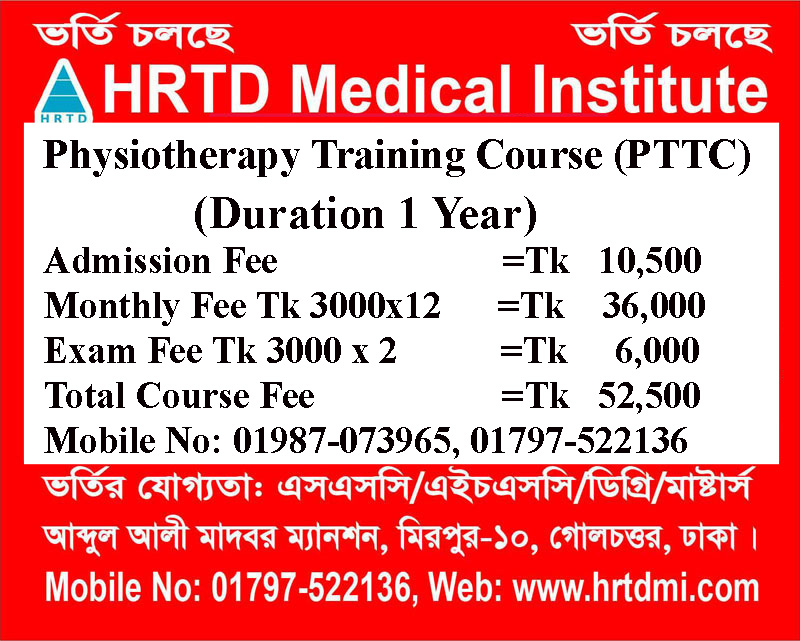
Physiotherapy Training Course (PTTC) 1 Year: Mobile No: 01969947171, 01987-073965, 01797-522136. This short course of Physiotherapy contains 10 subjects in 2 semesters. 1st Semester contains 5 subjects. The subjects are Human Anatomy & Physiology, Chemistry & Pharmacology, First Aid & Treatment, Hematology & Pathology, and the Study of OTC Drugs & Medicine.
2nd semester of this short physiotherapy course contains 5 subjects. The subjects are Orthopedic anatomy & Physiology, Neuroanatomy & Physiology, Cardiovascular Anatomy & Physiology, Electro Physics, and the Study of TENS.
Course Fee Summary:
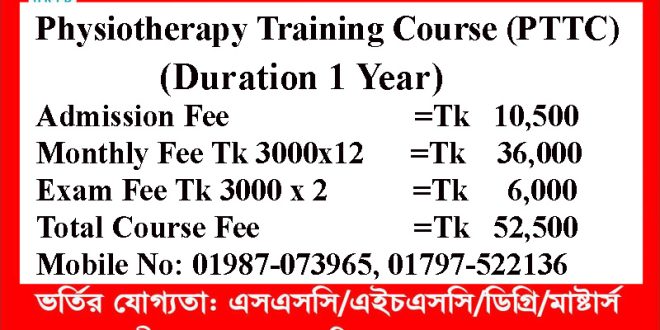
Course fee for 1 year Physiotherapy Training Course Tk 62,500/- including admission fee Tk 12,500/-, Monthly fee Tk 3500/- and exam fee Tk 3000×2 = 6000/-.
Our Others Course:
Pharmacy Course, Dental Course, Nursing Course, Pathology Course, Homeopathy Course, Veterinary Course, Village Doctor Course, PDT( Post Diploma Training) Course, PPT, LMAF Training Course, LMAFP Course, Poultry Course, DMA ( Diploma Medical Assistant), Diploma in Medicine and Surgery (DMDS).
HRTD Medical Institute, located in the heart of Dhaka, is proud to announce the launch of its Physiotherapy Training Center. With a commitment to providing quality healthcare education, the Institute is dedicated to producing skilled physiotherapists who can provide the best possible care to patients.
The Physiotherapy Training Center offers a comprehensive curriculum that covers all aspects of physiotherapy, including anatomy, physiology, biomechanics, manual therapy, exercise therapy, and rehabilitation. Our experienced and knowledgeable faculty members, who have years of experience in the field, will provide students with hands-on training and practical experience through clinical placements.
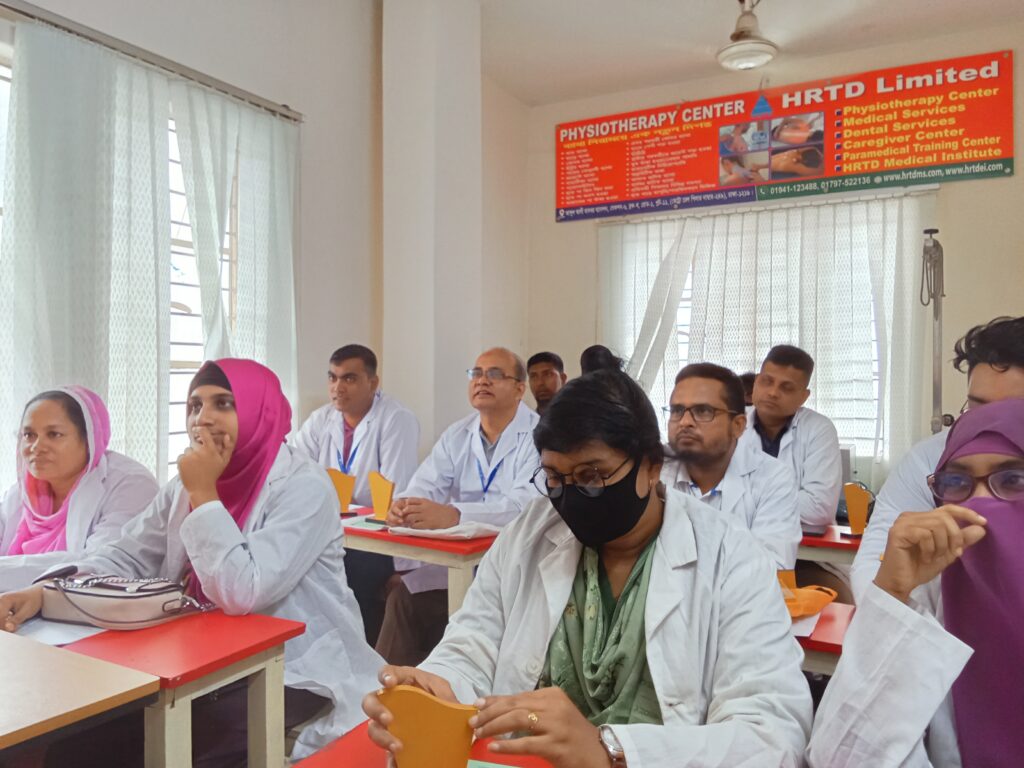
Our state-of-the-art facilities include well-equipped lecture halls, anatomy and physiology labs, and a clinical skills lab, where students can practice various physiotherapy techniques under the supervision of qualified instructors. Additionally, the Institute has established partnerships with leading healthcare organizations, allowing students to gain practical experience in real-world settings.
At the end of the program, graduates will be equipped with the knowledge and skills necessary to work as physiotherapists in a variety of settings, including hospitals, rehabilitation centers, sports clinics, and private practices. Our graduates will also be eligible to sit for the national licensure examination, which will allow them to practice physiotherapy in Bangladesh and abroad.
We believe that every patient deserves access to high-quality physiotherapy care, and it is our mission to produce physiotherapists who can provide that care. If you are interested in pursuing a career in physiotherapy and are looking for a comprehensive training program, we invite you to join us at HRTD Medical Institute’s Physiotherapy Training Center. Enroll now and take the first step towards a fulfilling career in healthcare.
Location of Physiotherapy Training Course
Location of Physiotherapy Training Course. Mobile Phone Number 01969947171, 01797522136, 01987073965. HRTD Medical Institute, Section-6, Block-Kha, Road-1, Plot-11, Metro Rail Piller No. 249, Mirpur-10 Golchattar, Dhaka-1216.
Objectives of Physiotherapy Course
একজন ফিজিওথেরাপিষ্ট এর পক্ষে একটি ফিজিওথেরাপী চেম্বার বা ফিজিওথেরাপী সেন্টার বা ফিজিওথেরাপী ক্লিনিক ম্যানেজ করা সম্ভব হয় না বা ম্যানেজ করা উচিৎ না । কারন সেখানে থাকে অনেক মেশিনারী এবং অনেক কাজ । যেমন মেশিনারী ম্যানেজমেন্ট, মার্কেটিং ম্যানেজমেন্ট, একাউন্টস ম্যানেজমেন্ট, ফিনেনশিয়াল ম্যানেজমেন্ট, রোগীদের ডেটা ম্যানেজমেন্ট, রোগীদের কাউন্সিলিং ইত্যাদি ।
ফিজিওথেরাপি কোর্স করার পর শিক্ষার্থীরা-
(১) ফিজিওথেরাপি সম্পর্কিত অনেক জ্ঞান ও দক্ষতা অর্জন করতে পারবে ।
(২) বিভিন্ন ফিজিওথেরাপি সরঞ্জাম এবং আনুষাঙ্গিক পরিচালনা এবং রক্ষণাবেক্ষণের জ্ঞান ও দক্ষতা অর্জন করতে পারবে ।
(৩) ফিজিওথেরাপি সম্পর্কিত প্রয়োজনীয় ডকুমেন্টেশন বজায় রাখার জ্ঞান ও দক্ষতা অর্জন করতে পারবে ।
(৪) ফিজিওথেরাপি যন্ত্রগুলি পরিচালনার বিপদ এবং তাদের প্রতিরক্ষামূলক জ্ঞান ও দক্ষতা অর্জন করতে পারবে ।
(৫) ফিজিওথেরাপিউটিক কার্যক্রম তদারকি জ্ঞান ও দক্ষতা অর্জন করতে পারবে ।
(৬) ফিজিওথেরাপিউটিক কার্যক্রমের ভবিষ্যত উন্নয়ন ও পরিকল্পনায় অবদান রাখাতে পারবে।
ফিজিওথেরাপি ১ বছরের কোর্স এ কি কি শেখানো হবে?
১ বছরের ফিজিওথেরাপি সার্টিফিকেট কোর্সে সাধারণত প্রাথমিক চিকিৎসা, মানবদেহের গঠন, এবং বিভিন্ন শারীরিক সমস্যা দূর করার কৌশল শেখানো হয়। মূল বিষয়গুলোর মধ্যে রয়েছে মানবদেহের অস্থি ও মাংসপেশির পরিচিতি (Anatomy), থেরাপিউটিক এক্সারসাইজ বা ব্যায়াম, ইলেক্ট্রোথেরাপির ব্যবহার, এবং প্যারালাইসিস, বাত ও আঘাতজনিত ব্যথার পুনর্বাসন কৌশল।
কোর্সটির সাধারণ পাঠ্যসূচি ও কারিকুলাম নিচে দেওয়া হলো:
- বেসিক অ্যানাটমি এবং ফিজিওলজি: মানবদেহের হাড়, জয়েন্ট বা জোড়া এবং মাংসপেশির প্রাথমিক ধারণা।
- ইলেক্ট্রোথেরাপি (Electrotherapy): বিভিন্ন মেশিনের সাহায্যে ব্যথা কমানোর কৌশল, যেমন- Short Wave Diathermy, TENS।
- এক্সারসাইজ থেরাপি (Exercise Therapy): বিভিন্ন শারীরিক সমস্যা, স্পোর্টস ইনজুরি ও স্ট্রোকের পর নড়াচড়া উন্নত করার ব্যায়াম।
- ম্যানুয়াল থেরাপি এবং ম্যাসাজ: হাত দিয়ে শরীরের বিভিন্ন অংশের আড়ষ্টতা ও জয়েন্টের ব্যথা কমানোর পদ্ধতি।
- পুনর্বাসন (Rehabilitation): হাঁটাচলার জন্য সহায়ক সামগ্রী (যেমন- ওয়াকার, ক্রাচ) ব্যবহারের নিয়মকানুন এবং দৈনন্দিন কাজের ট্রেনিং।
- প্রাথমিক চিকিৎসা এবং রোগীর যত্ন (First Aid): জরুরি অবস্থায় করণীয় ও পেশেন্ট হ্যান্ডলিং।
Hostel Facilities in HRTD Medical Institute for 1 Year Physiotherapy Training Course
Hostal & Meal Facilities
The Institute has hostel facilities for the students. Students can take a bed in the hostel.
Hostel Fee Tk 3000/- Per Month
Meal Charges Tk 3000/- Per Month. ( Approximately )
হোস্টাল ও খাবার সুবিধা
ইনস্টিটিউটে শিক্ষার্থীদের জন্য হোস্টেল সুবিধা রয়েছে। ছাত্ররা হোস্টেলে বিছানা নিতে পারে।
হোস্টেল ফি 3000/- টাকা প্রতি মাসে,
খাবারের চার্জ 3000/- টাকা প্রতি মাসে।(প্রায়)
Class Time for 1 Year Physiotherapy Training Course
Weekly Class 3 hours. For Regular Students Friday 1 hour, Saturday 1 hour, and Monday 1 hour. For Job holders, Friday is 3 hours, or Monday is 3 hours. Morning Shift 9:00 am to 12:00 pm, and Evening Shift 3:00 pm to 6:00 pm.
Teacher of 1 Year Physiotherapy Training Course
- Dr. Md. Sakulur Rahman, MBBS, CCD (BIRDEM), Course Director
- Dr. Sanjana Binte Ahmed, BDS, MPH, Assistant Course Director
- Dr. Tisha, MBBS, PGT Gyne, Assistant Course Director
- Dr. Suhana, MBBS, PGT Medicine
- Dr. Danial Hoque, MBBS, C-Card
- Dr. Tisha, MBBS
- Dr. Afrin Jahan, MBBS, PGT Medicine
- Dr. Ananna, MBBS
- Dr. Lamia Afroze, MBBS
- Dr. Amena Afroze Anu, MBBS, PGT Gyne, Assistant Course Director
- Dr. Farhana Antara, MBBS,
- Dr. Nazmun Nahar Juthi, BDS, PGT
- Dr. Farhana Sharna, MBBS
- Dr. Bushra, MBBS
- Dr. Turzo, MBBS
- Dr. Kamrunnahar Keya, BDS, PGT (Dhaka Dental College)
- Dr. Shamima, MBBS, PGT Gyne
- Dr. Alamin, MBBS
- Dr. Benzir Belal, MBBS
- Dr. Disha, MBBS
- Dr. Mahinul Islam, MBBS
- Dr. Tisha, MBBS, PGT Medicine
- Dr. Anika, MBBS, PGT
- Dr. Jannatul Ferdous, MBBS, PGT Gyne
- Dr. Jannatul Aman, MBBS, PGT
- Dr. Rayhan, BPT
- Dr. Abu Hurayra, BPT
- Dr. Sharmin Ankhi, MBBS, PGT Medicine
- Md. Monir Hossain, B Pharm, M Pharm
- Md. Monirul Islam, B Pharm, M Pharm
- Md. Feroj Ahmed, BSc Pathology, PDT Medicine
Subjects for 1 Year Physiotherapy Training Course
1st Semester Subject:
Human Anatomy & Physiology
Chemistry & Pharmacology
First Aid & Treatment
Hematology & Pathology
Orthopedic Anatomy & Physiology
2nd Semester Subject:
Neuro Anatomy & Physiology
Orthopedic Disease & Complication
Therapeutic Exercise
Electro Physics
Electrotherapy
Human Anatomy & Physiology for 1 Year Physiotherapy Training Course
Human Anatomy & Physiology is an important subject in physiotherapy courses. The study of Body Structure and its functions is Anatomy and Physiology. Here we discuss the systems of the Human Body and its Organs, Tissues, and Cells. The systems of the Human Body are the Nervous System, Digestive System, Respiratory System, Circulatory System or Cardiovascular System, Skeletal System, Muscular System, Endocrine System, Immune System, Lymphatic System, Integumentary System or Covering System, and Urinary System.
শারীরিক গঠন এবং এর কার্যাবলীর অধ্যয়ন হল অ্যানাটমি এবং ফিজিওলজি। এখানে আমরা মানবদেহের সিস্টেম এবং এর অঙ্গ, টিস্যু এবং কোষ নিয়ে আলোচনা করি। মানবদেহের সিস্টেমগুলি হ’ল হজম সিস্টেম, শ্বাসযন্ত্র, কার্ডিওভাসকুলার সিস্টেম, কঙ্কাল সিস্টেম, পেশীতন্ত্র, স্নায়ুতন্ত্র, এন্ডোক্রাইন সিস্টেম, ইমিউন সিস্টেম, লিম্ফ্যাটিক সিস্টেম, ইন্টিগুমেন্টারি সিস্টেম এবং ইউরিনারি সিস্টেম।
What is Anatomy & Physiology?
- Anatomy → Study of body structures (bones, muscles, organs, nerves, vessels, etc.).
- Physiology → Study of how these structures function and work together.
In physiotherapy, both are essential to understand movement, posture, exercise, and rehabilitation.
Major Systems to Study
1. Skeletal System (Bones & Joints)কঙ্কালতন্ত্র
কঙ্কালতন্ত্র হলো আমাদের শরীরের হাড়, সন্ধি (joints), তরুণাস্থি (cartilage) ও লিগামেন্টের (ligaments) সমন্বয়, যা শরীরকে কাঠামো দেয়, অঙ্গ-প্রত্যঙ্গকে রক্ষা করে এবং পেশির সাহায্যে নড়াচড়া সম্ভব করে।
- Structure & types of bones
- Spine, upper & lower limb bones
- Joints (synovial, cartilaginous, fibrous)
- Posture & alignment (important for physiotherapy exercises)
প্রধান উপাদান
- হাড় (Bones) → প্রাপ্তবয়স্ক মানুষের শরীরে মোট ২০৬টি হাড় আছে।
- তরুণাস্থি (Cartilage) → হাড়ের প্রান্তে থাকে, ঘর্ষণ কমায় এবং নড়াচড়ায় সাহায্য করে।
- সন্ধি (Joints) → হাড়গুলোর সংযোগস্থল, যা নড়াচড়া করতে সাহায্য করে।
- লিগামেন্ট (Ligaments) → হাড়কে হাড়ের সাথে যুক্ত করে।
ফিজিওথেরাপিতে গুরুত্ব
- হাড় ও সন্ধির নড়াচড়া বোঝা
- ভাঙা হাড় বা আথ্রাইটিস রোগীদের চিকিৎসা করা
- ভঙ্গি (Posture) ও চলাফেরার (Gait) সমস্যা নির্ণয় ও সমাধান
2. Muscular System-পেশী তন্ত্র
The muscular system is one of the most important systems studied in physiotherapy, because movement, posture, balance, and rehabilitation all depend on muscles.
- Types of muscles (skeletal, smooth, cardiac)
- Muscle structure & contraction (sliding filament theory)
- Major muscle groups (back, neck, upper limb, lower limb, trunk)
- Role in movement & exercise therapy
3. Nervous System
- Central nervous system (brain, spinal cord)
- Peripheral nerves (motor & sensory)
- Reflexes & coordination
- Neuroanatomy related to physiotherapy (stroke, spinal cord injury, neuropathy)
নার্ভাস সিস্টেম আমাদের দেহের চলন, সমন্বয়, ভারসাম্য, রিফ্লেক্স ও অনুভূতি নিয়ন্ত্রণ করে। ফিজিওথেরাপির জন্য নার্ভাস সিস্টেম ভালোভাবে জানা খুব জরুরি, কারণ প্রায় সব ধরনের পুনর্বাসন (rehabilitation) এ এর ভূমিকা রয়েছে।
ফিজিওথেরাপিতে নার্ভাস সিস্টেমের ভূমিকা
- মোটর কন্ট্রোল: মাংসপেশীর নড়াচড়া নিয়ন্ত্রণ করে।
- সেন্সরি ফিডব্যাক: স্পর্শ, ব্যথা, তাপমাত্রা ও দেহের অবস্থান (proprioception) বোঝায়।
- রিফ্লেক্স: যেমন হাঁটুতে হাতুড়ি মারলে পা নড়া।
- ভারসাম্য ও সমন্বয়: cerebellum এবং brain নিয়ন্ত্রণ করে।
- Neuroplasticity: মস্তিষ্ক ও স্নায়ুর পুনঃসংগঠন ক্ষমতা, যা স্ট্রোক বা নার্ভ ইনজুরিতে কাজে লাগে।
4. Cardiovascular System
- Heart structure & function
- Blood vessels, circulation
- Physiological basis of exercise & endurance training
- Vital signs (pulse, BP, heart rate monitoring in physiotherapy)
5. Respiratory System
- Lungs & airways
- Breathing mechanism
- Oxygen exchange & respiration
- Importance in chest physiotherapy & exercise tolerance
6. Digestive & Excretory Systems
- Nutrition & metabolism (important for energy in rehab)
- Kidney function & fluid balance
7. Endocrine System
- Hormones regulating metabolism, growth, healing
- Stress & exercise hormones
8. Integumentary System (Skin)
Pharmacology for 1 Year Physiotherapy Training Course
The study of Drugs and Medicine is called Pharmacology. Drugs are chemicals that can react with cells, tissues, and organs of the body. Here we discuss group-wise drugs and their medicines. Common Groups of Drugs are Pain Killer Drugs, Anti Ulcer Drugs, Anti Vomiting Drugs, Anti Viral Drugs, Laxative Drugs, Motility Drugs and Antimotility Drugs, Bronchodilator Drugs, Antibiotic Drugs, Anti Fungal Drugs, Anti Thrombotic Drugs, Anti Protozoal Drugs, Anthelmintic Drugs, Anti Hypertensive Drugs, Beta Blocker Drugs, Calcium Channel Blocker Drugs, ACE Inhibitor Drugs, Hemostatic Drugs, Analgesic Drugs, Antipyretic Drugs, Steroid Drugs, NSAID Drugs, CNS Drugs, Neuropathic Pain Keller Drugs, Spasmodic Drugs, etc.
ওষুধ ও ওষুধের অধ্যয়নকে ফার্মাকোলজি বলা হয়। এখানে আমরা ফার্মাকোলজি-১ এ গ্রুপভিত্তিক ওষুধ ও তাদের ওষুধ নিয়ে আলোচনা করেছি। ওষুধের সাধারণ গ্রুপগুলি হল পেইন কিলার ড্রাগস, অ্যান্টি আলসার ড্রাগস, অ্যান্টি-ভোমিটিং ড্রাগস, ল্যাক্সেটিভ ড্রাগস, মোটিলিটি ড্রাগস, অ্যান্টিমোটিলিটি ড্রাগস, ব্রঙ্কোডাইলেটর ড্রাগস, অ্যান্টিবায়োটিক ড্রাগস, অ্যান্টি ফাংগাল ড্রাগস, অ্যান্টি প্রোটোজোয়াল ড্রাগস, অ্যান্টি ভাইরাল ড্রাগস, অ্যান্টি-ভাইরাল ড্রাগস, অ্যান্টি-অ্যান্টিভেনস ড্রাগস। , বিটা ব্লকার ওষুধ, ক্যালসিয়াম চ্যানেল ব্লকার ড্রাগস, এসিই ইনহিবিটর ড্রাগস, হেমোস্ট্যাটিক ড্রাগস, অ্যানালজেসিক ড্রাগস, অ্যান্টিপাইরেটিক ড্রাগস, অ্যান্টি থ্রম্বোটিক ড্রাগস ইত্যাদি।
Pharmacology is the study of drugs—their actions, uses, side effects, and interactions.
For physiotherapists, understanding pharmacology helps in:
- Knowing how medications affect muscle function, mobility, and recovery.
- Identifying contraindications before therapy.
- Understanding pain management, inflammation control, and neurological effects.
First Aid for 1 Year Physiotherapy Training Course
First Aid is an important subject for all courses. It is very important for the Physiotherapy Training Course. Here we discuss Shock, Classifications of Shock, Causes of Shock, Stages of Shock, Clinical Features of Shock, Hypovolemic Shock, Cardiogenic Shock, Neurogenic Shock, Traumatic Shock, Burn Shock, Electric Shock, Psychogenic Shock, Anaphylactic Shock, First Aid of Shock, Management of Shock, First Aid of Cut, First of Snake Bite, First Aid of Accidental Injury, etc.
ফার্স্ট এইড মেডিসিন এবং সার্জারি কোর্সের ডিপ্লোমা, আরএমপি কোর্স, এলএমএএফ কোর্স, প্যারামেডিক্যাল কোর্স, ডিএমএ কোর্স, ডিএমএস কোর্স, নার্সিং কোর্স, ডেন্টাল কোর্স, প্যাথলজি কোর্স, ফিজিওথেরাপি কোর্স, কেয়ারগিভার কোর্স, ইত্যাদির জন্য একটি গুরুত্বপূর্ণ বিষয়। শক, শ্রেণিবিন্যাস শক, শকের কারণ, পর্যায় নিয়ে আলোচনা করুন শক, শকের ক্লিনিকাল বৈশিষ্ট্য, হাইপোভোলেমিক শক, কার্ডিওজেনিক শক, নিউরোজেনিক শক, ট্রমাটিক শক, বার্ন শক, বৈদ্যুতিক শক, সাইকোজেনিক শক, অ্যানাফিল্যাকটিক শক, শকের প্রাথমিক চিকিৎসা, কাটার প্রাথমিক চিকিৎসা, সাপের কামড়ের প্রাথমিক চিকিৎসা, প্রাথমিক চিকিৎসা দুর্ঘটনাজনিত আঘাত, ইত্যাদি
প্রথমিক চিকিৎসা (First Aid) হলো – যে কোনো দুর্ঘটনা বা অসুস্থতার পরপরই দ্রুত, সহজ ও প্রাথমিক চিকিৎসা দেওয়া হয় যাতে জীবন রক্ষা হয়, আঘাত না বাড়ে এবং আরোগ্য দ্রুত হয়।
ফিজিওথেরাপির জন্য ফার্স্ট এইডের গুরুত্ব অনেক বেশি, কারণ ফিজিওথেরাপিস্টরা রোগীর সাথে সরাসরি কাজ করেন, বিশেষ করে স্পোর্টস, এক্সারসাইজ, আউটডোর ও ক্লিনিকাল সেটিংসে জরুরি অবস্থা তৈরি হতে পারে।
ফিজিওথেরাপির জন্য ফার্স্ট এইডের গুরুত্ব
- জরুরি অবস্থায় জীবন রক্ষা
- চিকিৎসা আসার আগ পর্যন্ত CPR, শ্বাস-প্রশ্বাস নিয়ন্ত্রণ, রক্তপাত বন্ধ করা ইত্যাদি করে রোগীর জীবন বাঁচানো যায়।
- খেলাধুলা ও এক্সারসাইজ ইনজুরি ম্যানেজমেন্ট
- স্পোর্টস ফিজিওথেরাপিতে খেলোয়াড়দের মচকানো, টান ধরা, মাথায় আঘাত, হিট স্ট্রোক ইত্যাদির তাৎক্ষণিক সেবা দিতে হয়।
- হাসপাতাল ও ক্লিনিকে আকস্মিক সমস্যা
- থেরাপির সময় রোগীর মাথা ঘোরা, মূর্ছা যাওয়া, খিঁচুনি বা হার্ট অ্যাটাক হতে পারে। ফার্স্ট এইড জানা থাকলে দ্রুত ব্যবস্থা নেওয়া যায়।
- হাড় ভাঙা ও জয়েন্ট ডিসলোকেশন সামলানো
- ফিজিওথেরাপিস্টরা মুভমেন্ট, এক্সারসাইজ বা রিহ্যাবিলিটেশনের সময় রোগীর আঘাতের ঝুঁকি কমাতে ও প্রাথমিক চিকিৎসা দিতে পারেন।
- রোগীর আস্থা বৃদ্ধি
- রোগী ও খেলোয়াড়রা জানে যে ফিজিওথেরাপিস্ট ফার্স্ট এইড জানেন, এতে তাদের আত্মবিশ্বাস ও নিরাপত্তা বাড়ে।
- পেশাগত দায়িত্ব
- একজন ফিজিওথেরাপিস্ট শুধু রিহ্যাব নয়, বরং হেলথকেয়ার টিমের সদস্য। তাই প্রাথমিক চিকিৎসার জ্ঞান থাকা বাধ্যতামূলক।
Study of OTC Drugs for 1 Year Physiotherapy Training Course
OTC is the short form of over-the-counter. That is OTC Drugs are over-the-counter drugs. The study of OTC Drugs is important for Physiotherapy Courses. These Drugs can be sold or purchased without any prescription from Registered MBBS Doctors. These Drugs are Emergency and Safe for the patients. The study of OTC Drugs improves the quality of practice. Some OTC Drugs are Paracetamol, Albendazole, Ascorbic Acid, Calcium, Multivitamins, Vitamin B Complex, Omeprazole, Oral Rehydration Salt, Salbutamol, Mebendazole, Neomycin, Gentamycin, Bacitracin, etc.
ওটিসি ওষুধগুলি সমস্ত মেডিকেল কোর্স,ডিপ্লোমা মেডিকেল কোর্স, এলএমএএফ কোর্স এবং আরএমপি কোর্সের জন্য গুরুত্বপূর্ণ। ডিপ্লোমা ইন ফিজিওথেরাপির জন্যও এটি গুরুত্বপূর্ণ। এই OTC ওষুধগুলি নিবন্ধিত এমবিবিএস ডাক্তারদের কোনও প্রেসক্রিপশন ছাড়াই বিক্রি বা কেনা যায়। এই ওষুধগুলি জরুরী এবং রোগীদের জন্য নিরাপদ। ওটিসি ওষুধের অধ্যয়ন অনুশীলনের মান উন্নত করে। কিছু ওটিসি ওষুধ হল অ্যালবেনডাজল, অ্যাসকরবিক অ্যাসিড, ক্যালসিয়াম, মাল্টিভিটামিন, ভিটামিন বি কমপ্লেক্স, ওমেপ্রাজল, ওরাল রিহাইড্রেশন সল্ট, সালবুটামল ইত্যাদি।
OTC Drug কী?
OTC (Over The Counter) drugs হলো সেই সব ওষুধ, যেগুলো রোগীরা সরাসরি ফার্মেসি থেকে কিনতে পারে, ডাক্তারের প্রেসক্রিপশন ছাড়া।
ফিজিওথেরাপিতে OTC ওষুধের গুরুত্ব
ফিজিওথেরাপিস্টরা ওষুধ প্রেসক্রাইব করতে পারেন না (বেশিরভাগ দেশে), কিন্তু রোগীরা যে সাধারণ ওষুধ ব্যবহার করে থাকে, তা সম্পর্কে জ্ঞান থাকা জরুরি—
- রোগীর পেইন ম্যানেজমেন্ট
- সেশন চলাকালীন পার্শ্বপ্রতিক্রিয়া বুঝতে পারা
- রোগীকে সঠিকভাবে গাইড করা
OTC drugs যেমন – Pain relievers (Paracetamol, Ibuprofen), Topical gels, Antihistamines, Antacids, Vitamins – ফিজিওথেরাপি প্র্যাকটিসে খুব সাধারণ।ফিজিওথেরাপিস্টদের এগুলো সম্পর্কে ধারণা থাকতে হবে
Hematology and Pathology for 1 Year Physiotherapy Training Course
Hematology and Pathology are important subjects in medical science. The study of Blood is called Hematology and the Study of Pathos is called Pathology. In Hematology and Pathology, we discuss blood cells, their morphology and functions, Blood Diseases, Common Pathos and their pathogenesis, Atrophy, Hypertrophy, Metaplasia, Gangrene, Pathological Tests like TC, DC, ESR, Hemoglobin Percentage, etc.
রক্ত ও রক্তের রোগের অধ্যয়নকে বলা হয় হেমাটোলজি এবং স্টাডি অফ প্যাথোস এবং রোগ সৃষ্টি ও নির্ণয়ের প্রক্রিয়াকে প্যাথলজি বলা হয়। হেমাটোলজি এবং প্যাথলজিতে, আমরা রক্তের কোষ, তাদের গঠন এবং কার্যকারিতা, রক্তের রোগ, সাধারণ প্যাথোস এবং তাদের প্যাথোজেনেসিস, অ্যাট্রোফি, হাইপারট্রফি, মেটাপ্লাসিয়া, গ্যাংগ্রিন, প্যাথলজিকাল টেস্ট যেমন TC, DC, ESR, হিমোগ্লোবিন শতাংশ ইত্যাদি নিয়ে আলোচনা করি।
Hematology হলো রক্ত এবং রক্ত তৈরির অঙ্গ-প্রত্যঙ্গ (bone marrow, spleen, lymph nodes ইত্যাদি) সম্পর্কিত বিজ্ঞান। একজন physiotherapist-এর জন্য hematology জানা গুরুত্বপূর্ণ, কারণ রোগীর চিকিৎসা ও exercise plan করার সময় রক্তের অবস্থা ও রোগের প্রভাব বুঝতে হয়।
Therapeutic Exercise-1 for Physiotherapy Training Course
Exercise Therapies are discussed in Therapeutic Exercise. After completing Theory Classes, Practical Classes are done. Topics for Therapeutic Exercise-1 are Lever, Types of Lever, 1st Degree Lever, Pulley, Types of Pulley, Movable Pulley, Energy, Types of Energy, Kinetic Energy, Axis, Types of Axis, Plane, Types of Plane, Names of Shoulder Movement, Names of Hip Movement, Names of Wrist Movement, MCP Movement, Range of Motion of Elbow Joint, Muscle action, Types of Muscle action, Muscle work, Types of Muscle work, Types of Fundamental Position, Pelvic tilt, Types o Pelvic tilt, Relax Passive Movement, Indication of Relax Passive Movement, Contraindication of Relax Passive Movement.
ব্যায়াম থেরাপি থেরাপিউটিক ব্যায়াম আলোচনা করা হয়. থিওরি ক্লাস শেষ করার পর ব্যবহারিক ক্লাস করা হয়। থেরাপিউটিক এক্সারসাইজ-১-এর বিষয়গুলো হলো লিভার, লিভারের ধরন, ১ম ডিগ্রি লিভার, পুলি, পুলির প্রকার, চলনশীল পুলি, শক্তি, শক্তির প্রকার, গতিশক্তি, অক্ষ, অক্ষের প্রকার, সমতল, সমতলের ধরন, নাপুল। আন্দোলন, নিতম্ব আন্দোলনের নাম, কব্জির নড়াচড়ার নাম, MCP মুভমেন্ট, কনুই জয়েন্টের গতির পরিসর, পেশীর ক্রিয়া, পেশীর ক্রিয়ার ধরন, পেশীর কাজ, পেশীর কাজের ধরন, মৌলিক অবস্থানের ধরন, শ্রোণী কাত, পেলভিক কাত, শিথিলকরণ, নিষ্ক্রিয় গতির ধরন প্যাসিভ আন্দোলন শিথিল করুন, প্যাসিভ মুভমেন্ট শিথিল করার বিরোধীতা,
Types of skeletal muscle fibers, Clinical Examination of the Motor Nervous System, Clinical Examination of the Sensory Nervous System, Clinical Examination of Cranial Nerves, Clinical Examination of the Cardiovascular System, Measurement of the Pelvic Angle of Inclination, Factors affecting the Joint Range of Motion, Starting and Derived Positions, Suspension therapy, Advantage of Suspension therapy, Names of Suspension Instrument, Types of Suspension Therapy, etc.
কঙ্কালের পেশী তন্তুর ধরন, মোটর স্নায়ুতন্ত্রের ক্লিনিকাল পরীক্ষা, সংবেদনশীল স্নায়ুতন্ত্রের ক্লিনিকাল পরীক্ষা, ক্রানিয়াল স্নায়ুর ক্লিনিকাল পরীক্ষা, কার্ডিওভাসকুলার সিস্টেমের ক্লিনিক্যাল পরীক্ষা, পেলভিক প্রবণতার কোণ পরিমাপ, জোড়ের সীমাকে প্রভাবিত করার কারণগুলি , শুরু এবং প্রাপ্ত অবস্থান, সাসপেনশন থেরাপি, সাসপেনশন থেরাপির সুবিধা, সাসপেনশন যন্ত্রের নাম, সাসপেনশন থেরাপির প্রকারভেদ ইত্যাদি।
Electro Therapy for 1 Year Physiotherapy Training Course
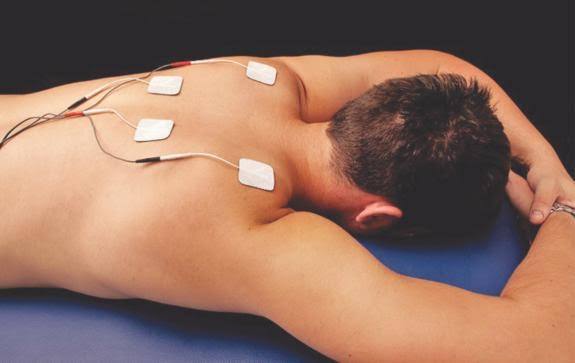
Electrotherapy uses electrical currents for medical treatment, primarily to relieve pain, reduce inflammation, and stimulate muscles, commonly seen in physiotherapy with devices like TENS or NMES, but also extends to psychiatric uses like Electroconvulsive Therapy (ECT) for severe mood disorders, and even cosmetic treatments for skin. It works by applying electrical energy to tissues, affecting nerve signals or muscle contractions for therapeutic effects, often complementing other active therapies for better results.
Common Types & Uses:
- Transcutaneous Electrical Nerve Stimulation (TENS): Mild currents through skin pads to block pain signals (gate control theory).
- Neuromuscular Electrical Stimulation (NMES): Stronger currents to contract muscles, preventing atrophy, retraining muscles after injury, or improving strength.
- Interferential Current (IFC): Uses two currents for deeper pain relief and increased circulation.
- Electroconvulsive Therapy (ECT): Controlled electric seizure for severe depression, bipolar disorder, or catatonia, when other treatments fail.
- Galvanic Current (Cosmetic): Uses direct current for skin cleansing (desincrustation) and nourishing (iontophoresis) to improve skin conditions like aging or acne.
How it Works (General):
- Pain Relief: Interrupts pain signals or triggers endorphin release.
- Muscle Rehab: Stimulates nerve & muscle fibers, improving tone, strength, or re-education.
- Healing: Can accelerate healing and reduce swelling by improving local circulation.
Key Considerations:
Skilled Application: Effectiveness depends on the therapist choosing the right type, intensity, and duration for the individual.
Not a Replacement: Best when combined with exercise and manual therapy, not as a standalone solution.
Neuro Anatomy-1 & 2 for Physiotherapy Course
Neuroanatomy is a specialized branch of anatomy that deals with the brain, spinal cord, cranial nerves, and spinal nerves. Anatomy of the brain, the function of the brain, lobes, and segments of the brain, functions of different lobes and segments of the brain, anatomy of the spinal cord, functions of the spinal cord, anatomy of cranial nerves, functions of cranial nerves, anatomy of spinal nerves and functions of spinal nerves, autonomic nervous system, functions of the autonomic nervous system, etc.
Microbiology for Physiotherapy Course
Definition (সংজ্ঞা):
Microbiology হলো জীববিজ্ঞানের একটি শাখা, যা ক্ষুদ্র জীব (Microorganisms) যেমন ব্যাকটেরিয়া, ভাইরাস, ফাঙ্গাস, প্রোটোজোয়া ও এলগোর জীবন, গঠন, বৃদ্ধি ও রোগের কারণ নিয়ে আলোচনা করে।
ফিজিওথেরাপিতে এটি গুরুত্বপূর্ণ কারণ রোগীর infection control, hygiene এবং safe therapy environment নিশ্চিত করতে হয়।
Importance in Physiotherapy (ফিজিওথেরাপিতে গুরুত্ব)
- রোগীর infection prevention এবং cross-infection control শেখা
- Hospital environment ও equipments পরিষ্কার রাখার নিয়ম বোঝা
- রোগীর immune status অনুযায়ী therapy পরিকল্পনা করা
- Wound care এবং post-operative infection prevention
- Communicable disease (যেমন TB, Hepatitis, COVID-19) সম্পর্কে সচেতনতা
Basic Microorganisms (মূল জীবাণুসমূহ):
1️⃣ Bacteria (ব্যাকটেরিয়া)
- সাইজ: 1–5 μm
- Shapes: Cocci (round), Bacilli (rod), Spirilla (spiral)
- Disease examples: TB, Staphylococcus infection, UTI
- Physiotherapy relevance: Infection prevention, hygien
Viruses (ভাইরাস)
- Size: 20–300 nm
- Require host cell to replicate
- Disease examples: Hepatitis, HIV, Influenza
- Physiotherapy relevance: Isolation, PPE usage
Protozoa (প্রোটোজোয়া)
- Single-celled eukaryotes
- Disease examples: Malaria, Amoebiasis
- Physiotherapy relevance: Patient care in endemic area
Prions
- Infectious protein particles
- Cause neurological disorders
- Rare, but important for safety awareness
infection Control in Physiotherapy:
- Hand hygiene (সঠিকভাবে হাত ধোয়া)
- Use of PPE (Gloves, Mask, Gown)
- Equipment disinfection
- Sterile technique during wound care
- Isolation of infectious patients
- Safe disposal of contaminated materials
Clinical Relevance:
- Prevention of hospital-acquired infection (HAI)
- Safe management of post-surgical patients
- Respiratory therapy & hygiene
- Skin care in immobile or bed-ridden patients
- Knowledge of pathogen transmission routes (Airborne, Contact, Droplet)
Orthopedic Medicine for 1 Year Physiotherapy Training Course
1. Introduction
Orthopedic Medicine is a branch of medical science that deals with the diagnosis, treatment, prevention, and rehabilitation of disorders related to the bones, joints, muscles, tendons, and ligaments.
For physiotherapy students, it forms the foundation for understanding musculoskeletal problems and applying proper manual therapy, exercise, and rehabilitation techniques.
2. Importance in Physiotherapy
Physiotherapists play a vital role in:
- Assessing musculoskeletal injuries and disorders
- Planning and implementing rehabilitation programs
- Restoring movement, strength, and function
- Reducing pain and preventing re-injury
3. Main Topics Covered
A. Introduction to Orthopedics
- Definition and scope
- Common orthopedic terms
- Role of physiotherapy in orthopedics
B. Anatomy & Physiology Review
- Bones, joints, muscles, ligaments
- Types of joints and movements
- Healing processes of bone and soft tissue
C. Common Orthopedic Conditions
- Fractures – types, healing, physiotherapy management
- Dislocations and Subluxations
- Sprains and Strains
- Arthritis (Osteoarthritis, Rheumatoid arthritis)
- Low Back Pain & Sciatica
- Scoliosis and Kyphosis
- Cervical and Lumbar Spondylosis
- Sports Injuries (ACL tear, Tennis elbow, etc.)
- Postural deformities
- D. Orthopedic Assessment
- History taking
- Inspection, palpation, movement testing
- Special orthopedic tests
- X-ray and imaging interpretation basics
E. Physiotherapy Management
- Exercise therapy (ROM, strengthening, stretching)
- Manual therapy & mobilization
- Electrotherapy modalities
- Hydrotherapy
- Ergonomic and postural education
- Rehabilitation after surgery (joint replacement, fracture fixation, etc.)
F. Orthopedic Appliances
- Splints, braces, supports, crutches, and traction
- Role of physiotherapist in their use and care
4. Learning Outcomes
After completing this subject, a student should be able to:
- Identify and assess orthopedic conditions
- Plan physiotherapy treatment programs
- Apply evidence-based rehabilitation methods
- Communicate effectively with orthopedic doctors and patients
5. Related Practical Sessions
- Demonstration of fracture immobilization
- Gait analysis and crutch training
- Joint mobilization techniques
- Postoperative rehabilitation protocols
3. Orthopedic Pathology and Healing
- Inflammation and tissue repair
- Fracture: definition, types, stages of healing
- Delayed and non-union fractures
- Bone infections (Osteomyelitis, Septic arthritis)
- Degenerative joint disease (Osteoarthritis)
- Rheumatoid and autoimmune joint diseases
4. Common Orthopedic Conditions
- Fractures – upper and lower limb fractures, spine fractures
- Dislocations and subluxations – shoulder, hip, knee, patella
- Sprains and strains – mechanism, symptoms, management
- Soft tissue injuries – tendinitis, bursitis, ligament tear
- Back and neck pain – causes and physiotherapy management
5. Orthopedic Assessment Techniques
- Patient history taking
- Observation and palpation methods
- Measurement of limb length, girth, ROM (Range of Motion)
- Manual muscle testing
- Special orthopedic tests (e.g., Lachman’s, Drawer test, Neer’s test, etc.)
- Use of diagnostic aids (X-rays, CT, MRI – basic interpretation)
6. Orthopedic Appliances & Aids
- Plaster of Paris (POP) – application and care
- Splints, braces, and orthoses
- Walking aids – crutches, cane, walker
- Principles of traction (manual, skin, skeletal)
- Role of physiotherapist in their application
7. Physiotherapy Management in Common Orthopedic Problems
- Acute phase management (pain relief, swelling reduction)
- Subacute and chronic stage management (exercise, mobilization)
- Use of physical agents – heat, cold, ultrasound, TENS
- Posture correction and ergonomic advice
Cardiovascular Anatomy for 1 Year Physiotherapy Training Course
1. Introduction
The cardiovascular system (also called the circulatory system) consists of the heart, blood vessels, and blood.
It is responsible for transporting oxygen, nutrients, hormones, and removing waste products from body tissues.
In physiotherapy, understanding this system helps in cardiac rehabilitation, exercise prescription, and patient monitoring.
2. Major Components
A. The Heart
- Location: In the thoracic cavity, between the lungs (in the mediastinum).
- Size: About the size of a closed fist.
- Layers of the Heart Wall:
- Epicardium – Outer protective layer.
- Myocardium – Muscular middle layer responsible for contraction.
- Endocardium – Inner lining of the heart chambers.
Chambers of the Heart
- Right Atrium – Receives deoxygenated blood from the body.
- Right Ventricle – Pumps deoxygenated blood to the lungs.
- Left Atrium – Receives oxygenated blood from the lungs.
- Left Ventricle – Pumps oxygenated blood to the body (most powerful chamber).
Valves of the Heart
- Atrioventricular (AV) Valves:
- Tricuspid (Right side)
- Bicuspid or Mitral (Left side)
- Semilunar Valves:
- Pulmonary valve
- Aortic valve
These valves prevent backflow of blood.
3. Blood Vessels
Types of Blood Vessels:
- Arteries – Carry blood away from the heart (usually oxygenated).
- Arterioles – Small branches of arteries leading to capillaries.
- Capillaries – Microscopic vessels for exchange of gases and nutrients.
- Venules – Collect blood from capillaries.
- Veins – Carry blood toward the heart (usually deoxygenated).
Major Blood Vessels:
- Aorta – Main artery supplying oxygenated blood to the body.
- Pulmonary arteries – Carry deoxygenated blood to the lungs.
- Pulmonary veins – Carry oxygenated blood to the heart.
- Superior & Inferior vena cava – Bring deoxygenated blood to the right atrium.
4. Blood Circulation
A. Pulmonary Circulation
- Path: Right ventricle → Pulmonary artery → Lungs → Pulmonary veins → Left atrium
Purpose: Exchange of gases (adds O₂, removes CO₂).
B. Systemic Circulation
- Path: Left ventricle → Aorta → Body tissues → Veins → Right atrium
Purpose: Supplies oxygen and nutrients to body tissues.
5. Conduction System of the Heart
- SA Node (Sinoatrial node) – Pacemaker; initiates heartbeat.
- AV Node (Atrioventricular node) – Delays signal for proper filling.
- Bundle of His
- Right and Left Bundle Branches
- Purkinje Fibers – Spread impulse to ventricles → contraction.
6. Physiotherapy Relevance
- Understanding heart rate, blood pressure, and cardiac output is vital in:
- Cardiac rehabilitation
- Exercise therapy
- Monitoring circulatory response to exercise
- Detecting circulatory abnormalities
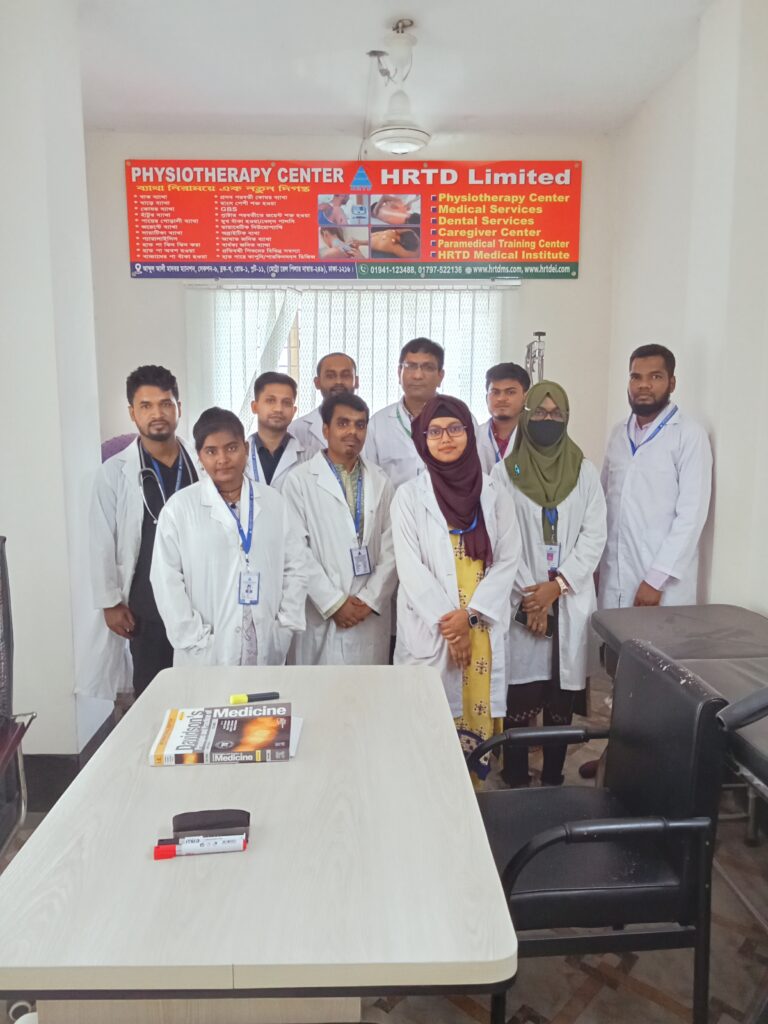
Practicle Class for 1 Year Physiotherapy Training Course
Manual /Exercise Therapy :
Surface Anatomy & basic assessment , AROM, PROM, AAROM , Muscle Power testing , Basic Stretching and positioning
Electro therapy
Electroduction to electro therapy instruments. Safety, Contraindication, TENS : Applied & Parameter
Manual Practicle Class in Surface Anatomy & basic assessment
Surface anatomy is the study of external bodily features used by physiotherapists to locate underlying muscles, bones, and joints. Mastery of palpation and visual landmarks enables clinicians to accurately perform physical examinations, identify painful structures, and safely guide therapeutic interventions like joint mobilizations and massage.
1. Palpation Techniques
Palpation is the cornerstone of a physiotherapy assessment. Use the pads of your index, middle, and ring fingers rather than your fingertips.
- Tissue Differentiation: Bones are firm and rigid. Tendons feel like tight, taut cords. Ligaments are dense, tough bands. Muscle bellies are softer and yield to pressure.
- Guidelines: Ensure your peer/model is in a relaxed position. Visualize the underlying structure in your mind before applying pressure, and start with light touch to assess skin temperature and texture before pressing deeply to locate bone or tissue.
2. Key Anatomical Landmarks
Familiarity with bony and soft-tissue landmarks allows you to identify spinal segments and joint lines quickly:
Spine
- C7 (Vertebra Prominens): Located at the base of the neck. It is the most prominent spinous process when the neck is flexed.
- T3 Spinous Process: Aligned with the medial root of the spine of the scapula.
- T7 Spinous Process: Aligned with the inferior angle of the scapula.
- L4 Spinous Process: Found by drawing a horizontal line across the highest points of the iliac crests (supracristal plane). This is the key landmark for lumbar spine levels.
- Posterior Superior Iliac Spine (PSIS): Visible as dimples of Venus; directly over the S2 sacral segment.
Upper Limb
- Acromion Process: The bony peak at the top of the shoulder.
- Greater Tubercle of the Humerus: Palpated just inferior and lateral to the acromion; this is where the rotator cuff tendons insert.
- Medial and Lateral Epicondyles: The prominent bony bumps on either side of the distal humerus at the elbow.
Lower Limb
- Greater Trochanter: The large, palpable bony prominence on the lateral side of the proximal thigh/hip.
- Tibial Tuberosity: The bony knob just below the patella (kneecap); serves as the attachment point for the patellar ligament.
- Medial and Lateral Malleolus: The distinct bony bumps that form the ankle joint on either side.
3. Basic Bedside Assessment Flow
Always correlate palpation with functional tests to ensure a comprehensive evaluation:
- Observation: Visually inspect for swelling, redness, muscle atrophy, or postural asymmetry.
- Active Range of Motion (AROM): Ask the patient to move the joint voluntarily through available motions. Note restrictions or compensatory movements.
- Passive Range of Motion (PROM): Move the joint for the patient to feel for joint end-feels and overall flexibility.
- Resisted Isometric Movements: Have the patient hold a contraction against your resistance in a neutral position. This isolates specific muscles and tendons to check for strength or pain.
- Special Tests: Perform standardized clinical tests (e.g., empty can test, Lachman’s test) to confirm specific joint or ligament pathologies.
Manual Practicle Class in AROM, PROM, AAROM
In physiotherapy, AROM (Active Range of Motion), PROM (Passive Range of Motion), and AAROM (Active-Assisted Range of Motion) are foundational clinical assessments and interventions. Understanding when and how to apply each is critical for evaluating joint health, muscle strength, and rehabilitation progress.
1. Active Range of Motion (AROM)
- What it is: The patient moves the joint entirely through their own muscle contraction without any outside assistance.
- Practical Purpose: Assesses the patient’s willingness to move, muscle strength, coordination, and the presence of pain during voluntary movement.
- Clinical Tip: Always observe AROM before PROM. If a patient can perform full AROM comfortably, you rarely need to perform PROM.
2. Passive Range of Motion (PROM)
- What it is: The therapist (or an external mechanical device) moves the joint entirely for the patient. The patient’s muscles remain completely relaxed.
- Practical Purpose: Assesses “end-feel” (the barrier at the end of a movement, e.g., bone-on-bone, tissue stretch). It is used as a treatment to prevent joint stiffness, contractures, and to maintain circulation in paralyzed or comatose patients.
- Clinical Tip: PROM is typically greater than AROM because the muscles controlling the joint are not actively resisting the stretch.
3. Active-Assisted Range of Motion (AAROM)
- What it is: The joint receives partial assistance from an outside force (the therapist, equipment like a pulley/towel, or gravity) because the patient’s muscles are too weak to complete the movement alone.
- Practical Purpose: Used during the early stages of rehabilitation (e.g., post-surgery or after an acute injury) to help patients safely regain strength and mobility without overloading the healing tissues.
- Clinical Tip: The therapist should only provide the exact amount of assistance needed—encourage the patient to use their own active contraction as much as safely possible.
Key Differences at a Glance
| Feature | AROM | AAROM | PROM |
|---|---|---|---|
| Muscle Contraction | Active & unassisted | Active, but partially assisted | None (completely passive) |
| Primary Goal | Assess muscle strength, motor control | Begin strengthening & safely restore mobility | Assess end-feel & prevent joint contractures |
| Level of Assistance | Zero | Partial | Total (external force) |
For comprehensive guides and techniques, consult the Physiopedia Range of Motion reference.
If you are preparing for a specific practical exam, let me know:
- Which joint you will be testing (e.g., shoulder, knee, ankle)
- What specific conditions you are studying (e.g., stroke, frozen shoulder, post-op fracture)
Manual Practicle Class in Muscle Power testing
Manual Muscle Testing (MMT) is a standardized physiotherapy assessment used to evaluate muscle strength and pinpoint neuromuscular deficits. The examiner grades the muscle’s ability to contract against gravity and manual resistance on a standardized 0–5 scale. Testing involves careful positioning, stabilization, and palpation to prevent compensatory movements.
The Oxford / MRC Grading Scale
This classic grading system helps document, differentiate, and track patient progress over time:
- 5 (Normal): The muscle can complete the full range of motion (ROM) against gravity and withstand maximal manual resistance.
- 4 (Good): The muscle completes full ROM against gravity and moderate resistance.
- 3 (Fair): The muscle completes full ROM against gravity but cannot tolerate any added manual resistance.
- 2 (Poor): The muscle can only complete full ROM if gravity is eliminated (e.g., sliding the limb horizontally on a smooth surface).
- 1 (Trace): No joint movement occurs, but the examiner can palpate or visibly see a muscle flicker/contraction.
- 0 (Zero): No muscle contraction is observed or palpated.
Practical Examination Protocol
When executing MMT in a practical setting, follow these step-by-step procedures to ensure validity:
- Test the Unaffected Side First: Always establish the patient’s personal baseline by testing the healthy limb first. This allows them to understand the expected movement.
- Proper Positioning: Ensure the patient is in the correct starting posture and that the tested body segment is appropriately draped and exposed.
- Stabilization: Manually stabilize the body part proximal to the joint being tested. This isolates the target muscle and prevents the patient from “cheating” with stronger neighboring muscles.
- Determine Gravity: Decide if you are testing in an anti-gravity position (Grades 3–5) or a gravity-eliminated position (Grades 0–2).
- Apply Resistance: Instruct the patient to perform the full active ROM. Apply smooth, gradually increasing manual resistance in the opposite direction of the muscle’s pull at the distal end of the limb (avoid jerking).
- Watch for Substitution: Closely observe for compensatory movements or the use of synergistic muscles.
Key Clinical Considerations
- Documentation: Use exact notation. For example, 3+ indicates the patient can hold the test position against slight pressure.
- Pain vs. Weakness: Pain can inhibit muscle activation. If pain limits movement, document that the strength could not be fully assessed due to discomfort, rather than immediately marking it as motor weakness.
If you want to practice specific joints, tell me:
Are you looking for the testing protocol for specific muscles (like the biceps, quadriceps, or deltoid)?
Which region of the body are you testing (e.g., upper limb, lower limb, spine)?
Manual Practicle Class in Basic Stretching and positioning
Physiotherapy stretching and positioning rely on proper alignment, joint stabilization, and controlled intensity to elongate soft tissues safely. Core practical techniques typically involve static holds, PNF (Proprioceptive Neuromuscular Facilitation), and custom patient positioning to maximize muscle relaxation and improve joint mobility.
1. Core Principles of Stretching
- Stabilization: Always stabilize the proximal (nearest to the center of the body) joint to isolate the target muscle and prevent compensation.
- Intensity & Pain: Intensity should be low to moderate. The stretch should feel like a gentle tension; never stretch to the point of sharp pain.
- Duration: Hold stretches for 20 to 30 seconds. Repeat the process 3 to 4 times for optimal tissue elongation.
- Breathing: Instruct the patient to exhale deeply during the stretch to prevent the muscle from guarding or tensing up.
2. Common Practical Techniques
- Static Stretching: Manually moving a joint to the end of its range and holding the position with no extra external force.
- PNF (Contract-Relax): Move the limb to the point of limitation, ask the patient to isometrically contract the target muscle for 5–6 seconds against resistance, relax the muscle, and then gently stretch it further into the new range.
- Passive vs. Active Stretching: Passive involves the therapist or a device moving the limb, whereas active uses the patient’s own opposing muscles.
3. Patient Positioning for Common Target Areas
- Hamstrings: Position the patient supine (lying on their back). Stabilize the pelvis, keep the knee fully extended, and flex the hip until a stretch is felt in the back of the thigh.
- Calves (Gastrocnemius): With the patient supine or sitting, support the leg, cup the heel, and gently push the ball of the foot upward toward the patient’s shin (dorsiflexion) with the knee straight.
- Neck / Trapezius: Position the patient seated or supine. Stabilize the shoulder, and gently tilt the head to the opposite side (bringing the ear toward the shoulder).
- Lumbar Spine (Open Book): Position the patient side-lying with hips and knees flexed at 90 degrees. Have them rotate their top arm and upper torso backwards to create a gentle mid-back stretch.
Always ensure your patient warms up for 5–10 minutes with light movements before beginning any intensive flexibility protocols. You can review detailed guides and safety tips on clinical execution via the Mayo Clinic Stretching Guide.
Practicle Class in Electroduction to electro therapy instruments
Electrotherapy in physiotherapy utilizes controlled electrical, thermal, and mechanical energies to relieve pain, promote tissue healing, and re-educate muscles. Its practical application requires proper patient evaluation, precise machine calibration, electrode placement, and strict adherence to safety guidelines.
1. Low and Medium Frequency Currents
These currents stimulate motor and sensory nerves to modulate pain and induce muscle contractions.
- TENS (Transcutaneous Electrical Nerve Stimulation): Primarily used for pain relief.
- Placement: Directly over or around the site of pain, along dermatomes, or over trigger points.
- Settings: High frequency (e.g., 80-120 Hz) for Gate Control theory; Low frequency (e.g., 2-10 Hz) for endogenous opioid release.
- NMES / EMS (Neuromuscular/Electrical Muscle Stimulation): Used for muscle strengthening and preventing atrophy.
- Placement: Over the motor points of the targeted muscle belly.
- Settings: Adjust pulse width and intensity to comfortably elicit a visible muscle contraction.
- IFT (Interferential Therapy): Utilizes two crossing medium-frequency currents to produce a deep, low-frequency effect. Great for deep tissue pain.
2. High Frequency / Deep Heating Modalities
These modalities convert high-frequency electrical energy into deep tissue heat (diathermy) to increase circulation and reduce joint stiffness.
- Shortwave Diathermy (SWD): Delivers continuous or pulsed high-frequency waves (usually 27.12 MHz) via capacitor or inductor electrodes.
- Procedure: Ensure no metallic jewelry is worn, maintain an even air gap with towels (for condenser pads), and verify the patient reports a mild, comfortable warmth.
- Ultrasound Therapy: Employs high-frequency acoustic sound waves (1 MHz or 3 MHz) for deep tissue healing and reducing soft tissue inflammation.
- Procedure: A coupling medium (gel) is mandatory. Keep the sound head moving constantly to prevent the generation of “hot spots” and potential periosteal burns.
3. Practical Setup and Safety Workflow
Always execute these steps systematically to ensure an effective, safe physiotherapy practical:
- Patient Screening: Identify the presence of any contraindications (e.g., pacemakers, malignancies, open wounds, pregnancy, impaired sensation).
- Skin Preparation: Clean the skin with alcohol to reduce impedance and remove oils.
- Electrode Application: Ensure electrode pads have uniform adhesion, use wet sponges for reusable electrodes, and secure them firmly with straps.
- Parameter Setting: Double-check frequency, intensity, and treatment time based on the patient’s goal.
- Patient Monitoring: Check sensory perception before raising the current. Observe the patient and ask for feedback throughout the treatment.
- Documentation: Record parameters, treatment duration, and patient response post-session.
Practicle Class in Safety, Contraindication
In physiotherapy practice, absolute contraindications—conditions where treatment must never be performed—include active deep vein thrombosis (DVT), acute fractures, pacemakers (for electrotherapy), and malignant tumors. Always review a patient’s medical history thoroughly to avoid serious adverse events and ensure patient safety.
Review these essential guidelines for safe clinical practice:
🛑 Absolute Contraindications (Never Apply)
- DVT or Thrombosis: Avoid massage or deep tissue manipulation due to the risk of dislodging blood clots.
- Pacemakers & Defibrillators: Never apply electrophysical agents (e.g., TENS, ultrasound, electrical stimulation) near these devices.
- Malignancy: Avoid heat therapy or deep massage over active tumors, as increased circulation can potentially promote cancer cell spread.
- Pregnancy: Avoid deep heat modalities and electrical stimulation near the pelvic and lower back regions during pregnancy.
Relative Contraindications (Require Modifications)
- Impaired Sensation: Proceed with caution during heat, cold, or electrical treatments, as patients cannot provide normal pain or temperature feedback.
- Osteoporosis & Fractures: Avoid high-force mobilizations or aggressive resisted exercises; modify techniques to match bone fragility.
- Infection or Open Wounds: Prevent the spread of infection by avoiding massage or modality application directly over broken skin or acutely inflamed joints.
✔️ Universal Safety Protocols
- Supervision: Never leave a patient unattended while they are hooked up to electrotherapy devices or electrical muscle stimulators (EMS).
- Patient Feedback: Continuously monitor the patient’s vitals (blood pressure, heart rate) and pain levels during active and passive therapy sessions.
Practicle Class in TENS : Applied & Parameter
Transcutaneous Electrical Nerve Stimulation (TENS) is a non-invasive physiotherapy modality used to manage acute and chronic pain. It delivers low-voltage electrical currents through skin electrodes to block pain signals (Gate Control Theory) and stimulate the release of natural painkillers like endorphins.
For physiotherapy practicle, mastering the three primary stimulation parameters—Frequency, Pulse Duration (Width), and Intensity (Amplitude)—is essential. The settings dictate the physiological response and must be tailored to the patient’s pain presentation.
1. Conventional TENS (High-Frequency TENS)
- Goal: To block pain signals via the Gate Control Theory, producing a comfortable, tingling sensation without muscle contraction.
- Frequency (Pulse Rate): 80 to 150 Hz
- Pulse Duration: 50 to 100 μs (microseconds)
- Intensity: Low amplitude. Adjusted to a strong but comfortable “pins and needles” sensation without motor response.
- Application: Acute pain, postoperative pain, and to desensitize an area before therapeutic exercise.
2. Acupuncture-Like TENS (Low-Frequency TENS / AL-TENS)
- Goal: To trigger the release of endogenous opioids (endorphins) and promote descending pain inhibition.
- Frequency: 1 to 4 Hz
- Pulse Duration: 150 to 250 μs
- Intensity: High amplitude. Adjusted to a level that causes visible, rhythmic muscle twitches.
- Application: Chronic musculoskeletal pain or deep, aching pain.
3. Burst TENS
- Goal: Combines the benefits of Conventional and AL-TENS for patients who experience nerve accommodation.
- Frequency: High-frequency pulses delivered in bursts (usually 1 to 3 bursts per second).
- Pulse Duration: 100 to 300 μs
- Intensity: Moderate, producing a comfortable sensory or slight motor response.
- Application: Chronic pain and conditions where longer-lasting narcotic-like relief is desired.
Practical Application Steps
- Skin Preparation: Clean the skin with soap and water or an alcohol swab. Trim excess hair if necessary to ensure good pad adhesion and reduce electrical resistance.
- Electrode Placement: Place electrodes 2 to 5 cm apart. Common placements include directly over the painful site, surrounding the pain (“bracket placement”), or along the corresponding dermatome or motor point.
- Parameter Setup: Turn the machine off, connect the lead wires to the pads, and select the desired mode (e.g., Conventional). Set the frequency and duration first.
- Intensity Adjustment: Turn the intensity dial slowly and instruct the patient to let you know as soon as they feel the current. Slowly increase until it reaches their tolerance (e.g., strong but comfortable paraesthesia).
- Duration: Treat for 20 to 60 minutes. Check skin under the electrodes post-treatment for signs of irritation.
- Contraindications: Never apply TENS over pacemakers, active malignancies, broken skin, areas of impaired sensation, or the anterior neck/carotid sinus. Use caution during early pregnancy.