 HRTD Medical Institute


Pediatric Course (Post-Diploma Training) Details
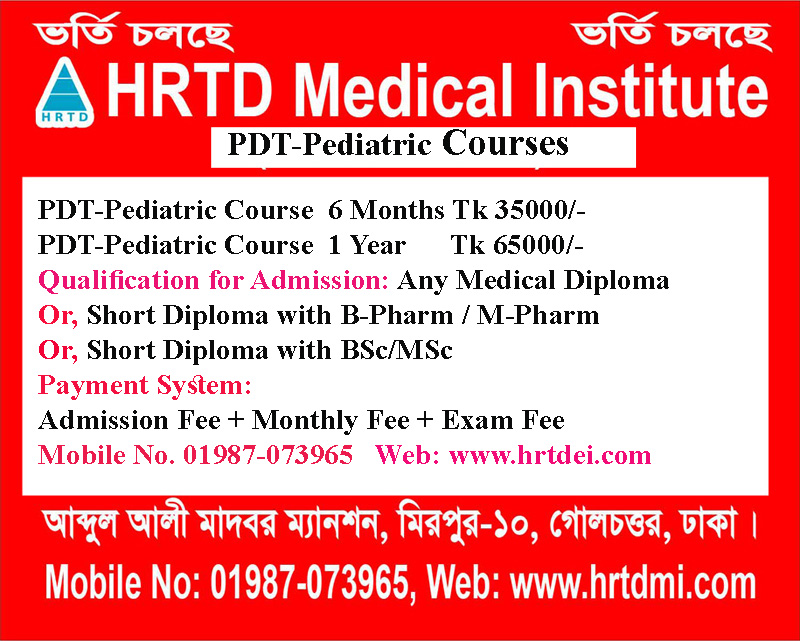
Pediatrics Course. Mobile No. 01969947171, 01987-073965, 01797-522136. These Pediatric Courses are 6-month PDT-Pediatrics Course, 1-Year PDT-Pediatrics Course, and 2-Year PDT-Pediatrics Course. 6 Month PDT Pediatrics course Fee is Tk 35500/-, 1 Year PDT Pediatrics Course Fee is Tk 70500/-, and 2 Years PDT Pediatrics Course Fee Tk 130500/-. Each Semester of 6 Months contains 4 subjects and an exam mark of 400.
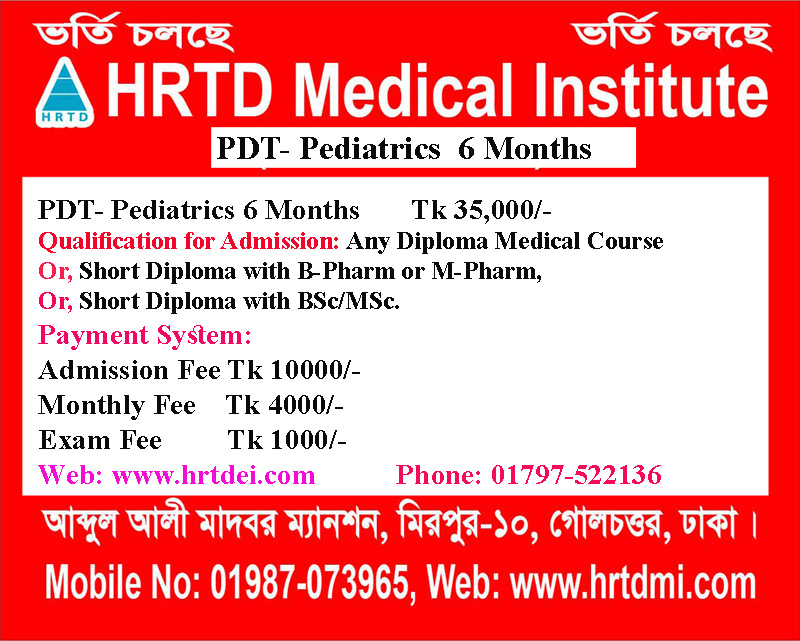
6 Months Pediatric Course (PDT-Pediatrics Course) Course Details
6 Months Post-Diploma Training in Pediatrics that is PDT-Pediatrics 6 Months Course Fee 35500/-. The payment system is an Admission Fee of Tk 15500/-, Monthly Fee of Tk 3500/- and Exam Fee of Tk 4000. 6 Months PDT-Pediatrics Course contains 4 subjects. You can choose any 4 of these subjects Pediatric Gastrology, Pediatric Dermatology, Pediatric Bronchology, Pediatric Cardiology, Pediatric Nutrition, and Pediatric Drugs.
1 Year Pediatric Course ( PDT-Pediatrics 1 Year) Details
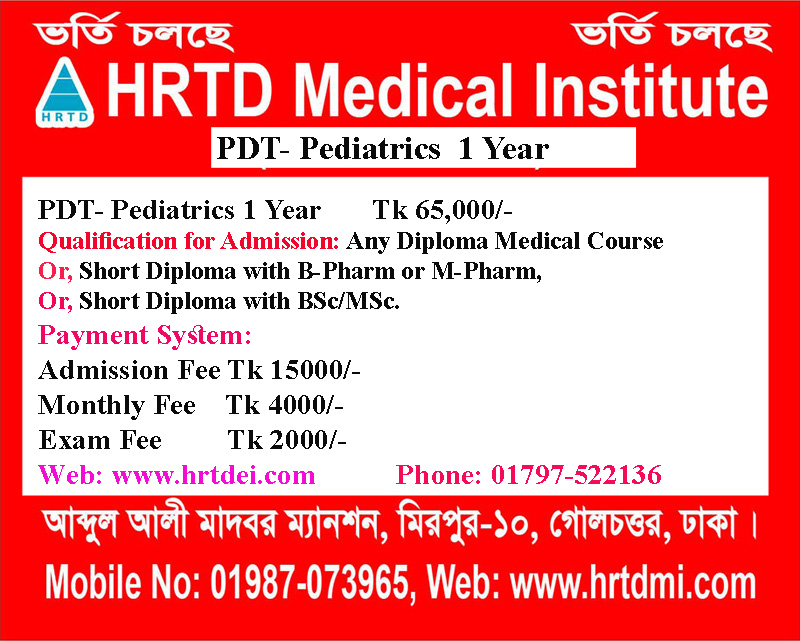
1 Year Pediatric Course that is PDT-Pediatrics 1 Year Course Fee Tk 70500/-. The payment system is an Admission Fee of Tk 20500/-, Monthly Fee of Tk 35500/- and Exam Fee of Tk 4000. 1 Year PDT-Pediatrics Course contains 8 subjects. You can choose any 8 of these subjects Pediatric Gastrology, Pediatric Dermatology, Pediatric Bronchology, Pediatric Cardiology, Pediatric Nutrition, Pediatric Drugs, Pediatric Neurology, Pediatric Infectious Disease, and Pediatric Hepatology.
Post Diploma Training in Pediatric Course ( PDT-Pediatrics 2 Years) Details
2 Years Post-Diploma Training in Pediatrics that is PDT-Pediatrics 2 Years Course Fee Tk 130500/-. The payment system is an Admission Fee of Tk 30500/-, a Monthly Fee of Tk 3500/-, and an Exam Fee of Tk 4000/- per Semester. 2 Years PDT-Pediatrics Course contains 16 Subjects. Some subjects of PDT-Pediatrics are Pediatric Gastrology, Pediatric Dermatology, Pediatric Bronchology, Pediatric Cardiology, Pediatric Nutrition, Pediatric Drugs, Pediatric Neurology, Pediatric Infectious Disease, Pediatric Hepatology, Pediatric Endocrinology, Autism, Child Development, etc.
Hostel Facilities in HRTD Medical Institute for Pediatric Course (Post-Diploma Training)
Hostal & Meal Facilities
The Institute has hostel facilities for the students. Students can take a bed in the hostel.
Hostel Fee Tk 3000/- Per Month
Meal Charges Tk 3000/- Per Month. ( Approximately )
হোস্টাল ও খাবার সুবিধা
ইনস্টিটিউটে শিক্ষার্থীদের জন্য হোস্টেল সুবিধা রয়েছে। ছাত্ররা হোস্টেলে বিছানা নিতে পারে।
হোস্টেল ফি 3000/- টাকা প্রতি মাসে,
খাবারের চার্জ 3000/- টাকা প্রতি মাসে।(প্রায়)
Address of HRTD Medical Institute for Pediatric Course (Post-Diploma Training)
আমাদের ঠিকানাঃ HRTD মেডিকেল ইন্সটিটিউট, আব্দুল আলী মাদবর ম্যানশন, সেকশন ৬, ব্লোক খ, রোড ১, প্লট ১১, মেট্রোরেল পিলার নাম্বার ২৪৯, ফলপট্টি মসজিদ গলি, মিরপুর ১০ গোলচত্ত্বর, ঢাকা ১২১৬ । মোবাইল ফোন নাম্বার ০১৭৯৭৫২২১৩৬, ০১৯৮৭০৭৩৯৬৫ ।
Our Address: HRTD Medical Institute, Abdul Ali Madbor Mansion, Section-6, Block- Kha, Road- 1, Plot- 11, Metro Rail Pilar No. 249, Falpatty Mosjid Goli, Mirpur-10 Golchattar, Dhaka 1216. Mobile Phone No. 01969947171, 01797522136, 01987073965
Teachers for Pediatric Course (Post-Diploma Training)
- Dr. Md. Sakulur Rahman, MBBS, CCD (BIRDEM), Course Director
- Dr. Sanjana Binte Ahmed, BDS, MPH, Assistant Course Director
- Dr. Tisha, MBBS, PGT Gyne, Assistant Course Director
- Dr. Suhana, MBBS, PGT Medicine
- Dr. Danial Hoque, MBBS, C-Card
- Dr. Tisha, MBBS
- Dr. Afrin Jahan, MBBS, PGT Medicine
- Dr. Ananna, MBBS
- Dr. Lamia Afroze, MBBS
- Dr. Amena Afroze Anu, MBBS, PGT Gyne, Assistant Course Director
- Dr. Farhana Antara, MBBS,
- Dr. Nazmun Nahar Juthi, BDS, PGT
- Dr. Farhana Sharna, MBBS
- Dr. Bushra, MBBS
- Dr. Turzo, MBBS
- Dr. Kamrunnahar Keya, BDS, PGT (Dhaka Dental College)
- Dr. Shamima, MBBS, PGT Gyne
- Dr. Alamin, MBBS
- Dr. Benzir Belal, MBBS
- Dr. Disha, MBBS
- Dr. Mahinul Islam, MBBS
- Dr. Tisha, MBBS, PGT Medicine
- Dr. Anika, MBBS, PGT
- Dr. Jannatul Ferdous, MBBS, PGT Gyne
- Dr. Jannatul Aman, MBBS, PGT
- Dr. Rayhan, BPT
- Dr. Abu Hurayra, BPT
- Dr. Sharmin Ankhi, MBBS, PGT Medicine
- Md. Monir Hossain, B Pharm, M Pharm
- Md. Monirul Islam, B Pharm, M Pharm
- Md. Feroj Ahmed, BSc Pathology, PDT Medicine
Subject for Pediatric Course (Post-Diploma Training)-6 Months Details
- Pediatric Gastrology.
- Pediatric Cardiology
- Pediatric Broncholog
- Pediatric Dermatology
Pediatric Course (Post-Diploma Training)-1 Year Details
1 Year Post-Diploma Training in Pediatric that is PDT- Pediatric 1 Year Course Fee Tk 70500/-. The payment system is an Admission Fee of Tk 15000/-, Monthly Fee of Tk 4000/- and Exam Fee of Tk 2000/-. 1 Year Post Diploma Training in Pediatric Course contains 8 subjects. You can choose any 8 of these subjects:
Subject for Pediatric Course (Post-Diploma Training)-1 Year
Subject for 1’st Semester
- Pediatric Gastrology.
- Pediatric Cardiology
- Pediatric Broncholog
- Pediatric Dermatology
Subject for 2’nd Semester
- Pediatric Neurology
- Pediatric Nutrition
- Pediatric Immunology
- Pediatric Surgery
Subject for Pediatric Course (Post-Diploma Training) 2 Years
Subject for 1’st Semester
- Pediatric Gastrology.
- Pediatric Cardiology
- Pediatric Broncholog
- Pediatric Dermatology
Subject for 2’nd Semester
- Pediatric Neurology
- Pediatric Nutrition
- Pediatric Immunology
- Pediatric Surgery
Subject for 3’rd Semester
Subject for 4’th Semester
Pediatric Gastrology for Pediatric Course (Post-Diploma Training)
Key Pediatric Gastroenterology topics include inflammatory bowel disease (IBD), celiac disease, chronic constipation, gastroesophageal reflux disease (GERD), and chronic diarrhea. Critical areas also involve neonatal jaundice, failure to thrive, food allergies (CMPA), eosinophilic esophagitis, and acute/chronic hepatitis. Key nutritional management, including enteral nutrition, is essential.
Here are the critical topics in Pediatric Gastroenterology for study and clinical review:
1. Gastrointestinal Disorders
- Inflammatory Bowel Disease (IBD): Crohn’s disease and ulcerative colitis, including management of severe acute colitis.
- Celiac Disease: Diagnosis and management of gluten-sensitive enteropathy.
- Gastroesophageal Reflux Disease (GERD): Differentiating physiological spit-up from pathologic reflux.
- Constipation & Encopresis: Functional constipation, Hirschsprung disease, and fecal retention management.
- Chronic Diarrhea & Malabsorption: Evaluation of malabsorption syndromes, including infectious and post-infectious causes.
- Eosinophilic Esophagitis (EoE): Dietary, medical, and endoscopic management.
- Food Allergies & Intolerances: Cow’s Milk Protein Allergy (CMPA) and lactose intolerance.
- Acute & Chronic Pancreatitis: Presentation and management.
- Foreign Body Ingestion: Management and endoscopic removal.
2. Hepatology & Nutrition
- Neonatal Cholestasis & Jaundice: Evaluation of neonatal hepatitis and Biliary Atresia (Kasai portoenterostomy).
- Metabolic/Fatty Liver Disease (MASLD): Rising rates in children, associated with obesity.
- Autoimmune Hepatitis: Diagnostic and therapeutic approaches.
- Nutritional Support: Nutritional deficiencies, enteral nutrition, and total parenteral nutrition (TPN).
3. Functional & General Complaints
- Functional Abdominal Pain Disorders: Such as Irritable Bowel Syndrome (IBS) and abdominal migraine.
- Chronic Vomiting/Abdominal Pain: Evaluation of chronic nausea, vomiting, and pain.
4. Key Clinical Skills
- Pediatric History & Physical Exam: Detailed feeding history, growth monitoring, and nutritional assessment.
- Diagnostic Procedures: Endoscopy (upper/lower), Capsule Endoscopy, and Liver Biopsy.
Pediatric Cardiology for Pediatric Course (Post-Diploma Training)
Key pediatric cardiology topics include structural congenital heart diseases (ASD, VSD, Tetralogy of Fallot), fetal circulation, arrhythmias (SVT, Long QT), Kawasaki disease, and rheumatic heart disease. Essential diagnostics include pediatric ECG, chest X-ray interpretation, and echocardiography. Other critical areas are heart failure management, pulmonary hypertension, and cardiomyopathy.
Top 10 Essential Pediatric Cardiology Topics:
- Congenital Heart Disease (CHD) – Acyanotic: Ventricular Septal Defect (VSD), Atrial Septal Defect (ASD), Patent Ductus Arteriosus (PDA), and Coarctation of the Aorta.
- Congenital Heart Disease (CHD) – Cyanotic: Tetralogy of Fallot (TOF), Transposition of the Great Arteries (TGA), and Tricuspid Atresia.
- Neonatal Cardiology: Duct-dependent lesions, pulmonary hypertension, and persistent fetal circulation.
- Arrhythmias & Electrophysiology: Supraventricular tachycardia (SVT), ventricular tachycardia, and Long QT syndrome.
- Acquired Heart Disease: Kawasaki disease (coronary artery management) and Acute Rheumatic Fever/Rheumatic Heart Disease.
- Cardiomyopathies: Hypertrophic cardiomyopathy (HOCM) and dilated cardiomyopathy.
- Heart Failure Management: Acute heart failure in infants/children, low cardiac output, and mechanical circulatory support.
- Diagnostic Modalities: Echocardiography, chest X-ray interpretation (e.g., cardiomegaly, heart silhouettes), and cardiac CT/MRI.
- Clinical Evaluation: Differentiation of innocent vs. organic murmurs, neonatal cardiac screening, and cyanosis differential diagnosis.
- Genetic Syndromes & Cardiology: Heart defects associated with Down syndrome, Turner syndrome, and Marfan syndrome.
Key Skills for Assessment:
- Interpreting Pediatric ECGs.
- Understanding fetal-to-neonatal circulation changes.
- Recognizing signs of severe heart failure or shock in neonates.
Pediatric Broncholog for Pediatric Course (Post-Diploma Training)
In pediatric bronchology (pulmonology), key topics center on the unique anatomical and physiological differences in children compared to adults, as well as common and rare respiratory conditions.
1. Essential Anatomical & Physiological Differences
Because “children are not just small adults,” understanding these differences is critical for safe bronchoscopy and treatment:
- Airway Size: Infants have smaller endotracheal tubes (3.0–5.0 mm), limiting the types of bronchoscopes and tools that can be used.
- Narrowest Point: The cricoid cartilage is the narrowest part of a child’s airway, whereas the vocal cords are the narrowest in adults.
- Higher Oxygen Consumption: Infants consume oxygen roughly twice as fast as adults (6 mL/kg/min vs. 3 mL/kg/min), leading to rapid desaturation during procedures.
- Airway Compliance: Pediatric airways are softer and more prone to collapse under pressure.
2. Common Pediatric Respiratory Disorders
- Asthma: Chronic inflammation and wheezing; management often follows GINA guidelines.
- Bronchiolitis: Often caused by RSV (Respiratory Syncytial Virus); it is the leading cause of hospitalization in infants under age 2.
- Cystic Fibrosis: A genetic disorder requiring aggressive airway clearance and nutritional support.
- Pneumonia: Recurring infections are a frequent reason for referral to a specialist.
- Bronchopulmonary Dysplasia (BPD): Chronic lung disease common in premature infants.
3. Bronchoscopy Indications & Procedures
Bronchoscopy is used for both diagnosis and treatment in children:
- Foreign Body Aspiration: A major indication for rigid bronchoscopy in toddlers.
- Stridor & Chronic Cough: Diagnostic evaluation of noisy or persistent breathing.
- Bronchoalveolar Lavage (BAL): Used to collect fluid samples for diagnosing infections or interstitial lung disease.
- Congenital Malformations: Identifying issues like tracheomalacia, laryngomalacia, or tracheoesophageal fistulae.
4. Advanced & Emerging Topics
- Rare Lung Diseases: Managing interstitial and diffuse lung disease in children.
- Endobronchial Ultrasound (EBUS): An emerging tool for less invasive diagnostics in older pediatric patients.
- Lung Ultrasound (POCUS): Increasingly used in neonatal intensive care for real-time airway and lung assessment.
Pediatric Dermatology for Pediatric Course (Post-Diploma Training)
Pediatric dermatology focuses on diagnosing and managing skin, hair, and nail disorders in children, from infancy to adolescence. Key topics include common inflammatory conditions (Atopic Dermatitis, Acne), birthmarks (vascular tumors/malformations), neonatal dermatology, infections, and inherited genodermatoses.
Key Subject Areas in Pediatric Dermatology
- Common Inflammatory Dermatoses:
- Atopic Dermatitis (Eczema): Management, emollients, and anti-inflammatory treatment.
- Acne: Evaluation and treatment in adolescents.
- Psoriasis: Pediatric plaque psoriasis and its impact.
- Neonatal and Infant Skin Disorders:
- Neonatal Dermatoses: Benign pustular eruptions, diaper dermatitis.
- Birthmarks: Congenital nevi and infantile hemangiomas (including ulceration management).
- Vascular Anomalies: Hemangiomas and vascular malformations.
- Infections and Infestations: Bacterial (impetigo), viral (warts, molluscum), and fungal infections.
- Genetic and Chronic Conditions: Genodermatoses (e.g., ichthyosis), epidermolysis bullosa, and morphea.
- Allergic Reactions: Contact dermatitis and patch testing.
Hot Topics and Emerging Trends
- Therapeutics: Use of systemic agents like methotrexate and cyclosporine for severe atopic dermatitis.
- Management: Increased focus on quality of life and patient-reported outcomes (CDLQI).
- Diagnostics: Refining the role of patch testing in children.
Pediatric Neurology for Pediatric Course (Post-Diploma Training)
Pediatric neurology focuses on diagnosing and treating nervous system disorders in children (0-18 years), covering epilepsy, cerebral palsy, developmental delays, neuromuscular diseases, and genetic/metabolic conditions. Key areas include neuro-immunology, neuro-degenerative disorders, brain traumas, headaches, and neuro-functional assessments.
Core Topics in Pediatric Neurology
- Epilepsy and Seizures: Diagnosis, management, and ketogenic diet therapies.
- Neurodevelopmental Disorders: Autism, cognitive impairment, and developmental delays.
- Neuromuscular Diseases: Spinal Muscular Atrophy (SMA), muscular dystrophies, and nerve injuries.
- Cerebral Palsy and Motor Disorders: Movement disorders, walking disorders, and spasticity.
- Neuro-genetic & Metabolic Disorders: Genetic disorders and mitochondrial diseases.
- Acute Neurological Conditions: Headaches, meningitis, encephalitis, and brain tumors.
- Neonatal Neurology: Neurological processes in premature/risky babies, hypotonia.
- Neurological Evaluation: Detailed assessment, lumbar puncture, and neuroimaging.
- Neuro-immunology: Autoimmune encephalitis and demyelinating diseases.
These topics address the specific, evolving neurological needs of children as they grow.
Pediatric Nutrition for Pediatric Course (Post-Diploma Training)
Pediatric nutrition focuses on essential dietary needs for growth, covering infancy (breastfeeding/formula), toddlerhood, and adolescence. Key topics include nutrient requirements (proteins, fats, vitamins), cognitive development, immune support, and preventing chronic diseases through healthy eating. It addresses clinical issues like obesity, allergies, and malnutrition.
Core Topics in Pediatric Nutrition
- Fundamental Requirements:
- Macronutrients: Protein for growth, carbohydrates for energy, and healthy fats for brain development.
- Micronutrients: Key focus on Calcium, Vitamin D, Iron, and Zinc for development.
- Fluid & Electrolytes: Proper hydration guidelines.
- Life Stages & Feeding Practices:
- Infancy: Breastfeeding, formula feeding, and the introduction of complementary foods.
- Toddler/School-Age: Establishing healthy eating habits, managing picky eaters, and routine dietary needs.
- Adolescence: Addressing increased energy demands and nutritional needs for rapid growth.
- Clinical & Nutritional Challenges:
- Malnutrition & Deficiency: Micronutrient deficiencies, undernutrition, and overnutrition (obesity).
- Food Allergies & Intolerances: Celiac disease, lactose intolerance, and managing dietary restrictions.
- Chronic Diseases: Nutritional management for diabetes, liver disease, and gastrointestinal issues.
- Assessment & Development:
- Anthropometry: Measuring growth, height, weight, and head circumference.
- Dietary Assessment: Analyzing diet history and nutrient intake.
- Cognitive Support: Role of nutrition in brain development.
Pediatric Immunology for Pediatric Course (Post-Diploma Training)
Pediatric Immunology focuses on diagnosing and treating immune system disorders in children, specifically addressing primary immunodeficiencies (PIDs), allergic diseases (eczema, asthma, food allergies), and autoimmune conditions. Key topics include immune system development, genetic defects in immunity, infections in immunocompromised hosts, and therapeutic interventions like stem cell transplants.
Core Topics in Pediatric Immunology
- Primary Immunodeficiency Diseases (PIDs):
- SCID (Severe Combined Immunodeficiency): Known as “bubble baby disease,” requiring urgent hematopoietic stem cell transplant.
- Antibody Deficiencies: Common Variable Immunodeficiency (CVID) and selective IgA deficiency.
- Phagocytic Defects: Chronic Granulomatous Disease (CGD).
- Combined Immunodeficiencies: Wiskott-Aldrich syndrome (characterized by eczema, thrombocytopenia, and infections).
- Allergic and Inflammatory Diseases:
- Allergic March: The progression from eczema to food allergies, allergic rhinitis, and asthma.
- Food Allergy Management: IgE and non-IgE mediated allergies.
- Autoimmune and Autoinflammatory Disorders:
- Genetically driven auto-inflammation and autoimmune conditions in children.
- Infections in the Immunocompromised Host:
- Management of recurrent, severe, or unusual infections.
- HIV infection management.
- Diagnostic and Therapeutic Approaches:
- Diagnostic Tools: Flow cytometry, immunoglobulin levels, genetic testing (whole exome sequencing).
- Treatments: Intravenous Immunoglobulin (IVIG) therapy, Hematopoietic Stem Cell Transplant (HSCT), and immunosuppression.
- Neonatal and Pediatric Immunology:
- Immune system maturation and development.
These topics cover the spectrum from understanding normal immune development to diagnosing rare genetic, immunological, and allergic conditions in children.
Pediatric Surgery for Pediatric Course (Post-Diploma Training)
Pediatric surgery focuses on the surgical management of congenital malformations, diseases, and injuries from birth through adolescence, covering neonates to teenagers. Key topics include neonatal emergency surgery (e.g., atresia, diaphragmatic hernia), gastrointestinal, urological, and tumor surgeries, along with MIS (Minimally Invasive Surgery) and specialized prenatal interventions.
Main Topics in Pediatric Surgery:
- Neonatal Surgery (Congenital Anomalies):
- Esophageal Atresia and Tracheoesophageal Fistula: Surgical repair of birth defects in the esophagus.
- Diaphragmatic Hernia: Management of congenital abdominal organ hernia into the chest.
- Hirschsprung’s Disease: Surgical treatment for congenital megacolon.
- Abdominal Wall Defects: Management of gastroschisis and omphalocele.
- Anorectal Malformations: Repair of imperforate anus.
- Pediatric General Surgery & Gastrointestinal:
- Appendicitis: One of the most common acute abdominal emergencies.
- Intussusception and Volvulus: Acute obstruction management.
- Hypertrophic Pyloric Stenosis: Surgical splitting of the pylorus (Pyloromyotomy).
- Hernia/Hydrocele: Inguinal and umbilical hernia repairs (very common).
- Pediatric Urology:
- Undescended Testis (Cryptorchidism): Orchidopexy procedures.
- Hypospadias and Urethral Malformations: Congenital penis/urethra repairs.
- Vesicoureteral Reflux: Surgical management of urine backflow.
- Pediatric Oncology (Tumor Surgery):
- Solid Tumors: Removal of Wilms’ tumor (kidney), Neuroblastoma, and Teratomas.
- Lymph Node Disorders: Excisional biopsies.
- Specialized Areas & Techniques:
- Minimally Invasive Surgery (MIS): Thoracoscopy and laparoscopy for faster recovery.
- Pediatric Trauma and Burns: Management of traumatic injuries, including fractures and severe burns.
- Vascular Anomalies: Treatment of hemangiomas and vascular malformations.
- Pediatric Thoracic Surgery: Lung and chest wall operations.
- Fetal Surgery: Prenatal interventions for congenital defects.
- Perioperative Care:
- Fluid/electrolyte management and anesthesia in neonates and children.
These areas involve managing complex, specialized cases often requiring multidisciplinary care, particularly for congenital disabilities.
What are the most common pediatric procedures?
The most common pediatric procedures are ear, nose, and throat surgeries—specifically tonsillectomies, adenoidectomies, and tympanostomy tube placement. Other frequent surgical interventions include appendectomies, hernia repairs, and circumcisions. Common bedside or emergency procedures include IV insertion, lumbar punctures, and incision and drainage of abscesses.
Common Pediatric Surgical Procedures
- ENT: Tonsillectomy, adenoidectomy, and tympanostomy tubes (ear tubes).
- General/Abdominal: Appendectomy, hernia repair (inguinal/umbilical), and gallbladder removal.
- Urology: Circumcision, undescended testes (orchiopexy), and hydrocele repair.
- Congenital/Other: Correction of pyloric stenosis, Hirschsprung’s disease, and vascular access device placement.
Common Bedside/Emergency Procedures
- Respiratory: Endotracheal intubation, bag-mask ventilation, and nebulizer use.
- Access/Diagnostic: Peripheral intravenous catheter placement, lumbar puncture, bladder catheterization, and arterial/venous umbilical catheterization.
- General: Incision and drainage of abscesses, foreign body removal (e.g., from nose or ear).
Many of these, particularly hernia repairs and appendectomies, are increasingly performed using minimally invasive (laparoscopic) techniques.
বেসিক পেডিয়াট্রিক কি?
বেসিক পেডিয়াট্রিকস (Basic Pediatrics) হলো চিকিৎসাবিজ্ঞানের সেই শাখা যা জন্ম থেকে ১৮ বছর বয়স পর্যন্ত শিশুদের স্বাস্থ্য, বৃদ্ধি, বিকাশ এবং রোগ নির্ণয় ও চিকিৎসা নিয়ে কাজ করে । এটি সাধারণ রোগ, পুষ্টি, টিকাদান, এবং দৈহিক ও মানসিক স্বাস্থ্যসেবা নিশ্চিত করে এছাড়া, জরুরি পরিস্থিতিতে শিশুদের জীবন রক্ষাকারী প্রাথমিক চিকিৎসাও (PBLS) এর অন্তর্ভুক্ত ।
বেসিক পেডিয়াট্রিকসের মূল বিষয়সমূহ:
- শিশুস্বাস্থ্য: শিশুদের স্বাভাবিক বৃদ্ধি ও বিকাশের পর্যবেক্ষণ ।
- রোগ চিকিৎসা: সাধারণ সংক্রামক রোগ, জ্বর, অ্যালার্জি এবং বিভিন্ন স্বাস্থ্য সমস্যার চিকিৎসা ।
- প্রতিরোধমূলক যত্ন: টিকার ব্যবস্থা করা, পুষ্টি পরামর্শ এবং নিয়মিত চেক-আপ ।
- বয়সসীমা: নবজাতক থেকে শুরু করে শৈশব ও কৈশোর পর্যন্ত (সাধারণত ১৮ বছর) ।
- পেডিয়াট্রিক বেসিক লাইফ সাপোর্ট (PBLS): হার্ট বা শ্বাস-প্রশ্বাস বন্ধ হয়ে গেলে জরুরি প্রাথমিক উদ্ধার পদ্ধতি ।
একজন পেডিয়াট্রিশিয়ান (শিশুরোগ বিশেষজ্ঞ) শিশুদের শারীরিক, মানসিক এবং সামাজিক সুস্থতা নিশ্চিত করতে অভিভাবক বা মা-বাবার সাথে কাজ করে থাকেন ।
পেডিয়াট্রিক ডাক্তারের কাজ কি?
পেডিয়াট্রিক সার্জারী হল একটি বিশেষ চিকিৎসা বিভাগ যেখানে, ভ্রুন থেকে শুরু করে কিশোর পর্যন্ত যেকোন বয়সী শিশু বা বাচ্চাদের অপারেশন করা হয় । শিশুদের সকল সমস্যার সমাধান করে থাকেন একজন পেডেট্রিশিয়ান। রোগ নির্ণয়ের কথা হিসাবে নিলে বাংলাদেশের প্রেক্ষাপটে একজন পেডেট্রিশিয়ানের প্রয়োজনীয়তা বেশ গুরুত্বপূর্ণ।
পেডিয়াট্রিক ডাক্তার বা শিশু বিশেষজ্ঞরা জন্ম থেকে শুরু করে কিশোর বয়স (সাধারণত ১৫-১৮ বছর) পর্যন্ত শিশুদের শারীরিক, মানসিক ও সামাজিক স্বাস্থ্যসেবা প্রদান করেন । তারা শিশুদের নিয়মিত চেকআপ, টিকা প্রদান, রোগ নির্ণয়, অসুস্থতা ও আঘাতের চিকিৎসা এবং শারীরিক বিকাশ পর্যবেক্ষণ করে থাকেন ।
পেডিয়াট্রিক ডাক্তারের প্রধান কাজের ক্ষেত্রগুলো নিচে দেওয়া হলো:
- নিয়মিত স্বাস্থ্য পরীক্ষা (Checkup): শিশুদের বৃদ্ধি এবং বিকাশের (ওজন, উচ্চতা, মানসিক বিকাশ) ওপর নজর রাখা ।
- রোগ নির্ণয় ও চিকিৎসা: সাধারণ সর্দি-কাশি, জ্বর থেকে শুরু করে জটিল বা দীর্ঘস্থায়ী রোগের নির্ণয় ও চিকিৎসা করা ।
- টিকা বা ভ্যাকসিন: শিশুদের রোগ প্রতিরোধ ক্ষমতা বাড়াতে প্রয়োজনীয় টিকা দেওয়া [১৩]।
- পরামর্শ দেওয়া: শিশুদের পুষ্টি, নিরাপত্তা, আচরণ এবং দৈনন্দিন যত্ন সম্পর্কে বাবা-মাকে পরামর্শ দেওয়া ।
- জরুরি চিকিৎসা: শিশুদের যেকোনো জরুরি শারীরিক সমস্যা বা দুর্ঘটনার (যেমন- হাড় ভাঙা, কাটা) চিকিৎসা করা ।
- বিশেষজ্ঞের পরামর্শ: প্রয়োজনে শিশু বিশেষজ্ঞ (যেমন- হৃদরোগ বা নিউরোলজি) বা সার্জনের কাছে রেফার করা ।
তারা সাধারণত হাসপাতাল, ক্লিনিক বা কমিউনিটি সেন্টারে কাজ করে থাকেন এবং শিশুদের সুস্বাস্থ্য নিশ্চিত করতে গুরুত্বপূর্ণ ভূমিকা রাখেন ।