 HRTD Medical Institute



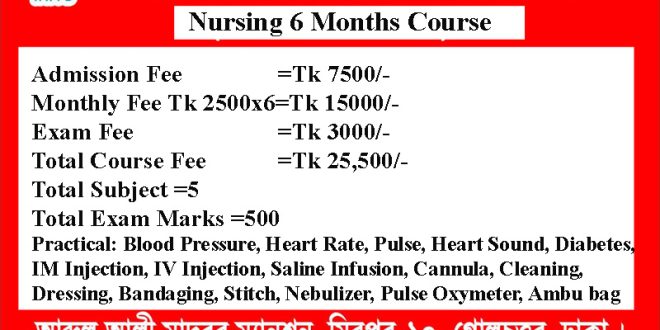
6 Months Nursing course details are given below:
6 Months Nursing Course. Mobile No: 01987-073965. 6 Months Nursing Course (NTC 6 Months). Admission Fee Tk 10500, Monthly Fee Tk 3000×6=Tk 18000, Exam Fee Tk 4,000/-. Total Subjects 5, Total Exam Marks 500. The Subjects are Human Anatomy & Physiology, Chemistry & Pharmacology, First Aid & OTC Drugs, General Nursing & Clinical Nursing.
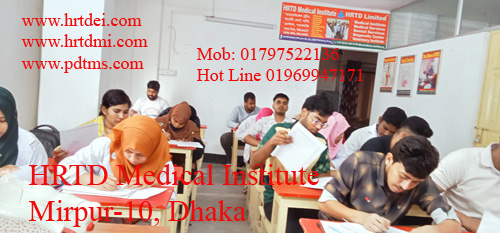
6 Months Nursing Course provides some benefits:
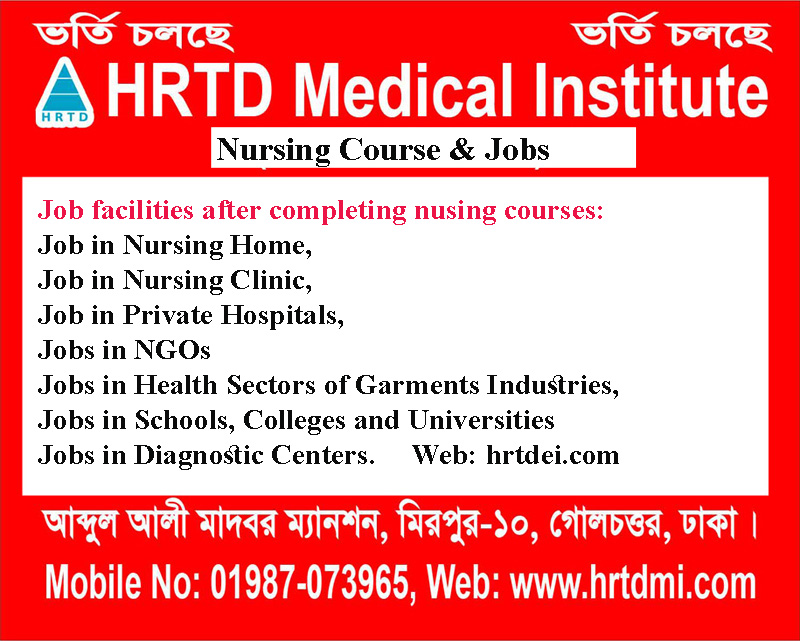
After completing the 6 Months nursing course, you can take a job as a nursing assistant in many nursing centers, nursing clinics, private hospitals, diagnostic centers, NGOs, health centers of garments, schools, and colleges. After providing services in those places, you will be skillful, and then your salary will be handsome.
6 Months Nursing Course, Job and then Diploma Nursing Course:
We provide the students step-by-step opportunities for studying nursing courses. After completing a 6 Months nursing Course students can take a nursing job, and then study for Diploma Nursing Courses at HRTD Medical Institute.
6 Months Nursing Courses and other Nursing Courses in Bangladesh:
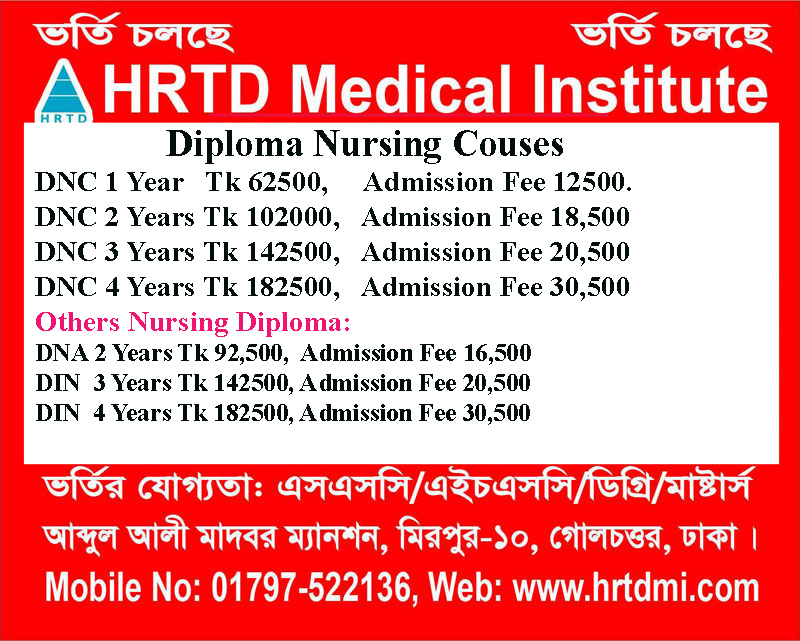
Other Nursing Courses Except for the 6-month nursing Course, We have some diploma-type nursing Courses of Duration 1 Year, 2 Years, 3 Years, and 4 Years. These courses are more valuable and demandable not only in Bangladesh but also over the world. Nursing Course 1 Year Tk 52500/-, Nursing Course 2 Years Tk 92500/-, Nursing Course 3 Years Tk 142500/-, and Nursing Course 4 Years Tk 182500/-. Payment System: Admission Fee, Monthly Fee, and Exam Fee.
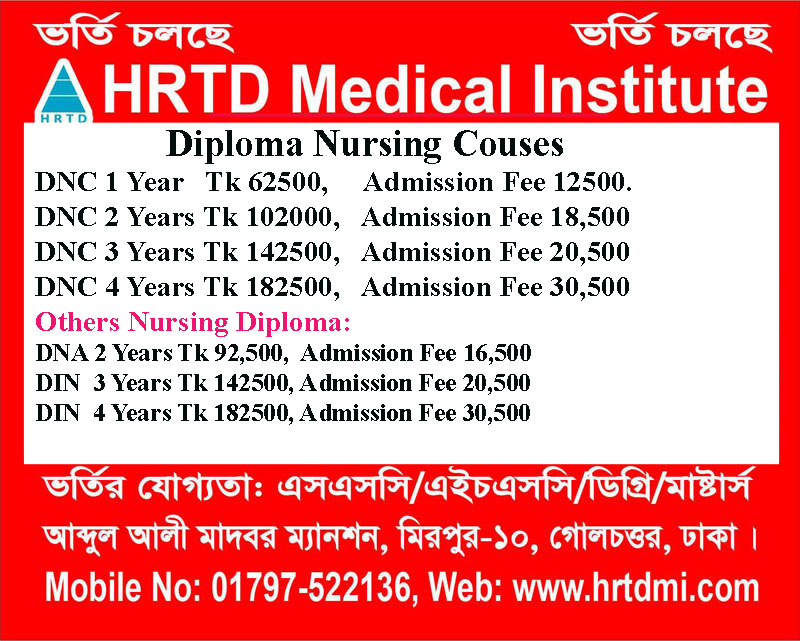
These Diploma Type Nursing Courses teach some important surgical nursing, caregiver nursing, neurological nursing, clinical nursing, pain management nursing, etc.
Location of 6 Months Nursing Course Location
Location of 6 Months Nursing Course. Mobile No: 01987-073965, 01797-522136. HRTD Medical Institute, Section-6, Block-Kha, Road-1, Plot-11, Metro Rail Piller No. 249, Mirpur-10 Golchattar, Dhaka-1216. It is just by the side of Islami Bank Bangladesh Limited, Janata Bank Limited, and Agrani Bank Limited.
6 Months Nursing Course Fee in HRTD Medical Institute
6- Month Nursing Course Fee 32,500/- Admission 10,500/- Monthly Fee (6×3000)=18,0000/- Exam& Practical Fee=4,000/-
Document for admission in 6 months Nursing Course in Dhaka
6 Months Nursing Course in Dhaka.Mobile No: 01987-073965, 01797-522136. HRTD Medical Institute.
Photocopy of Certificate, Photocopy of NID, Passport Size Photo 4 Pcs. Without NID, a Birth Certificate is allowed for an emergency case.
What nursing means?
Nursing is a profession that is focused on providing healthcare to individuals, families, and communities, so they can attain, maintain, or recover optimal health and quality of life. It encompasses a wide range of care activities from helping people stay healthy to providing medical care, as well as providing emotional, psychological, and spiritual support. If you want to complete your Nursing Courses in Mirpur, please contact with us.
Nursing is an incredibly diverse profession. Nurses are involved in every aspect of healthcare, from working in hospitals and clinics to visiting homebound patients to conducting research. They are also involved in educating the public about health and safety and advocating for policy changes that improve access to quality care. If you want to complete your Nursing Courses in Mirpur, please contact with us.
Nurses are highly trained professionals who must pass rigorous licensing exams to practice. They must be able to assess patient needs, develop care plans, and provide direct care. They must also be able to work as part of a team, communicating and collaborating with other healthcare professionals. If you want to complete your Nursing Courses in Mirpur, please contact with us.
Practical Works for Nursing Course
Practical Works for 6 Months Nursing Course: Understanding of heartbeat, Heart Rate, Pulse Rate, Weak Pulse, Strong Pulse, Normal Pulse, Tachycardia, Bradycardia, Heart Sound, Normal Heart Sound, Measurement of Blood Pressure, Systolic Blood Pressure, Diastolic Blood Pressure, Pulse Pressure, Mean Blood Pressure, Hypertension, Hypotension, Hypertension Emergency, Emergency Management of Hypertension, Emergency Management of Hypotension, Emergency Management of Hypertension Urgency,
Pushing Injection, Pushing IM Injection, Pushing IV Injections, Setting of Cannula, Cleaning, Dressing, Bandaging, Stitching, Diabetic Checking, Blood Glucose Measurement, Report Understanding of Diabetic Patient, Report Understanding of Hypertensive Patient, Prescription Understanding of Diabetic Patient, Prescription Understanding of Hypertensive Patient, Prescription Understanding of Hypotensive Patient,
Application of Ophthalmic Drugs, Application of Pediatric Drugs, Inhalation, Exhalation, Use of Inhaler, Use of Rotahaler, Use of Nebulizer Machine, Management of Oral Dose Schedule, Application of Ointment and Cream, Setting Splinter, First Aid of Shock, First Aid of Snake Bite, First Aid of Burn, First Aid of Electric Shock, Emergency Management of Anaphylactic Shock, CPR Application Process, Uges of Antiseptic Drugs, Dosage forms of Drugs, Application of Sublingual Rout, etc.
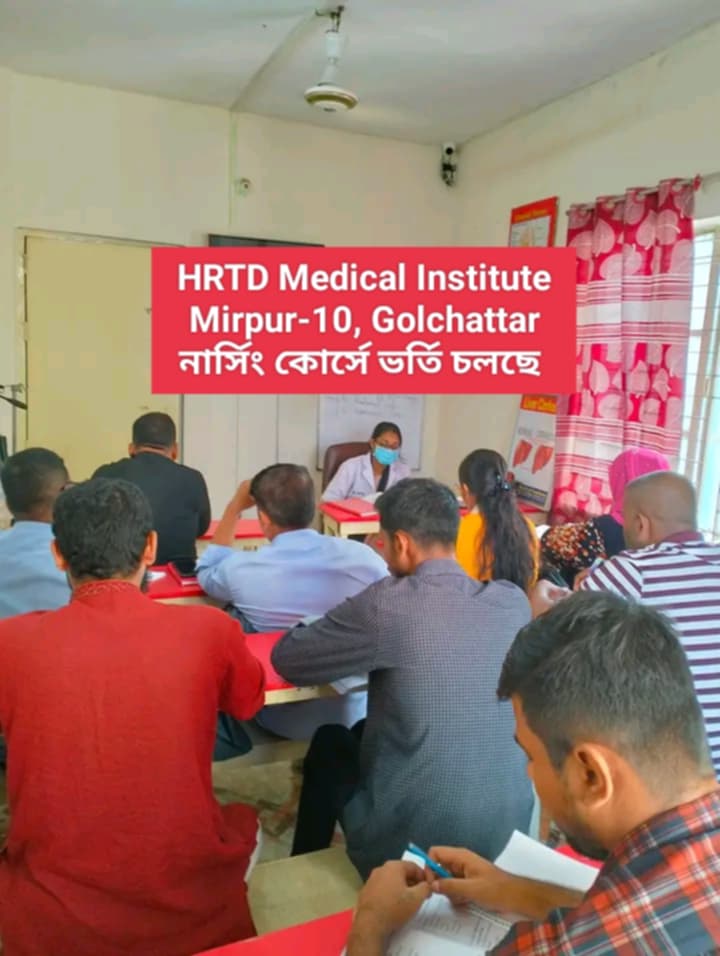
Subjects for 6 months Nursing Course in Dhaka
- Human Anatomy & Physiology
- First Aid & Pharmacology-1
- Study of OTC
- Pediatric Nursing
- Geriatric Nursing
Teachers for 6Months Nursing Course in Dhaka
- Dr. Shamima, MBBS, PGT
- Dr. Lamia, MBBS
- Dr. Amena Afroze Anu, MBBS, PGT
- Dr. Farhana, MBBS, PGT
- Dr. Md. Sakulur Rahman, MBBS, CCD (BIRDEM)
- Dr. Benzir, MBBS, FCPS ( FP)
- Dr. Disha, MBBS, FCPS ( FP)
- Dr. Turzo, MBBS
- Dr. Tisha, MBBS
- Dr. Sanjana, BDS, MPH
- Dr. Nazmun Nahar Juthi, BDS, PGT
- Dr. Kamrunnahar Keya, BDS, PGT
- Dr. Suhana, MBBS, PGT
- Eti Zahan, BSc Nurse, (Nursing Council of Bangladesh)
- Dr. Jannatul Aman, MBBS, PGT
- Dr. Anika, MBBS, PGT
Total Nursing Course of HRTD Medical Institute
- 6 Months Nursing Course
- 1 Year Nursing Course
- 2 Years Nursing Course
- 3 Years Nursing Course
- 4 Years Nursing Course
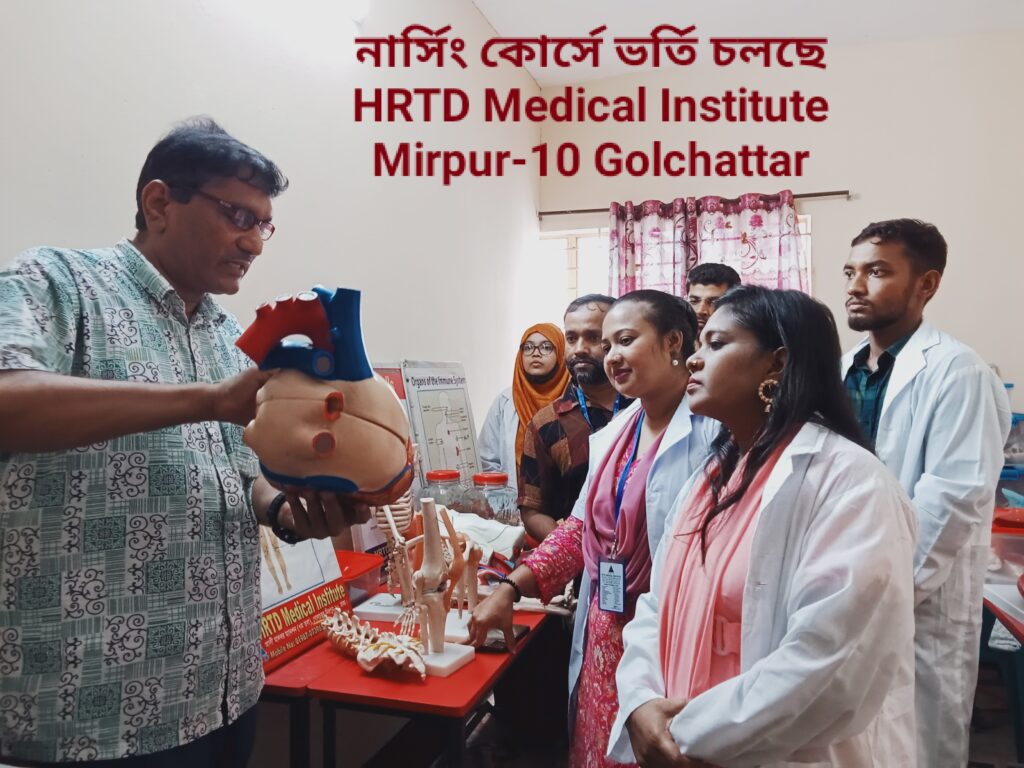
Anatomy & Physiology for 6 Months Nursing Course in Dhaka
Anatomy and Physiology. Mobile No: 01987-073965, 01797-522136. The study of the structures of the body is called Anatomy, and the Study of the functions of the body is called physiology. In Anatomy, we study the systems, organs, tissues, and cells, and in physiology, we study the functions of the systems, organs, tissues, and cells. The systems of the Human body are The Respiratory System, Digestive System, The Cardiovascular System, The Muscular System, The Skeletal System, The Endocrine System, The Nervous System, The Excretory System and Urinary System, The Reproductive System, and The Covering System.
শারীরিক গঠন এবং এর কার্যাবলীর অধ্যয়ন হল অ্যানাটমি এবং ফিজিওলজি। এখানে আমরা মানবদেহের সিস্টেম এবং এর অঙ্গ, টিস্যু এবং কোষ নিয়ে আলোচনা করি। মানবদেহের সিস্টেমগুলি হ’ল হজম সিস্টেম, শ্বাসযন্ত্র, কার্ডিওভাসকুলার সিস্টেম, কঙ্কাল সিস্টেম, পেশীতন্ত্র, স্নায়ুতন্ত্র, এন্ডোক্রাইন সিস্টেম, ইমিউন সিস্টেম, লিম্ফ্যাটিক সিস্টেম, ইন্টিগুমেন্টারি সিস্টেম এবং ইউরিনারি সিস্টেম
Definition of Anatomy-Anatomy is the scientific study of the structure of the human body and its parts, including bones, muscles, organs, tissues, and cells.
Anatomy হচ্ছে মানবদেহের কাঠামো বা গঠন নিয়ে বৈজ্ঞানিক অধ্যয়ন।
এর মধ্যে হাড়, পেশী, অঙ্গ-প্রত্যঙ্গ, টিস্যু ও কোষ—সবকিছুর গঠন কীভাবে সাজানো আছে তা শেখানো হয়।
Definition of Physiology-Physiology is the scientific study of the functions and activities of the parts of the human body and how they work together to maintain life.
Physiology হচ্ছে মানবদেহের বিভিন্ন অংশের কাজ বা কার্যক্রম নিয়ে বৈজ্ঞানিক অধ্যয়ন।
দেহের প্রতিটি অঙ্গ কীভাবে কাজ করে এবং একসাথে জীবনের কার্যক্রম বজায় রাখে—তা ব্যাখ্যা করে
সহজভাবে মনে রাখার ট্রিক:
- Anatomy = Structure (গঠন)
- Physiology = Function (কাজ)
Human Body Systems
- Skeletal System(অস্থি তন্ত্র)
- Muscular System(পেশী তন্ত্র)
- Nervous System(স্নায়ুতন্ত্র)
- Endocrine System(হরমোন তন্ত্র)
- Respiratory System(শ্বাসযন্ত্র)
- Cardiovascular / Circulatory System(রক্ত সঞ্চালন তন্ত্র)
- Digestive System(পরিপাক তন্ত্র)
- Urinary System(মূত্র তন্ত্র)
- Reproductive System(প্রজনন তন্ত্র — Male/Female)
- Integumentary System(ত্বক তন্ত্র — Skin, hair, nail)
- Immune / Lymphatic System(রোগ প্রতিরোধ ও লসিকা তন্ত্র)
- Special Sense Organ System(ইন্দ্রিয় তন্ত্র — চোখ, কান, নাক, জিহ্বা, ত্বক)
কয়েকটি সিস্টেম সম্পর্কে আলোচনা করা হলো:
Skeletal System (অস্থি তন্ত্র)
Anatomy
- শরীরের মোট হাড়: প্রায় 206 টি
- প্রধান অংশ:
- Skull (মস্তিষ্কের খুলি)
- Vertebral column (মেরুদণ্ড)
- Rib cage (বক্ষপিঞ্জর)
- Upper limb bones (হাতের হাড়)
- Lower limb bones (পায়ের হাড়)
- Jaw bone (Mandible—দাঁতের গুরুত্বপূর্ণ)
Physiology (কাজ)
- শরীরকে কাঠামো দেয়
- অভ্যন্তরীণ অঙ্গকে রক্ষা করে
- চলাফেরায় সাহায্য করে (muscles এর সাথে joint)
- RBC তৈরি হয় Bone marrow-তে
- Calcium ও Minerals storage
Muscular System (পেশী তন্ত্র)
Anatomy:
- Skeletal muscles (ইচ্ছামতো নড়ানো যায়)
- Smooth muscles (অটোমেটিক—intestine, blood vessels)
- Cardiac muscle (হৃদপেশী)
Physiology:
- শরীর নড়া–চড়া
- Walking, running, chewing (দাঁতের জন্য গুরুত্বপূর্ণ)
- Posture ঠিক রাখা
- Body heat উৎপাদন
- Heart beating (cardiac muscle)
Nervous System (স্নায়ুতন্ত্র)
Anatomy:
- Brain
- Spinal cord
- Peripheral nerves
- 12 pairs Cranial nerves (Trigeminal nerve – dental pain sensation)
Physiology:
- Sensation (pain, touch, temperature)
- শরীরের প্রতিটি কাজ নিয়ন্ত্রণ
- Reflex action
- Muscle movement control
- Body coordination
Respiratory System (শ্বাসযন্ত্র)
Anatomy:
Nose → Pharynx → Larynx → Trachea → Bronchi → Lungs → Alveoli
Physiology:
- Oxygen শরীরে প্রবেশ
- Carbon dioxide বের করে
- Acid-base balance
- Speech / Voice production
Digestive System (পরিপাক তন্ত্র)
Anatomy:
Mouth → Esophagus → Stomach → Small intestine → Large intestine → Liver → Pancreas
Physiology:
- খাদ্য ভাঙ্গা (digestion)
- পুষ্টি শোষণ
- Energy supply
- Waste elimination
Nursing importance: Nutrition, ORS, Feeding tube care
Chemistry and Pharmacology for 6 months Nursing Course in Dhaka
Chemistry and Pharmacology. Mobile No: 01987-073965, 01797-522136. The study of Chemicals is called Chemistry and the Study of Drugs and Medicine is called Pharmacology. All drugs are produced from chemicals and all medicines are produced from drugs. So, Chemistry and Pharmacology are related subjects. Common Chemicals are steroids, acids, bases, salicylic acid, Benzoic acid, Benzin, Nitro Benzin, Toluin, etc.
Common drugs are Steroid Drugs, NSAID Drugs, Antivomiting Drugs, Anti Ulcer Drugs, Anti Microbial drugs, Anti Bacterial Drugs, Anti Fungal Drugs, Anti Protozoa Drugs, Anti Histamine Drugs, Anthelmintic Drugs, Anti Cholesterol Drugs, Anti Lekotrien Drugs, Anti Pyretic Drugs, Analgesic Drugs, Anti Hypertensive Drugs, Sedative Drugs, etc.
What is Chemistry? (সংজ্ঞা)
Chemistry হলো এমন একটি বিজ্ঞান শাখা যেখানে পদার্থের গঠন, উপাদান, বৈশিষ্ট্য এবং রাসায়নিক বিক্রিয়া নিয়ে আলোচনা করা হয়।
Chemistry হলো পদার্থ (matter)-এর
- গঠন (composition),ধর্ম (properties),পরিবর্তন (change/reaction) নিয়ে অধ্যয়ন।
Nursing ব্যবহার:
IV fluid, electrolyte, medicine interaction, pH balance বুঝতে chemistry দরকার।
Matter (পদার্থ)
- Matter = যেকোনো কিছু যার ভর আছে ও স্থান দখল করে।
Types:
- Solid (কঠিন) – bone, ice
- Liquid (তরল) – blood, water
- Gas (গ্যাস) – oxygen, CO₂
Atom & Molecule
- Atom: পদার্থের ক্ষুদ্রতম কণা (Proton + Neutron + Electron)
- Molecule: দুই বা ততোধিক atom যুক্ত হলে molecule।
উদাহরণ: H₂O, O₂
Element, Compound, Mixture
- Element: এক ধরনের atom, যেমন O, H, Na
- Compound: দুই বা ততোধিক element chemically যুক্ত, যেমন NaCl, H₂O
- Mixture: রাসায়নিক বিক্রিয়া ছাড়া মিশ্রণ, যেমন air, saline
Acid, Base & Salt
- Acid: pH < 7, H⁺ দেয়, টক স্বাদ (HCl, Vinegar)
- Base: pH > 7, OH⁻ দেয়, তিতা (NaOH, Soap)
- Salt: Acid + Base → Salt + Water (NaCl)
Nursing: IV saline, ORS, electrolyte balance
pH Scale
- Scale: 0–14
- pH 7 → Neutral, <7 Acid, >7 Base
- Normal blood pH: 7.35–7.45
- As imbalance → acidosis / alkalosis
Electrolytes
- Charged ions in body fluids
Major: Na⁺, K⁺, Ca²⁺, Mg²⁺, Cl⁻, HCO₃⁻
Nursing: IV therapy, cardiac monitoring, dehydration treatment
Solution
- Solute + Solvent = Solution
- Example: NaCl + water = saline
- Types: Isotonic, Hypotonic, Hypertonic
Chemical Reactions
- Combination: A + B → AB
- Decomposition: AB → A + B
- Displacement: A + BC → AC + B
- Neutralization: Acid + Base → Salt + Water
Biochemistry Basics
- Carbohydrates: Energy, Glucose, Starch
- Proteins: Body building, meat, egg
- Lipids (Fat): Energy storage, butter, oil
- Vitamins & Minerals: Metabolism & body function control
Water
- 60–70% of body
- Functions: Temperature regulation, Transport, Digestion, Lubrication
- Nursing: IV saline, ORS
Nursing Short Notes Summary
- Matter = Solid + Liquid + Gas
- Atom = Proton + Neutron + Electron
- pH normal = 7.35–7.45
- Saline = NaCl solution
- Acid + Base = Salt + Water
- Electrolyte = Na⁺, K⁺, Ca²⁺, Mg²⁺, Cl⁻, HCO₃⁻
- Glucose = main energy source
First Aid for 6 Months Nursing Course in Dhaka
First Aid is an important subject for Nursing Students. In the First Aid for 1 Year Nursing Course, We discuss the Definition of First Aid, the Application of First Aid, Shock, Classification of Shock, Causes of Shock, Hypovolemic Shock, Cardiogenic Shock, Neurogenic Shock, Burn Shock, Electric Shock, Symptoms of Shock, Anaphylactic Shock, Management of Shock, First Aid of Cut, First Aid of Bleeding, First Aid of Snakebite, First Aid of Fire Burn, First Aid of Road Trafic accident, etc.
First Aid is the immediate, temporary care given to a sick or injured person until professional medical help is available.
First Aid হলো আহত বা অসুস্থ ব্যক্তিকে দ্রুত এবং অস্থায়ী যত্ন প্রদান করা, যতক্ষণ না পেশাদার চিকিৎসা পাওয়া যায়।
Objectives of First Aid
- জীবন রক্ষা করা (Preserve life)
- অবস্থার অবনতি প্রতিরোধ করা (Prevent further injury)
- রোগীর আরাম ও স্বস্তি দেওয়া (Promote recovery & comfort)
- জরুরি চিকিৎসার জন্য প্রস্তুতি নেওয়া (Prepare for medical care)
Principles of First Aid
- Safety First – নিজের এবং রোগীর নিরাপত্তা নিশ্চিত করা
- Assessment – Patient evaluation (Airway, Breathing, Circulation)
- Immediate Action – দ্রুত ব্যবস্থা নেওয়া
- Professional Help – যত দ্রুত সম্ভব চিকিৎসকের সাহায্য নিন
- Do No Harm – ক্ষতি না করা
Primary Survey (ABC Method)
A – Airway
- Ensure airway is open
- Remove obstruction
B – Breathing
- Check breathing
- Provide artificial respiration if needed
C – Circulation
- Check pulse & bleeding
- Start CPR if pulse absent
Common First Aid Measures
- Bleeding / Wounds
- Apply direct pressure
- Elevate limb
- Clean with antiseptic
- Bandage
- Burns
- Cool burn with water
- Apply sterile dressing
- Do not apply oil/ointment immediately
- Fractures / Sprains
- Immobilize limb
- Apply splint
- Avoid movement
- Shock
- Lie patient down
- Keep warm
- Monitor vitals
- Seek medical help
- Choking / Airway obstruction
- Heimlich maneuver (abdominal thrust)
- Back blows for infants
- Poisoning / Drug overdose
- Identify poison
- Do not induce vomiting unless instructed
- Call poison control / hospital
- Electric Shock
- Switch off electricity source
- Check ABC
- Treat burns & monitor vitals
- Heat Stroke / Hypothermia
- Move patient to safe place
- Cool or warm body gradually
- Hydration
- Seizures / Epilepsy
- Protect head
- Clear surrounding objects
- Do not restrain limbs
- Monitor breathing
Role of Nurse in First Aid
- Prompt assessment & care
- Maintain patient safety
- Monitor vitals & condition
- Documentation & reporting
- Educate patient & family
- Coordinate with emergency team
First Aid Kit Essentials
- Bandages, gauze, adhesive tape
- Antiseptic, ointments
- Scissors, gloves, tweezers
- Thermometer, stethoscope
- CPR mask, splints, ice packs
- Emergency drugs (as allowed)
Hematology হলো রক্ত, রক্ত সংশ্লেষক অঙ্গ (যেমন bone marrow, spleen) এবং রক্তের অসুখ নিয়ে অধ্যয়ন।
Objectives of Hematology in Nursing
- Understand composition and functions of blood.
- Recognize normal vs abnormal blood parameters.
- Assist in diagnosis and treatment of blood disorders.
- Monitor patient safety during transfusion.
- Educate patients about blood-related health issues.
Composition of Blood
- Plasma – 55%
- Water, Proteins (Albumin, Globulin, Fibrinogen), Electrolytes, Nutrients
- Formed Elements – 45%
- RBC (Red Blood Cells / Erythrocytes) → Oxygen transport
- WBC (White Blood Cells / Leukocytes) → Infection defense
- Platelets (Thrombocytes) → Blood clotting
Functions of Blood
- Oxygen & CO₂ transport (RBC)
- Immune defense (WBC)
- Clotting (Platelets & clotting factors)
- Nutrient & hormone transport
- Temperature regulation
- Acid-base balance
Hematopoiesis (Blood Formation)
- Occurs in bone marrow, mainly in:
- Vertebra, sternum, pelvis, ribs
- Stem cells differentiate into RBC, WBC, Platelets
Normal Hematological Values
| Component | Normal Range |
|---|---|
| Hemoglobin (Hb) | Male: 13–17 g/dL, Female: 12–16 g/dL |
| RBC count | Male: 4.5–5.5 million/µL, Female: 4–5 million/µL |
| WBC count | 4,000–11,000 /µL |
| Platelet count | 150,000–450,000 /µL |
| Hematocrit (HCT) | Male: 40–54%, Female: 36–48% |
Common Blood Disorders
- Anemia – Low RBC or Hb
- Types: Iron deficiency, Megaloblastic, Hemolytic
- Nursing: Monitor fatigue, pallor, oxygen saturation
- Leukemia – Malignant WBC proliferation
- Nursing: Infection control, monitor WBC, patient education
- Thrombocytopenia – Low platelet count
- Nursing: Bleeding precautions, monitor bruising
- Polycythemia – High RBC count
- Nursing: Monitor for blood clots, hydration
- Hemophilia – Clotting factor deficiency
- Nursing: Prevent trauma, monitor bleeding
Blood Transfusion in Nursing
- Indications: Severe anemia, blood loss, surgery
- Types: Whole blood, Packed RBC, Platelets, Plasma
- Nursing Role:
- Verify patient & blood group
- Monitor for reaction (fever, rash, hypotension)
- Maintain sterile technique
- Record transfusion time & volume
Laboratory Tests in Hematology
- Complete Blood Count (CBC)
- Blood smear
- Coagulation tests (PT, aPTT)
- Bone marrow examination
- Blood typing & crossmatch
Role of Nurse in Hematology
- Collect blood samples safely
- Administer blood & blood products
- Monitor for side effects / transfusion reactions
- Educate patient about anemia, nutrition, medication
- Document findings & report abnormal results
Hematology:
- Bone Marrow: Hematology also involves the study of the bone marrow, the site of blood cell production.
- Diagnosis and Treatment:Hematologists use various tests and techniques to diagnose blood disorders and develop appropriate treatment plans.
- Specialization: Hematology is often combined with oncology, leading to hematologic oncologists who specialize in blood cancers and related disorders.
- Blood Disorders:Hematology deals with a wide range of conditions affecting the blood and its components, including anemia, blood-clotting disorders, and infections.
- Blood Cancers:It plays a crucial role in the diagnosis and treatment of blood cancers, such as leukemia, lymphoma, and myeloma.
Pathology for Medical Practice In 6 Months Nursing Course in Dhaka
Pathology plays a crucial role in medical practice by diagnosing diseases, advising on treatment, and monitoring patient conditions through laboratory tests and analysis of tissues and fluids. It is a bridge between science and medicine, providing the necessary diagnostic information for clinicians to make informed decisions. Pathologists, specialized medical professionals, analyze samples to identify the cause and nature of diseases, ultimately impacting patient care across various specialties.
Key Functions of Pathology in Medical Practice:
- Diagnosis:Pathologists help diagnose diseases by examining tissues, fluids, and cells, providing crucial information for determining the nature and cause of illness.
- Treatment Guidance:Pathology findings, such as identifying the type of cancer or the presence of an infection, guide treatment decisions, including the selection of appropriate medications, surgical interventions, or other therapies.
- Monitoring Patient Conditions:Pathology tests, like blood analysis or tissue biopsies, enable the monitoring of disease progression and the effectiveness of treatment, allowing for timely adjustments to patient care.
- Advancing Medical Knowledge:Pathology research and advancements in laboratory techniques contribute to a deeper understanding of diseases, leading to new diagnostic tools, treatments, and preventative measures.
Definition Pathology-Pathology is the study of diseases, their causes, mechanisms, structural and functional changes, and effects on the body.
Pathology হলো রোগের কারণ, প্রক্রিয়া, দেহের গঠন ও কাজের পরিবর্তন, এবং রোগের প্রভাব অধ্যয়নের বিজ্ঞান।
Objectives of Pathology
- Understand disease causes (etiology) – রোগের উৎপত্তি।
- Study pathogenesis – রোগ কীভাবে শরীরে প্রভাব ফেলে।
- Identify morphological changes – দেহের টিস্যু বা অঙ্গের পরিবর্তন।
- Guide diagnosis & treatment – চিকিৎসা ও নার্সিং পরিকল্পনায় সাহায্য।
Branches of Pathology
| Branch | English | Bangla |
|---|---|---|
| General Pathology | Study of disease mechanisms, cell injury, inflammation, tissue repair | রোগ প্রক্রিয়া, কোষ ক্ষতি, প্রদাহ, টিস্যু মেরামত অধ্যয়ন |
| Systemic Pathology | Study of specific organ systems & related diseases | নির্দিষ্ট অঙ্গ-প্রণালী ও সংশ্লিষ্ট রোগ অধ্যয়ন |
| Clinical Pathology | Laboratory study of blood, urine, body fluids | রক্ত, মূত্র, শরীরের তরল পরীক্ষার মাধ্যমে রোগ নির্ণয় |
| Surgical Pathology | Examination of tissues removed during surgery | অস্ত্রোপচারের সময় সরানো টিস্যুর পরীক্ষা |
Causes of Disease (Etiology)
- Genetic – Congenital diseases, Sickle cell anemia
- Infectious – Bacteria, Virus, Fungi, Parasites
- Environmental – Toxins, Radiation, Pollution
- Nutritional – Vitamin & mineral deficiency/excess
- Trauma / Physical injury – Burns, Fracture
Bangla:
রোগের কারণ হতে পারে বংশগত, সংক্রমণজনিত, পরিবেশজনিত, পুষ্টি জনিত, আঘাতজনিত।
Pathogenesis (Disease Mechanism)
- Disease process = How disease develops in body
- Example: Infection → Inflammation → Tissue damage → Symptoms
Bangla:
রোগের প্রক্রিয়া = রোগ কীভাবে শরীরে শুরু হয় ও টিস্যু ক্ষতি ঘটায়।
উদাহরণ: সংক্রমণ → প্রদাহ → টিস্যু ক্ষতি → লক্ষণ
Cell Injury & Death
- Reversible injury – Temporary damage (e.g., mild hypoxia)
- Irreversible injury / Cell death – Necrosis, Apoptosis
Bangla:
কোষ ক্ষতি: উল্টানোযোগ্য (অস্থায়ী), উল্টানো অসম্ভব (মৃত কোষ)
Inflammation (প্রদাহ)
- Acute – Short-term, redness, swelling, pain, heat
- Chronic – Long-term, tissue destruction, fibrosis
Bangla:
প্রদাহ = শরীরের প্রতিক্রিয়া সংক্রমণ বা আঘাতের প্রতি।
Acute = হঠাৎ, Chronic = দীর্ঘস্থায়ী
Tissue Repair (টিস্যু পুনরায় নির্মাণ)
- Regeneration – Damaged cells replaced by same type
- Repair / Scar formation – Fibrous tissue replaces lost cells
Bangla:
কোষ বা টিস্যু ক্ষতির পরে শরীরের পুনরায় গঠন বা দাগ তৈরি প্রক্রিয়া।
Disorders Common in Nursing
| Disease Type | English | Bangla | Nursing Focus |
|---|---|---|---|
| Blood Disorders | Anemia, Leukemia | রক্তের অসুখ | Monitor CBC, transfusion care |
| Infectious Diseases | TB, Malaria, Hepatitis | সংক্রমণজনিত রোগ | Infection control, isolation |
| Cardiovascular | Hypertension, MI | হৃদরোগ | Monitor vitals, medication |
| Respiratory | Pneumonia, Asthma | শ্বাসযন্ত্রের রোগ | Oxygen therapy, airway care |
| Metabolic | Diabetes, Thyroid disorder | পুষ্টি ও হরমোন জনিত রোগ | Blood sugar, medication |
| Renal | CKD, UTI | বৃক্কের রোগ | Fluid balance, urine monitoring |
Role of Nurse in Pathology
- Sample collection: Blood, urine, sputum
- Assist in lab tests & diagnosis
- Monitor patient condition & vitals
- Educate patient & family on disease
- Maintain infection control & hygiene
- Documentation & reporting
Study of OTC Drugs & Medicines For 6 Months Nursing Course in Dhaka
The drugs that can be bought or sold without a prescription from doctors are OTC drugs. OTC Drugs stand for Over-the-counter Drugs. There are 39 OTC Drugs & Medicines in Bangladesh, but this range is very high in some countries like Japan and the USA. The OTC drugs are Paracetamol, Albendazole, Omeprazole, Bengyl Benzoate Lotion, Permethrin, Vitamin B Complex, Calciium, etc. In the Study of OTC Drugs & Medicine, students can learn about the drug knowledge administration practice of OTC Drugs and Medicine. The common points of Drug Knowledge are Description, Mode of action, Indication, Contraindication, Side effects, Dose form, Daily dose, Pregnancy category, Drug interaction, and Storage.
OTC Drugs Definition-OTC (Over-The-Counter) drugs are medicines that can be purchased without a doctor’s prescription.
OTC ঔষধ হলো এমন ঔষধ যা ডাক্তারি প্রেসক্রিপশন ছাড়া সরাসরি কেনা যায়।
Objectives / Importance in Nursing
- Recognize common OTC drugs patients may use.
- Educate patients about safe use of OTC drugs.
- Prevent overdose, side effects, and drug interactions.
- Promote self-care and minor illness management.
Examples of OTC Drugs
| Drug Category | English | Bangla | Nursing Notes |
|---|---|---|---|
| Analgesics / Painkillers | Paracetamol, Ibuprofen | ব্যথানাশক | Monitor dose, liver/kidney function |
| Antacids / Acid Reducers | Ranitidine, Omeprazole | এসিড নিয়ন্ত্রক | Prevent misuse, monitor heartburn symptoms |
| Cough & Cold | Dextromethorphan, Chlorpheniramine | কাশি ও সর্দি ঔষধ | Avoid overuse, check allergies |
| Laxatives / Anti-Constipation | Lactulose, Senna | কোষ্ঠকাঠিন্য নিয়ন্ত্রক | Monitor bowel movement, hydration |
| Topical Creams / Ointments | Antifungal cream, Hydrocortisone | ত্বকের ক্রিম | Clean area before application, avoid prolonged use |
| Vitamins & Supplements | Vitamin C, Multivitamins | ভিটামিন ও সম্পূরক | Check daily dose, advise balanced diet |
| Antihistamines | Loratadine, Cetirizine | অ্যালার্জি ঔষধ | Monitor drowsiness, allergic reaction |
Advantages of OTC Drugs
- Easy accessibility
- Quick relief for minor ailments
- Cost-effective
- Promote self-care
Disadvantages / Risks
- Misuse or overdose
- Side effects & drug interactions
- Masking serious disease symptoms
- Delay in proper medical treatment
Nursing Role with OTC Drugs
- Patient education – Explain correct dose & frequency.
- Monitor for side effects – Rash, dizziness, nausea.
- Check interactions – With prescription medicines.
- Document use – Especially in elderly or chronic patients.
- Advise consulting doctor – If symptoms persist > few d
Geriatric Nursing for 6 Months Nursing Course in Dhaka
Definition
Geriatric Nursing is a specialized branch of nursing that focuses on the care of elderly people (usually age 60 years and above). It aims to promote health, prevent disease, manage chronic illness, and improve quality of life of older adults.
Objectives of Geriatric Nursing
- Promote healthy aging
- Prevent illness and complications
- Manage chronic diseases
- Maintain independence and dignity
- Provide physical, psychological, and social support
- Improve quality of life
- Support family and caregivers
Characteristics of Elderly Patients
- Decreased physical strength
- Slow healing process
- Reduced immunity
- Memory loss or confusion
- Sensory impairment (vision, hearing)
- Emotional changes (loneliness, depression)
- Multiple chronic diseases
Common Health Problems in Elderly
1. Physical Problems
- Hypertension
- Diabetes Mellitus
- Arthritis
- Osteoporosis
- Heart disease
- Respiratory disorders
2. Mental Health Problems
- Dementia
- Alzheimer’s disease
- Depression
- Anxiety
3. Sensory Problems
- Cataract
- Glaucoma
- Hearing loss
Physiological Changes in Aging
| System | Changes |
|---|---|
| Cardiovascular | ↓ Cardiac output, ↑ BP |
| Respiratory | ↓ Lung capacity |
| Musculoskeletal | ↓ Bone density, muscle mass |
| Nervous | ↓ Reflexes, memory |
| Digestive | ↓ Appetite, constipation |
| Urinary | Incontinence |
| Skin | Thin, dry, wrinkled |
Role of Nurse in Geriatric Nursing
- Health assessment
- Medication management
- Fall prevention
- Nutrition support
- Personal hygiene care
- Psychological support
- Health education
- Pain management
Principles of Geriatric Nursing
- Respect dignity and autonomy
- Individualized care
- Safety first
- Holistic approach
- Family involvement
- Effective communication
Nutrition in Elderly
- High-protein diet
- Adequate calcium & vitamin D
- High-fiber foods
- Adequate fluids
- Low salt and fat
Prevention of Falls
- Proper lighting
- Use of walking aids
- Non-slippery floor
- Regular exercise
- Vision and hearing check
End-of-Life Care
- Pain relief
- Emotional and spiritual support
- Respect patient wishes
- Comfort care
Importance of Geriatric Nursing
- Increasing elderly population
- Better quality of life
- Reduced hospital admission
- Cost-effective care
Physical Problem Details for 6 Months Nursing Course in Dhaka
Hypertension (High Blood Pressure) Details for 6 Months Nursing Course in Dhaka
Definition
Hypertension is a chronic medical condition in which blood pressure is persistently ≥140/90 mmHg (for adults), measured on two or more occasions.
📌 Normal BP: 120/80 mmHg
Classification of Blood Pressure (Adults)
| Category | Systolic (mmHg) | Diastolic (mmHg) |
|---|---|---|
| Normal | <120 | <80 |
| Pre-hypertension | 120–139 | 80–89 |
| Stage 1 Hypertension | 140–159 | 90–99 |
| Stage 2 Hypertension | ≥160 | ≥100 |
| Hypertensive Crisis | ≥180 | ≥120 |
Types of Hypertension
- Primary (Essential) Hypertension
- Cause unknown
- 90–95% cases
- Related to lifestyle & genetics
- Secondary Hypertension
- Due to specific causes
- Kidney disease
- Endocrine disorders
- Drugs (oral contraceptives, steroids)
Risk Factors
- Increasing age
- Family history
- Obesity
- High salt intake
- Smoking
- Alcohol consumption
- Stress
- Physical inactivity
- Diabetes mellitus
Causes
- Narrowing of arteries
- Increased blood volume
- Increased cardiac output
- Renal dysfunction
- Hormonal imbalance
Signs and Symptoms
(Often asymptomatic – “Silent Killer”)
- Headache
- Dizziness
- Blurred vision
- Palpitations
- Nosebleed
- Fatigue
- Chest pain (severe cases)
Pathophysiology (Simple Explanation)
- Increased peripheral resistance
- Increased blood volume
- Increased cardiac workload
- Leads to persistent elevation of BP
Complications
- Stroke
- Myocardial infarction
- Heart failure
- Kidney failure
- Retinopathy
- Peripheral vascular disease
Diagnosis
- Repeated BP measurement
- Ambulatory BP monitoring
- Blood tests
- Urine analysis
- ECG
- Echocardiography
Management of Hypertension
Non-Pharmacological Management
- Low-salt diet
- Weight reduction
- Regular exercise
- Stress management
- Stop smoking
- Limit alcohol
- DASH diet
💊 Drug Therapy
- Diuretics
- ACE inhibitors
- ARBs
- Beta-blockers
- Calcium channel blockers
Nursing Management
- Regular BP monitoring
- Medication administration
- Monitor side effects
- Patient education
- Promote lifestyle modification
- Encourage compliance
- Prevent complications
Health Education
- Take medicines regularly
- Reduce salt intake
- Maintain ideal body weight
- Exercise daily
- Regular follow-up
Hypertension in Elderly
- Common due to arterial stiffness
- Higher risk of complications
- Careful drug dosing needed
- Monitor postural hypotension
Diabetes Mellitus Details for 6 Months Nursing Course in Dhaka
Definition
Diabetes Mellitus (DM) is a chronic metabolic disorder characterized by persistent hyperglycemia due to defect in insulin secretion, insulin action, or both.
📌 Normal fasting blood glucose: 70–110 mg/dl
Classification of Diabetes Mellitus
- Type 1 Diabetes Mellitus
- Insulin dependent
- Usually occurs in children & young adults
- Autoimmune destruction of β-cells
- Type 2 Diabetes Mellitus
- Non–insulin dependent
- Most common type
- Related to obesity, lifestyle & genetics
- Gestational Diabetes Mellitus
- Occurs during pregnancy
- Other Specific Types
- Drug-induced
- Genetic defects
- Endocrine disorders
Etiology / Risk Factors
- Family history
- Obesity
- Sedentary lifestyle
- Increasing age
- Stress
- Pregnancy
- Pancreatic disease
Pathophysiology (Simple)
- Decreased insulin secretion
- Insulin resistance
- Increased blood glucose level
- Glucose not utilized by cells
- Fat and protein breakdown increases
Signs and Symptoms
Classic 3 P’s:
- Polyuria (frequent urination)
- Polydipsia (excessive thirst)
- Polyphagia (excessive hunger)
Other symptoms:
- Weight loss
- Fatigue
- Blurred vision
- Slow wound healing
- Recurrent infections
Diagnosis
| Test | Diagnostic Value |
|---|---|
| Fasting blood glucose | ≥126 mg/dl |
| Random blood glucose | ≥200 mg/dl |
| HbA1c | ≥6.5% |
| OGTT | ≥200 mg/dl |
Acute Complications
- Hypoglycemia
- Diabetic Ketoacidosis (DKA)
- Hyperosmolar Hyperglycemic State (HHS)
Chronic Complications
Microvascular
- Diabetic retinopathy
- Nephropathy
- Neuropathy
Macrovascular
- Coronary artery disease
- Stroke
- Peripheral vascular disease
Management of Diabetes Mellitus
🥗 Diet Therapy
- Balanced diet
- Low sugar & refined carbs
- High fiber
- Small frequent meals
🏃 Exercise
- Regular physical activity
- Improves insulin sensitivity
💊 Drug Therapy
- Oral hypoglycemic agents
- Insulin therapy
🧠 Patient Education
- Self-monitoring of blood glucose
- Foot care
- Recognizing hypo/hyperglycemia
Nursing Management
- Monitor blood glucose
- Administer insulin/medications
- Observe for complications
- Diet and exercise counseling
- Wound and foot care
- Maintain intake–output chart
Diabetes Mellitus in Elderly
- Mostly Type 2 DM
- Risk of hypoglycemia
- Co-existing diseases common
- Careful drug and diet management
Prevention of Diabetes
- Healthy diet
- Regular exercise
- Weight control
- Regular screening
Arthritis Details for 6 Months Nursing Course in Dhaka
Definition
Arthritis is a condition characterized by inflammation of one or more joints, leading to pain, swelling, stiffness, and limitation of movement.
Classification of Arthritis
- Osteoarthritis (OA)
- Degenerative joint disease
- Most common in elderly
- Non-inflammatory
- Rheumatoid Arthritis (RA)
- Chronic autoimmune disease
- Inflammatory arthritis
- Symmetrical joint involvement
- Gouty Arthritis
- Due to uric acid crystal deposition
- Septic Arthritis
- Caused by infection
- Ankylosing Spondylitis
- Involves spine and sacroiliac joints
Risk Factors
- Increasing age
- Obesity
- Joint injury
- Family history
- Infection
- Autoimmune disorders
Causes
- Wear and tear of joints
- Autoimmune reaction
- Infection
- Metabolic disorder (gout)
Signs and Symptoms
- Joint pain
- Swelling
- Morning stiffness
- Reduced range of motion
- Warmth and redness (inflammatory type)
- Deformity (late stage)
Pathophysiology (Simple)
- Joint inflammation
- Cartilage destruction
- Narrowing of joint space
- Pain and stiffness occur
Diagnosis
- Clinical examination
- X-ray
- Blood tests (ESR, CRP, Rheumatoid factor)
- Uric acid level (gout)
Complications
- Joint deformity
- Disability
- Reduced quality of life
- Psychological stress
Management of Arthritis
🧪 Non-Pharmacological
- Rest and joint protection
- Weight reduction
- Physiotherapy
- Heat/cold therapy
- Assistive devices
💊 Drug Therapy
Nursing Management
- Assess pain level
- Administer medications
- Assist with mobility
- Encourage exercise
- Educate patient about joint care
- Provide psychological support
Arthritis in Elderly
- Very common problem
- Mostly osteoarthritis
- Increased fall risk
- Needs long-term care
Prevention
- Maintain healthy weight
- Regular exercise
- Avoid joint injury
- Early treatment
Osteoporosis Details For 6 Months Nursing Course in Dhaka
Definition
Osteoporosis is a metabolic bone disease characterized by low bone mass and deterioration of bone tissue, leading to increased bone fragility and risk of fractures.
📌 “Porous bone” disease
Types of Osteoporosis
- Primary Osteoporosis
- Type I (Postmenopausal): due to estrogen deficiency
- Type II (Senile): occurs in elderly (≥70 years)
- Secondary Osteoporosis
- Due to diseases or drugs (steroids, thyroid disorders)
Risk Factors
- Increasing age
- Female gender
- Postmenopausal status
- Low calcium & vitamin D intake
- Physical inactivity
- Smoking & alcohol
- Long-term steroid use
- Family history
Causes
- Decreased bone formation
- Increased bone resorption
- Hormonal imbalance
- Poor nutrition
Pathophysiology (Simple)
- Loss of bone density
- Bones become thin and weak
- High risk of fractures
Signs and Symptoms
- Often asymptomatic initially
- Bone pain
- Back pain
- Loss of height
- Stooped posture (kyphosis)
- Fractures (hip, spine, wrist)
Common Fracture Sites
- Hip
- Vertebrae
- Wrist (Colles’ fracture)
Diagnosis
- DEXA scan (Gold standard)
- X-ray (late stage)
- Serum calcium & vitamin D
- Bone mineral density (BMD)
Complications
- Fragility fractures
- Chronic pain
- Disability
- Loss of independence
Management of Osteoporosis
🥗 Dietary Management
- Calcium-rich foods
- Vitamin D supplementation
- High-protein diet
🏃 Exercise
- Weight-bearing exercise
- Balance training
💊 Drug Therapy
- Bisphosphonates
- Calcium supplements
- Vitamin D
- Hormone replacement therapy (select cases)
Nursing Management
- Assess risk of fracture
- Fall prevention strategies
- Administer medications
- Educate on diet & exercise
- Pain management
- Encourage compliance
Osteoporosis in Elderly
- Very common in older adults
- Higher risk in postmenopausal women
- Leads to hip fracture & disability
Prevention
- Adequate calcium & vitamin D
- Regular exercise
- Avoid smoking & alcohol
- Early screening
Heart disease Details For 6 Months Nursing Course in Dhaka
Definition
Heart disease (Cardiovascular disease) refers to a group of disorders affecting the heart and blood vessels, leading to impaired cardiac function.
Types of Heart Disease
- Coronary Artery Disease (CAD)
- Hypertension-related Heart Disease
- Heart Failure (Congestive Heart Failure)
- Valvular Heart Disease
- Arrhythmias
- Congenital Heart Disease
- Rheumatic Heart Disease
Risk Factors
- Increasing age
- Hypertension
- Diabetes Mellitus
- Smoking
- Obesity
- High cholesterol
- Family history
- Sedentary lifestyle
- Stress
Causes
- Atherosclerosis
- High blood pressure
- Infection (rheumatic fever)
- Congenital defects
- Lifestyle factors
Common Signs and Symptoms
- Chest pain (angina)
- Shortness of breath
- Palpitations
- Fatigue
- Edema (ankle swelling)
- Dizziness or syncope
Pathophysiology (Simple)
- Reduced blood supply to heart
- Decreased oxygen to myocardium
- Impaired pumping ability
- Leads to heart failure or ischemia
Diagnosis
- Blood pressure monitoring
- ECG
- Echocardiography
- Cardiac enzymes
- Lipid profile
- Chest X-ray
Complications
- Myocardial infarction
- Heart failure
- Stroke
- Arrhythmias
- Sudden cardiac death
Management of Heart Disease
🧪 Lifestyle Modification
- Low-fat, low-salt diet
- Regular exercise
- Weight control
- Stop smoking
- Stress reduction
💊 Drug Therapy
- Antihypertensives
- Antiplatelet drugs
- Statins
- Diuretics
- Beta-blockers
- Nitrates
🏥 Other Management
- Angioplasty
- Bypass surgery
- Pacemaker
Nursing Management
Heart Disease in Elderly
- Monitor vital signs
- Administer medications
- Observe for chest pain
- Maintain intake-output
- Oxygen therapy
- Patient education
- Emotional support
- Very common
- Atypical symptoms
- Multiple co-morbidities
- Careful drug management needed
Prevention
- Healthy diet
- Regular exercise
- BP & sugar control
- Regular check-up
Respiratory disorders Details For 6 Months Nursing Course in Dhaka
Definition
Respiratory disorders are diseases and conditions that affect the lungs, airways, and respiratory muscles, causing difficulty in breathing and impaired oxygen exchange.
Major Functions of Respiratory System
- Oxygen supply to body
- Removal of carbon dioxide
- Regulation of blood pH
- Voice production
Common Respiratory Disorders
- Bronchial Asthma
- Chronic Obstructive Pulmonary Disease (COPD)
- Pneumonia
- Tuberculosis (TB)
- Bronchitis
- Emphysema
- Upper Respiratory Tract Infection (URTI)
- Lung Cancer
Causes / Risk Factors
- Smoking
- Air pollution
- Infection (bacteria, virus)
- Allergens
- Occupational exposure
- Aging
- Weak immunity
Common Signs and Symptoms
- Shortness of breath (dyspnea)
- Cough (dry or productive)
- Wheezing
- Chest tightness
- Fever
- Cyanosis
- Fatigue
Pathophysiology (General – Simple)
- Airway inflammation or obstruction
- Reduced airflow
- Impaired gas exchange
- Decreased oxygen supply to tissues
Specific Respiratory Disorders (Brief)
🔸 Asthma
- Chronic inflammatory airway disease
- Reversible airway obstruction
- Triggered by allergens, dust, exercise
🔸 COPD
- Chronic, progressive disease
- Includes chronic bronchitis & emphysema
- Common in smokers
🔸 Pneumonia
- Infection of lung tissue
- Causes fever, cough, chest pain
🔸 Tuberculosis
- Caused by Mycobacterium tuberculosis
- Chronic cough, weight loss, night sweats
Diagnosis
- Physical examination
- Chest X-ray
- Sputum examination
- Pulmonary function test (PFT)
- Pulse oximetry
- ABG analysis
Complications
- Respiratory failure
- Hypoxia
- Pulmonary hypertension
- Cardiac complications
- Death (severe cases)
Management of Respiratory Disorders
🧪 Medical Management
- Bronchodilators
- Antibiotics
- Corticosteroids
- Oxygen therapy
- Nebulization
🏥 Supportive Care
- Chest physiotherapy
- Steam inhalation
- Adequate hydration
- Breathing exercises
Nursing Management
- Assess respiratory rate & pattern
- Monitor oxygen saturation
- Maintain airway patency
- Administer oxygen & medications
- Position patient (semi-Fowler’s)
- Encourage coughing & deep breathing
- Provide health education
Respiratory Disorders in Elderly
- Decreased lung elasticity
- Weak cough reflex
- Higher risk of infection
- Careful oxygen administration
Prevention
- Stop smoking
- Vaccination (influenza, pneumonia)
- Use mask in polluted areas
- Early treatment of infections
Mental Health Problems Details for 6 Months Nursing Course in Dhaka
- Dementia
- Alzheimer’s disease
- Depression
- Anxiety
Dementia Details for 6 Months Nursing Course in Dhaka
Definition
Dementia is a chronic, progressive neurological disorder characterized by decline in memory, thinking, orientation, language, judgment, and behavior, severe enough to interfere with daily activities and social functioning.
📌 It is not a normal part of aging.
Types of Dementia
- Alzheimer’s Disease – most common
- Vascular Dementia – due to stroke or reduced blood flow
- Lewy Body Dementia
- Frontotemporal Dementia
- Mixed Dementia
Risk Factors
- Increasing age
- Family history
- Hypertension
- Diabetes Mellitus
- Smoking
- Head injury
- Low education level
Causes
- Degeneration of brain cells
- Reduced cerebral blood flow
- Accumulation of abnormal proteins
- Stroke or repeated mini-strokes
Pathophysiology (Simple)
- Progressive loss of neurons
- Decreased neurotransmitters
- Brain atrophy
- Impaired cognitive function
Signs and Symptoms
Early Stage
- Forgetfulness
- Difficulty finding words
- Poor concentration
Middle Stage
- Disorientation (time/place/person)
- Behavioral changes
- Difficulty in daily activities
Late Stage
- Severe memory loss
- Incontinence
- Difficulty swallowing
- Total dependence
Diagnosis
- History taking
- Cognitive assessment (MMSE)
- Neurological examination
- CT/MRI brain
- Blood tests (to rule out other causes)
Complications
- Falls and injuries
- Malnutrition
- Infections
- Depression
- Caregiver stress
Management of Dementia
(No cure, only supportive care)
💊 Medical Management
- Cholinesterase inhibitors
- NMDA receptor antagonists
🧠 Non-Drug Management
- Cognitive stimulation
- Reality orientation
- Structured routine
- Safe environment
Nursing Management
- Maintain patient safety
- Assist with daily living activities
- Provide simple instructions
- Promote orientation (clock, calendar)
- Prevent falls
- Ensure proper nutrition & hydration
- Emotional support to patient & family
Dementia in Elderly
- Very common
- Progressive & irreversible
- Needs long-term care
- Family involvement essential
Prevention (Risk Reduction)
- Control BP & diabetes
- Healthy diet
- Mental stimulation
- Physical activity
- Social engagement
Alzheimer’s disease for 6 Months Nursing Course in Dhaka
Definition
Alzheimer’s disease is a chronic, progressive, neurodegenerative disorder and the most common cause of dementia, characterized by gradual loss of memory, thinking ability, behavior, and ability to perform daily activities.
Epidemiology
- Common in elderly (≥65 years)
- More common in females
- Progressive and irreversible
Causes / Etiology
- Degeneration of neurons
- Accumulation of beta-amyloid plaques
- Formation of neurofibrillary tangles (tau protein)
- Genetic and environmental factors
Risk Factors
- Increasing age
- Family history
- Down syndrome
- Head injury
- Hypertension & diabetes
- Low education level
Pathophysiology (Simple)
- Amyloid plaque deposition in brain
- Neurofibrillary tangles formation
- Neuronal death and brain atrophy
- Decreased acetylcholine level
Clinical Features
🟢 Early Stage
- Short-term memory loss
- Difficulty in learning new information
- Misplacing objects
🟡 Middle Stage
- Disorientation (time, place)
- Language problems (aphasia)
- Personality and behavior changes
- Difficulty in self-care
🔴 Late Stage
- Severe memory loss
- Loss of speech
- Incontinence
- Difficulty swallowing
- Bed-bound state
Diagnosis
- Detailed history
- Cognitive tests (MMSE, MoCA)
- CT / MRI brain (brain atrophy)
- Blood tests to exclude other causes
Complications
- Falls and fractures
- Malnutrition and dehydration
- Aspiration pneumonia
- Pressure sores
- Infections
Management of Alzheimer’s Disease
(No cure – symptomatic and supportive)
💊 Drug Therapy
- Cholinesterase inhibitors
- Donepezil
- Rivastigmine
- NMDA receptor antagonist
- Memantine
Nursing Management
- Ensure patient safety
- Assist with ADLs
- Maintain orientation
- Use simpl communication
- Prevent falls
- Monitor nutrition & hydration
- Support family and caregivers
Alzheimer’s Disease in Elderly
- Most common cause of dementia
- Gradual onset
- Progressive and irreversible
- Requires long-term nursing care
Prevention / Risk Reduction
- Control BP, diabetes
- Mental exercises
- Physical activity
- Healthy diet
- Social engagement
Difference: Dementia vs Alzheimer’s
| Dementia | Alzheimer’s |
|---|---|
| Syndrome | Specific disease |
| Many causes | Most common cause |
| May be reversible | Irreversible |
Depression for 6 Months Nursing Course in Dhaka
Definition
Depression is a common mental disorder characterized by persistent sadness, loss of interest or pleasure, and impaired daily functioning. It can affect emotions, behavior, physical health, and social life.
📌 It is more than normal sadness; it interferes with daily life.
Types of Depression
- Major Depressive Disorder (MDD) – severe, persistent
- Persistent Depressive Disorder (Dysthymia) – long-term, mild
- Bipolar Depression – part of bipolar disorder
- Seasonal Affective Disorder (SAD) – seasonal pattern
- Postpartum Depression – after childbirth
- Depression due to medical conditions – thyroid, anemia, etc.
Risk Factors
- Family history of depression
- Chronic illness (diabetes, heart disease)
- Stressful life events
- Female gender (hormonal influence)
- Substance abuse
- Elderly age (social isolation, chronic disease)
Causes
- Imbalance of neurotransmitters (serotonin, dopamine, norepinephrine)
- Genetics
- Psychological stress
- Medical illness
- Social factors (loneliness, abuse)
Pathophysiology (Simple)
Signs and Symptoms
Emotional:
- Sadness, hopelessness
- Irritability
- Loss of interest
Cognitive:
- Poor concentration
- Low self-esteem
- Guilt, suicidal thoughts
Physical:
- Fatigue
- Sleep disturbances (insomnia or hypersomnia)
- Appetite changes
- Psychomotor agitation or retardation
Behavioral:
- Social withdrawal
- Reduced work performance
- Neglect of personal hygiene
Diagnosis
- Clinical assessment (DSM-5 criteria)
- Patient history and mental status examination
- Screening tools:
- Beck Depression Inventory (BDI)
- Hamilton Depression Rating Scale (HDRS)
- Rule out medical causes
Complications
- Suicide or self-harm
- Substance abuse
- Social and occupational dysfunction
- Chronic illness worsening
Management of Depression
💊 Pharmacological
- Antidepressants:
- SSRIs (e.g., fluoxetine, sertraline)
- SNRIs (e.g., venlafaxine)
- Tricyclic antidepressants
- MAO inhibitors
🧠 Non-Pharmacological
- Cognitive Behavioral Therapy (CBT)
- Interpersonal Therapy
- Group therapy
- Lifestyle modification
- Physical activity
Nursing Management
- Assess mood and behavior
- Monitor for suicidal thoughts
- Encourage verbal expression
- Support adherence to treatment
- Provide patient & family education
- Promote social interaction
- Maintain safe environment
Depression in Elderly
- Often underdiagnosed
- Can be mistaken for dementia
- Social isolation & chronic illness increase risk
- Careful assessment and supportive care required
Prevention / Health Education
- Stress management
- Social engagement
- Physical exercise
- Early recognition and treatment of symptoms
- Healthy lifestyle and sleep hygiene
Anxiety for 6 Months Nursing Course in Dhaka
Definition
Anxiety is a psychological and physiological response to a perceived threat or stress, characterized by excessive worry, fear, and apprehension that interferes with daily life.
📌 Normal anxiety is temporary and adaptive; pathological anxiety is persistent and disproportionate.
Types of Anxiety Disorders
- Generalized Anxiety Disorder (GAD) – excessive, persistent worry
- Panic Disorder – sudden, intense fear with physical symptoms
- Social Anxiety Disorder – fear of social situations
- Specific Phobias – fear of specific objects/situations
- Obsessive-Compulsive Disorder (OCD) – anxiety with repetitive thoughts/behaviors
- Post-Traumatic Stress Disorder (PTSD) – anxiety after trauma
Risk Factors
- Genetics/family history
- Chronic medical illness
- Stressful life events
- Personality traits (neuroticism)
- Substance abuse
- Childhood trauma
Causes
- Imbalance of neurotransmitters (serotonin, GABA, norepinephrine)
- Hyperactive amygdala
- Environmental stressors
- Medical conditions (thyroid disorders, heart disease)
Pathophysiology (Simple)
- Overactivity of limbic system (amygdala)
- Dysregulation of HPA axis
- Increased sympathetic nervous system activity
- Elevated stress hormones (cortisol)
Signs and Symptoms
Physical:
- Palpitations
- Sweating
- Tremors
- Shortness of breath
- Dizziness
- Muscle tension
Psychological:
- Excessive worry
- Restlessness
- Irritability
- Difficulty concentrating
- Fear of losing control
Behavioral:
- Avoidance of anxiety-provoking situations
- Social withdrawal
Diagnosis
- Clinical assessment (history, symptom duration)
- DSM-5 criteria
- Anxiety scales (Hamilton Anxiety Rating Scale, GAD-7)
- Rule out medical causes
Complications
- Depression
- Substance abuse
- Impaired social/work functioning
- Sleep disturbances
- Physical health problems (hypertension, cardiac issues)
Management of Anxiety
💊 Pharmacological
- Benzodiazepines (short-term relief)
- SSRIs (first-line treatment)
- SNRIs
- Beta-blockers (for physical symptoms)
🧠 Non-Pharmacological
- Cognitive Behavioral Therapy (CBT)
- Relaxation techniques (deep breathing, meditation)
- Mindfulness therapy
- Lifestyle modifications (exercise, sleep hygiene)
- Exposure therapy (for phobias)
Nursing Management
- Assess severity and triggers
- Monitor vital signs and physical symptoms
- Encourage verbal expression
- Teach coping strategies
- Provide a calm and safe environment
- Educate patient and family about anxiety
- Promote adherence to therapy
Anxiety in Elderly
- May present as confusion or agitation
- Often associated with chronic illness
- Non-pharmacological interventions are preferred
- Monitor for drug interactions
Prevention / Health Education
- Stress management
- Regular exercise
- Adequate sleep
- Healthy social interaction
- Early recognition and treatment of symptoms
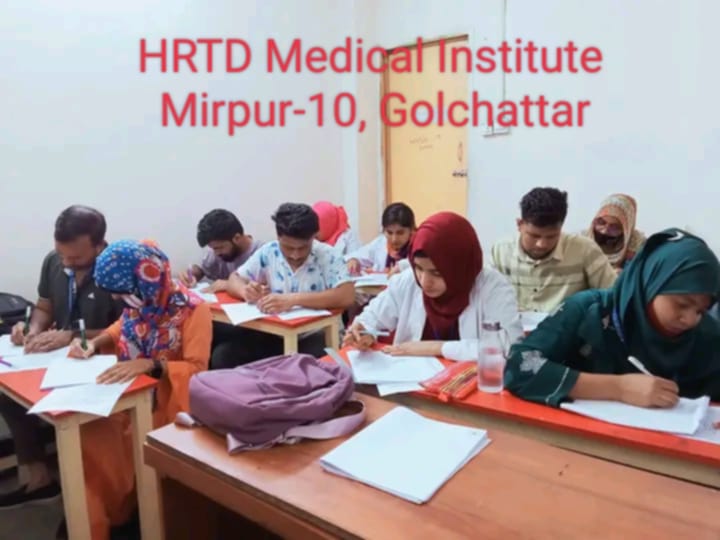
Pediatric Nursing For 6 Months Nursing Course in Dhaka


2 comments
Pingback: Best Nursing Training Course in Dhaka, 6 Months, 1, 2, 3,and 4 Years
Pingback: Best Nursing Courses in Mirpur 1 year, 2, 3 and 4 years